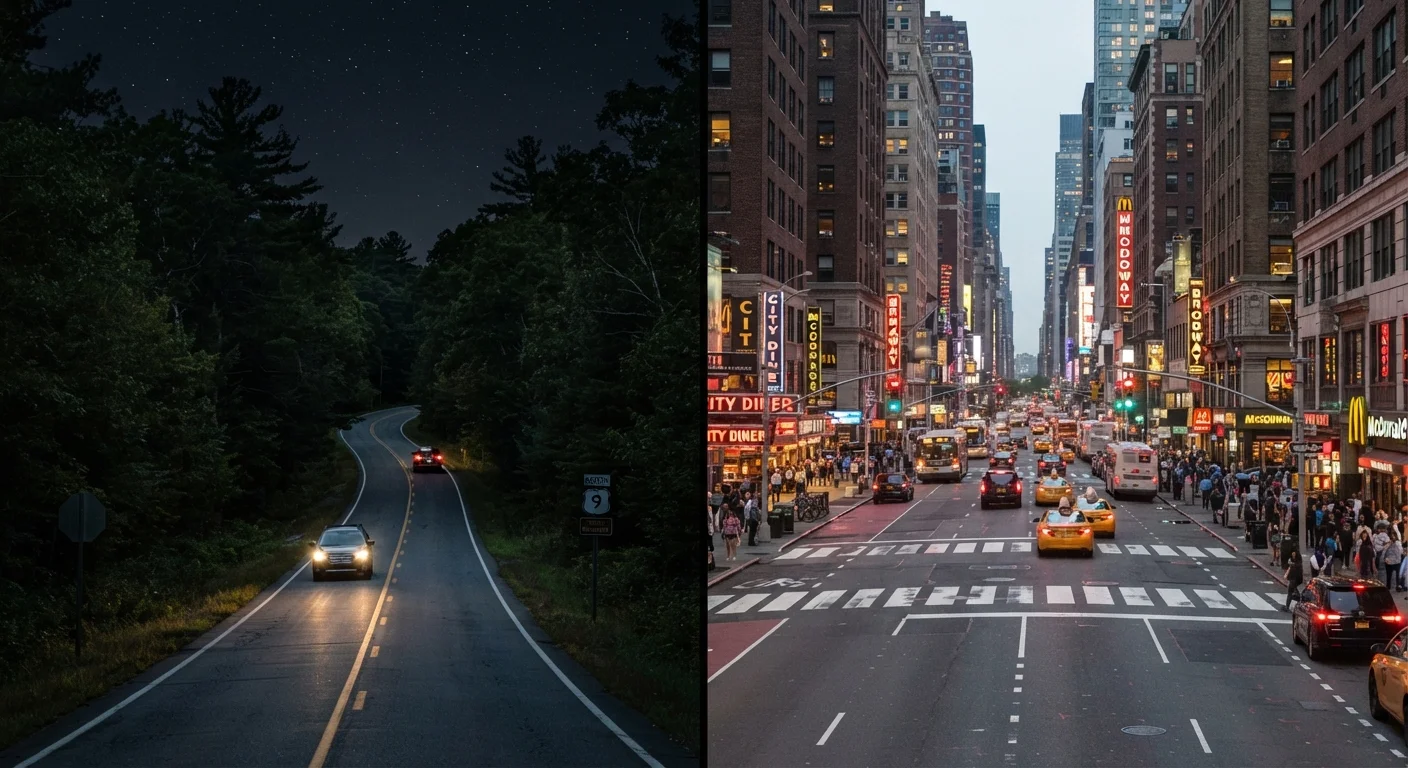
Why the Environment You Drive In Shapes Your Risk
Most American drivers spend the majority of their time in one type of environment - either navigating suburban-to-urban commutes or traveling rural routes. Each setting trains a set of instincts, and those instincts can become liabilities when the environment changes. Understanding what makes rural and urban roads categorically different is the first step toward safer driving in both.
According to the National Highway Traffic Safety Administration (NHTSA), rural roads consistently account for a disproportionate share of traffic fatalities relative to the miles driven on them. Urban areas, by contrast, see more crashes overall but a lower proportion of fatal ones. This divergence reflects the distinct hazard profiles built into each environment. For a broader look at how driving demands shift across settings, see our comparison of highway and city driving adjustments.
~50%
Fatal crashes occurring on rural roads
NHTSA data consistently shows rural roads account for roughly half of all U.S. traffic fatalities despite carrying a minority of total vehicle miles traveled.
2x+
Rural vs. urban fatality rate per mile
Studies from the Insurance Institute for Highway Safety indicate the rural fatality rate per mile driven is more than twice that of urban roads.
The Distinctive Hazards of Rural Roads
Rural roads look deceptively simple - wide open space, less traffic, fewer signals. That simplicity is partly what makes them dangerous. Several hazard categories concentrate specifically in rural environments:
- Speed and road geometry: Rural roads often have higher posted speed limits and no physical barriers separating opposing lanes. Curves that appear gentle at low speed become dangerous at 60 mph, particularly on roads without shoulders or guardrails.
- Wildlife crossings: Deer, livestock, and other animals enter roadways unpredictably, especially at dawn and dusk. A collision with a large animal at highway speeds can be fatal.
- Road surface conditions: Gravel patches, uneven pavement, and the absence of regular municipal maintenance create tire and traction hazards that paved urban streets typically don't present.
- Limited lighting: Most rural roads have no streetlights. Combined with narrow lanes, this significantly reduces reaction time at night. Our guide on night driving skills covers how to adapt to low-visibility conditions.
- Delayed emergency response: EMS response times in rural areas are substantially longer than in cities. A crash that might be survivable with rapid medical care carries higher fatality risk when help takes 20 or more minutes to arrive.
Scan Far Ahead on Rural Roads
On unlit rural roads, headlights illuminate only a fraction of your stopping distance at highway speeds. Scanning as far ahead as possible - and slowing down when visibility is limited - gives you more time to react to animals, debris, or sharp curves. Reduce speed proactively in areas with posted wildlife crossing signs, particularly between dusk and dawn when animal activity peaks.
The Distinctive Hazards of Urban Streets
Urban driving compresses multiple hazard types into a small space and demands continuous attention. The risks here are different in character - less likely to be instantly fatal, but far more frequent and cognitively demanding.
- Pedestrians and cyclists: High foot traffic, mid-block crossings, cyclists in lanes, and unexpected jaywalking create constant potential for vehicle-to-person conflicts. See our guide to sharing the road with cyclists and pedestrians for specific strategies.
- Complex intersections: Urban grids concentrate turning movements, signal phasing, and pedestrian crossings into tight spaces. Research consistently shows that intersection design significantly affects crash rates - see how roundabouts compare to traditional intersections for more on this.
- Congestion and rear-end risk: Stop-and-go traffic dramatically increases rear-end collision rates. Tailgating is more common, and sudden braking is frequent.
- Parking and door zones: Parallel parking creates the hazard of car doors opening into traffic - a risk known as dooring, which can injure cyclists and cause swerving crashes.
- Driver aggression: Congestion raises frustration. Road rage and aggressive driving are statistically more prevalent in dense urban environments.
| Hazard Factor | Rural Roads | Urban Streets | |
|---|---|---|---|
| Crash severity | Higher fatality rate per crash | More crashes, lower fatality rate | |
| Primary hazard type | Speed, wildlife, road condition | Pedestrians, cyclists, intersections | |
| Lighting conditions | Often unlit, high darkness risk | Generally well-lit by streetlights | |
| Emergency response time | Substantially longer response | Faster EMS and trauma care access | |
| Traffic volume | Lower volume, higher speed | High volume, lower average speed | |
| Cognitive demand | Vigilance and speed management | Continuous attention to multiple hazards |
Adapting When You Cross Between Environments
Drivers who commute between rural and urban areas - or travel between them on road trips - often underestimate how much their mental model needs to shift. A driver accustomed to rural roads may carry speed habits into urban streets, while a city driver on a country highway may be unprepared for a sudden animal crossing or an unmarked intersection.
Practical recalibration steps include reducing speed more deliberately when transitioning into unfamiliar territory, adjusting following distance to match road conditions rather than habit, and actively scanning for environment-specific hazards rather than relying on conditioned instincts. Older drivers, whose reaction times and visual processing may change over time, have particular reason to be intentional about this - our article on older drivers and changing road safety needs addresses these dynamics in more depth.
No single set of driving habits works equally well in both environments. The most safety-conscious drivers treat each environment on its own terms.