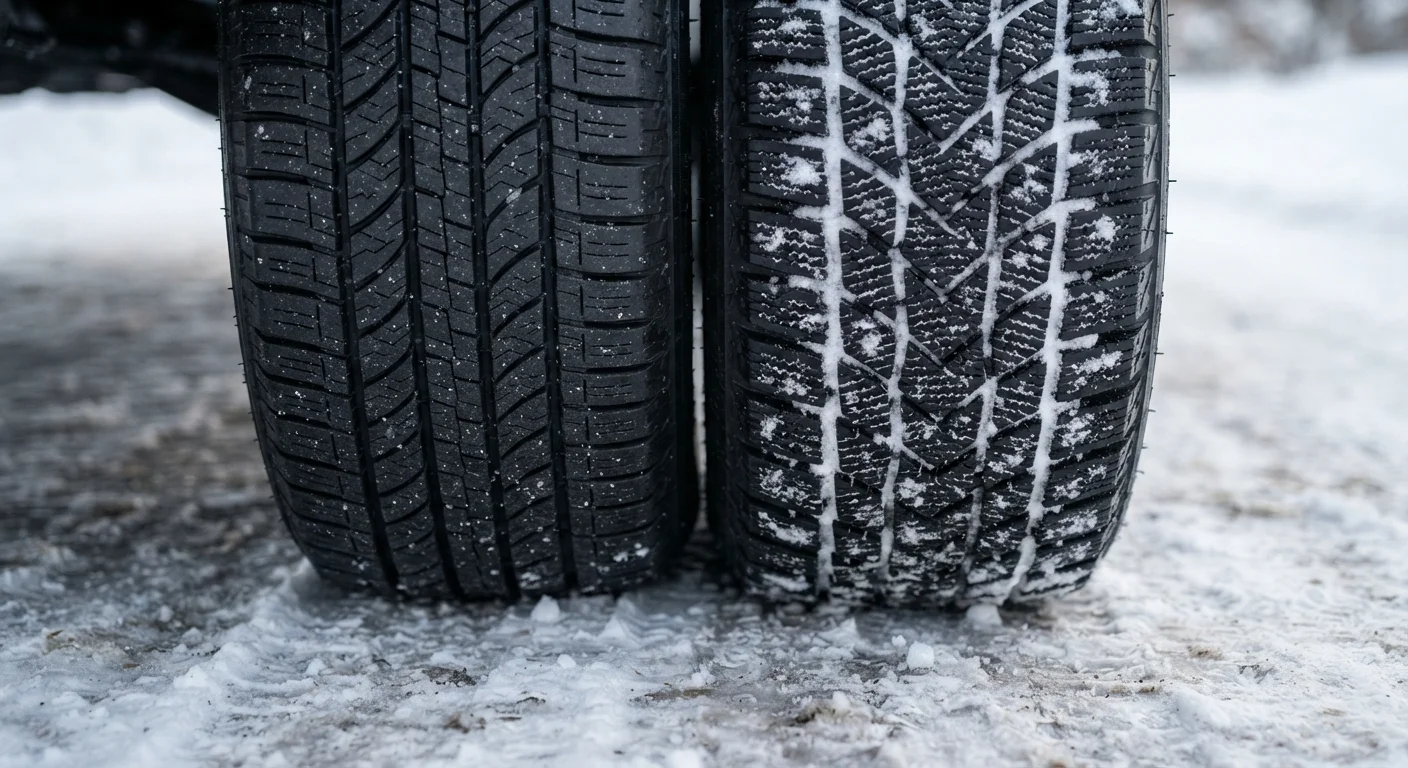
The Core Difference: Compound Before Tread
Most drivers focus on tread patterns when comparing tire types, but the rubber compound is the more consequential variable. All-season tires use a compound engineered to remain functional across a wide temperature range - roughly 40°F to 100°F. Below that range, the rubber progressively hardens, reducing its ability to conform to road irregularities and generate grip.
Winter tires use a softer, silica-enhanced compound that stays pliable well below freezing. That elasticity allows the tire to maintain contact with cold, uneven surfaces - packed snow, rutted ice, frost-covered asphalt - where a stiffened all-season compound would essentially skate across the surface rather than grip it.
The practical result: on a cold dry road, a winter tire may already outperform an all-season simply because its compound is working at the right temperature. Tread design amplifies that advantage but cannot replace it. As our guide to vehicle skids on ice explains, grip loss at the contact patch happens faster than most drivers expect - compound quality is the first line of defense.
| Criterion | All-Season Tires | Winter (Snow) Tires |
|---|---|---|
| Rubber compound | Hardens below ~45°F | Stays pliable well below freezing |
| Sipe density | Moderate - adequate for light conditions | High - thousands of biting edges |
| Snow stopping distance | Longer - compound limits grip | Shorter - measurably in testing |
| Ice traction | Limited | Substantially better |
| Warm-weather performance | Solid across spring, summer, fall | Degrades and wears faster above 50°F |
| Seasonal logistics | No swap required | Requires seasonal installation |
| Long-term tire wear | One set accumulates all mileage | Two sets share mileage - both last longer |
How Tread Patterns Do Their Part
Winter tires feature aggressive block patterns with high void ratios - the empty space between tread blocks - that channel slush and water away from the contact patch. They also include sipes, the fine cuts across each tread block that create thousands of additional biting edges. On compacted snow, those edges literally claw into the surface for traction.
All-season tires have moderate sipe density and shallower void ratios. They perform reasonably well in light rain and the occasional dusting of snow, but they are not designed to evacuate the volume of slush a heavy snowfall creates, nor do they provide enough biting edges to grip on ice.
It's also worth noting that studded winter tires - where allowed by state law - add metal studs that mechanically bite into ice. Studless winter tires rely entirely on compound and sipe technology, which has improved substantially and now delivers strong ice performance without the road-surface damage studs can cause. Check your state's regulations, as stud rules vary widely across the U.S.
45°F
Compound crossover temperature
Most tire engineers and industry sources cite approximately 45°F as the threshold below which all-season compounds begin to lose meaningful pliability.
25-30%
Typical snow stopping-distance improvement
Comparative tire testing by multiple automotive organizations has shown winter tires can reduce stopping distances on snow by roughly 25-30% versus all-season tires.
4
Wheels requiring winter tires for safe handling
Installing winter tires on only two wheels creates handling imbalance; safety guidance from tire industry bodies consistently recommends a full set of four.
Real-World Performance: What the Numbers Reflect
Independent testing by organizations such as the Tire and Rubber Association of Canada and various consumer automotive publications has consistently shown that vehicles equipped with winter tires stop in meaningfully shorter distances on snow and ice compared to the same vehicles on all-season tires. While exact figures vary by tire model, vehicle weight, and test conditions, the pattern is consistent: the gap widens as temperatures drop and road conditions deteriorate.
That stopping-distance difference translates directly to collision avoidance. At highway speeds, even a few feet of additional stopping distance can determine whether a driver avoids or causes a crash. See our overview of how different weather conditions change driving dynamics for context on how surface conditions affect braking.
It is also worth dispelling a common assumption: all-wheel drive (AWD) does not close the grip gap. AWD distributes engine power to improve acceleration on slippery surfaces, but it has no effect on braking or lateral grip - both of which depend entirely on the tire-to-road interface. Our breakdown of 4WD myths covers this in detail.
Practicalities: Cost, Wear, and the Swap Equation
The upfront cost of a second set of winter tires - ideally mounted on a dedicated set of steel or alloy wheels - is a legitimate consideration. However, running two seasonal sets means each set accumulates roughly half the mileage it would as your only tire. Both sets tend to last longer in aggregate, which offsets part of the initial outlay.
All-season tires left on through harsh winters also degrade faster than most drivers realize. Cold-hardened compounds are more susceptible to cracking, and the compound wears unevenly when it operates outside its optimal temperature range.
For drivers weighing the logistics, proper tire care habits - including inflation management and rotation schedules - apply equally to both tire types and help maximize the lifespan of whichever set you run. And when preparing your vehicle for winter more broadly, winter readiness checks beyond tires are worth reviewing before the first hard freeze.
This article is for general informational purposes. Tire performance varies by brand, vehicle, and road condition. Consult a qualified tire professional or mechanic for guidance specific to your vehicle and local climate.
Studded Tire Rules Vary by State
Several U.S. states permit studded snow tires only during specific calendar windows, while others ban them outright due to road-surface damage concerns. Before purchasing studded tires, verify your state's current regulations. A local tire shop or your state's Department of Transportation website is the most reliable source for up-to-date rules.