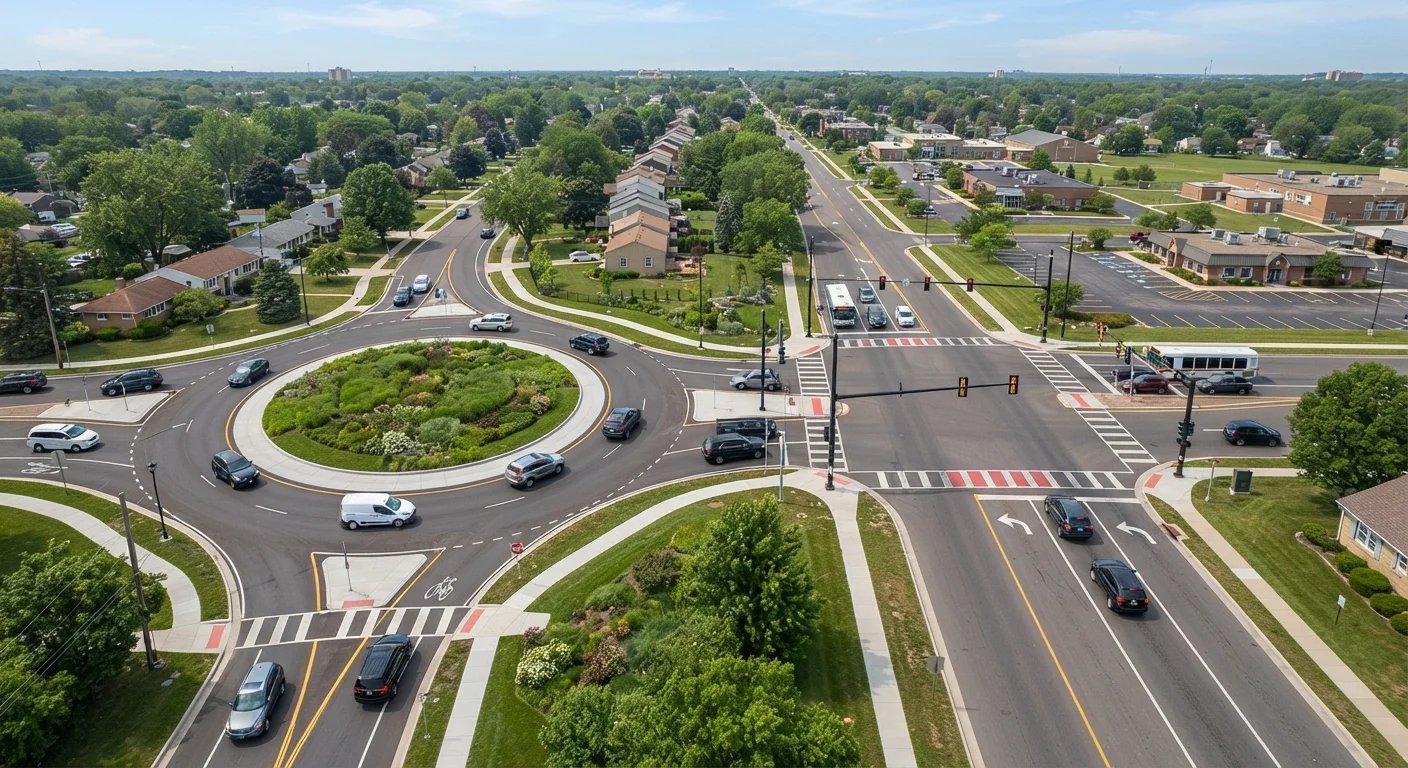
The Core Safety Difference: Conflict Points
Every intersection creates conflict points - locations where vehicle paths cross, merge, or diverge. The more conflict points an intersection has, and the faster vehicles travel through them, the higher the crash risk.
A typical four-way signalized intersection has 32 vehicle conflict points and an additional 24 involving pedestrians. A comparable single-lane roundabout reduces vehicle conflict points to just 8, and does so at lower speeds because drivers must slow to navigate the curve.
That geometric difference is why the Federal Highway Administration (FHWA) has documented roundabouts reducing all crashes by 35-47% and fatal and incapacitating-injury crashes by 72-90% compared to conventional intersections. The crashes that do occur at roundabouts tend to be lower-speed sideswipes rather than the high-energy angle or head-on collisions that cause the most deaths at traditional intersections.
| Criterion | Roundabouts | Traditional Intersections |
|---|---|---|
| Fatal crash reduction | Up to 90% fewer (vs. signals) | Baseline reference |
| Vehicle conflict points | ~8 (single-lane) | ~32 (four-way) |
| Typical approach speed | 15-25 mph by design | 25-45 mph common |
| Risk of head-on/angle crash | Very low | Higher, especially at speed |
| High-volume directional flow | Less efficient at peak | Handles well with signal timing |
| Pedestrian crossing clarity | Less structured, one-stage | Dedicated signal phase |
| Infrastructure & maintenance cost | Higher upfront, lower ongoing | Lower upfront, ongoing signal cost |
How Traditional Intersections Work - and Where They Fall Short
Stop signs and traffic signals manage conflict by assigning right-of-way through time: one set of vehicles moves while another waits. When the system works, it works well. When it breaks down - due to red-light running, signal failure, driver distraction, or misjudged gaps - the results can be severe because vehicles are still traveling at approach speed when they collide.
Right-of-way confusion at intersections is a persistent problem. Our guide on right-of-way rules American drivers most frequently get wrong outlines the most common misunderstandings that lead to preventable crashes. Signalized intersections also create the conditions for high-severity angle collisions - commonly called T-bone crashes - which are among the most injurious crash types in terms of occupant harm.
Traditional intersections do have genuine advantages: they handle asymmetric traffic volumes well, can be coordinated into signal progressions along corridors, and provide clearly structured pedestrian crossing phases that many people find easier to use.
90%
Reduction in fatal crashes at roundabouts
The FHWA has documented up to a 90% reduction in fatal and incapacitating-injury crashes where roundabouts replaced traditional intersections.
8 vs. 32
Vehicle conflict points: roundabout vs. four-way
Single-lane roundabouts create roughly 8 vehicle conflict points compared to approximately 32 at a conventional four-way intersection.
40%+
U.S. intersections that are signalized
A substantial share of American intersections rely on traffic signals, making signal comprehension a core driver safety skill alongside roundabout literacy.
Navigating Roundabouts: What American Drivers Need to Know
American drivers often feel uncertain at roundabouts simply because they're less common here than in Europe or Australia. The rules are straightforward once internalized:
- Yield to circulating traffic. Vehicles already in the roundabout have the right of way. You enter only when there's a safe gap.
- Slow before entry, not inside. Decelerate on the approach. Once you're in the circle, maintain a consistent, moderate speed.
- Signal your exit. Use your right turn signal as you pass the exit before the one you intend to take, signaling your intention to leave.
- Stay in your lane in multi-lane roundabouts. Choose the correct entry lane before you enter and hold it through the curve.
Understanding these basics connects directly to broader intersection right-of-way literacy - see our full right-of-way breakdown for a deeper look. And while signals are less central to roundabouts, knowing how to read complex signal phases at traditional intersections remains important - our guide to traffic signals beyond red, yellow, and green covers flashing lights, protected turns, and pedestrian phases in detail.
Multi-Lane Roundabouts: A Separate Skill
Multi-lane roundabouts - with two or more entry and circulating lanes - introduce additional complexity. Lane choice at entry determines which exits are accessible, and late lane changes inside the circle are a leading cause of sideswipe crashes. When approaching an unfamiliar multi-lane roundabout, choose the right lane for right or near exits and the left lane for far exits or full loops. When in doubt, slow down and yield; re-circling is always safer than a collision.
Pedestrians, Cyclists, and Vulnerable Road Users
The safety story for pedestrians at roundabouts is more nuanced. Crossing speeds are lower because vehicles slow to navigate the curve, and pedestrians only cross one direction of traffic at a time thanks to the splitter island design. However, some research suggests that pedestrians - particularly those who are visually impaired - find it harder to judge gaps in continuously flowing traffic compared to the structured stop-and-go of a signalized crosswalk.
Cyclists face similar complexity. Experienced cyclists often ride through roundabouts as vehicle operators; less confident cyclists may prefer to dismount and use the pedestrian crossing path. Infrastructure design matters enormously here, and well-designed modern roundabouts increasingly include separate cycling facilities.
For everyday drivers, the practical takeaway is to slow down on roundabout approaches and actively watch for pedestrians at the crosswalk before the yield line - a step many drivers skip. This same vigilance applies at low-speed environments generally; as our piece on why parking lot accidents are so common explains, reduced speed does not automatically mean reduced risk to people on foot.