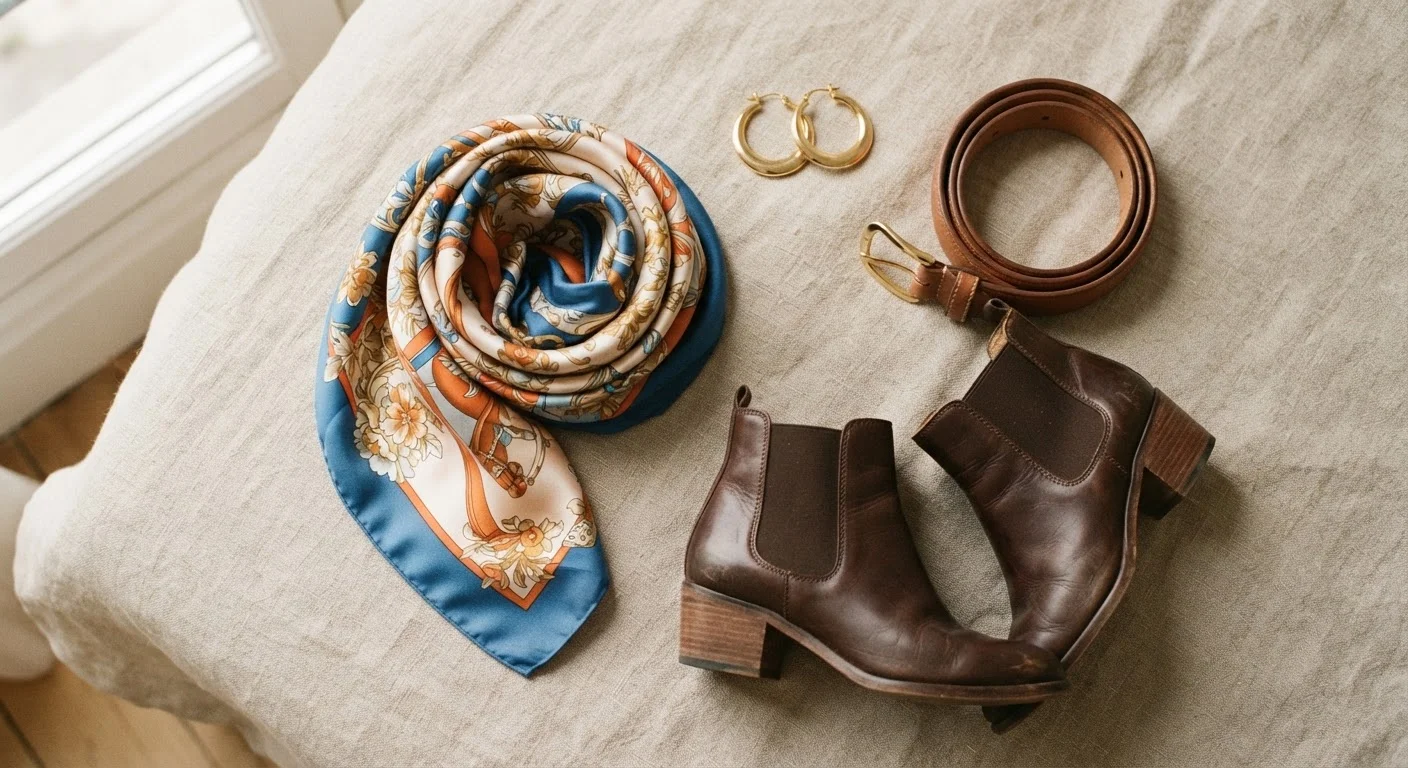
The Outfit Is Already There - It Just Needs a Finishing Move
Most wardrobes have more potential than their owners realize. The real limitation isn't a lack of clothes - it's a limited approach to what already hangs in the closet. Accessories are the tool that unlocks that potential, creating what feels like a new look from pieces you've worn a dozen times. If your outfits frequently feel flat or repetitive, the fix is rarely buying more clothing. It's usually about adding one deliberate layer of detail that shifts the whole picture. For a deeper look at why outfits can feel off even when nothing is technically wrong, see our piece on why outfits never feel quite right.
The accessories below aren't ranked - they're each capable of doing meaningful style work on their own. Try approaching them as styling tools rather than add-ons.
Audit What You Already Own First
Before adding anything new, lay out the accessories you already own and pair each one against three different outfits. You may discover versatility you'd forgotten. Many people find that styling gaps aren't about missing accessories - they're about habits, as covered in our guide to styling habits that make getting dressed easier.
Six Accessories Worth Treating as Wardrobe Essentials
A Belt That Actually Fits the Moment
A belt does more than hold pants up - it defines your silhouette and signals intention. Cinching a loose button-down at the waist with a wide leather belt immediately creates structure and shifts the look from casual to polished. A woven or braided belt reads relaxed and earthy, while a thin minimalist style leans sleek and modern. The key is treating the belt as a design element, not an afterthought. Try belting a blazer, a midi dress, or even a chunky cardigan to see how dramatically proportions can change without swapping a single garment.
Belting a loose layer transforms silhouette and signals intention in seconds.
Shoes as the Outfit's Real Personality
Swapping shoes is the fastest outfit edit you can make. The same dark jeans and white tee lands completely differently in white sneakers versus ankle boots versus strappy heeled sandals. Footwear sets the energy of an entire look - casual, dressed-up, edgy, or effortless. Rather than building more outfits, building a small rotation of shoe styles that span occasions gives your existing clothes enormous range. Think of shoes less as functional and more as the punctuation mark that tells the reader how seriously to take the sentence.
The same outfit worn with different shoes reads as three completely different looks.
Scarves: One Piece, Endless Configurations
A scarf is arguably the most versatile accessory in existence. Tied loosely around the neck, it adds a breezy, French-inspired touch. Knotted through belt loops, it injects color and pattern into a neutral look. Draped over the shoulders, it functions almost like a lightweight layer. Worn as a headband or tied around a ponytail, it elevates even the simplest hair moment. The same silk or lightweight scarf can cycle through multiple purposes across different outfits, making it a genuine wardrobe multiplier rather than a single-use item.
One scarf can serve as neckwear, belt accent, headband, or shoulder wrap interchangeably.
Jewelry That Shifts the Register
Jewelry choices tell people how dressed-up you are before they register anything else. Stacked delicate gold chains read as quietly elevated; a single bold statement necklace dominates the composition and makes everything else secondary. Layering mixed metals - once considered a style mistake - is now a confident styling choice that adds dimension and individuality. Swapping between understated studs and dramatic hoops can move the same outfit from a morning meeting to an evening out. Think of jewelry as the volume knob for any look.
Swapping earrings alone can shift one outfit from daytime understated to evening confident.
Bags as Color and Structure Anchors
A bag isn't just practical - it contributes shape, color, and texture to the overall outfit picture. A structured tote communicates organization and professionalism. A slouchy crossbody reads relaxed and off-duty. A small evening clutch signals that this occasion matters. Introducing a pop of color through a bag is one of the lowest-commitment ways to experiment with bolder hues - if it doesn't feel right, you simply don't reach for it again. Rotating between two or three bag styles rather than owning one default option opens up significant variety.
Rotating between two or three bag styles creates variety without changing a single clothing item.
Layering with Hats for Instant Character
A hat can do something most accessories can't - it changes the overall silhouette of a person, not just a garment. A wide-brim hat adds drama and a touch of old-Hollywood ease. A baseball cap grounds any look in a casual, sporty energy. A knit beanie pulled low reads cozy and unpretentious. Hats also solve low-effort days gracefully, pulling together a simple outfit and making it look considered. They're especially useful during seasonal wardrobe transitions when you want freshness without a full overhaul.
A hat changes the full silhouette of a look, not just the detail - it adds instant character.
Less Can Go Further Than More
Accessorizing well is as much about editing as it is about adding. Wearing every accessory at once can muddy the effect and dilute each individual piece. A helpful general principle: choose one focal point - whether that's the earrings, the belt, or the bag - and let the rest stay quieter. This approach tends to look more intentional and is easier to replicate consistently.
Building Variety Through Intention, Not Volume
The most confident dressers aren't necessarily the ones with the most clothes - they're the ones who know how to work what they have. Accessories make that possible at any wardrobe size. A few well-chosen pieces - a belt with range, shoes in two or three key styles, a scarf that multitasks - can generate more combinations than a closet full of garments worn the same way every time.
This is especially useful when moving between seasons. You don't need an entirely new wardrobe to feel seasonally fresh, and accessories are often the bridge that carries existing pieces forward - a topic we explore in detail in our guide to transitioning your wardrobe between seasons without buying everything new. Want to go even deeper on how accessories function as a deliberate style element? Our guide on accessories as the punctuation of an outfit covers exactly that.