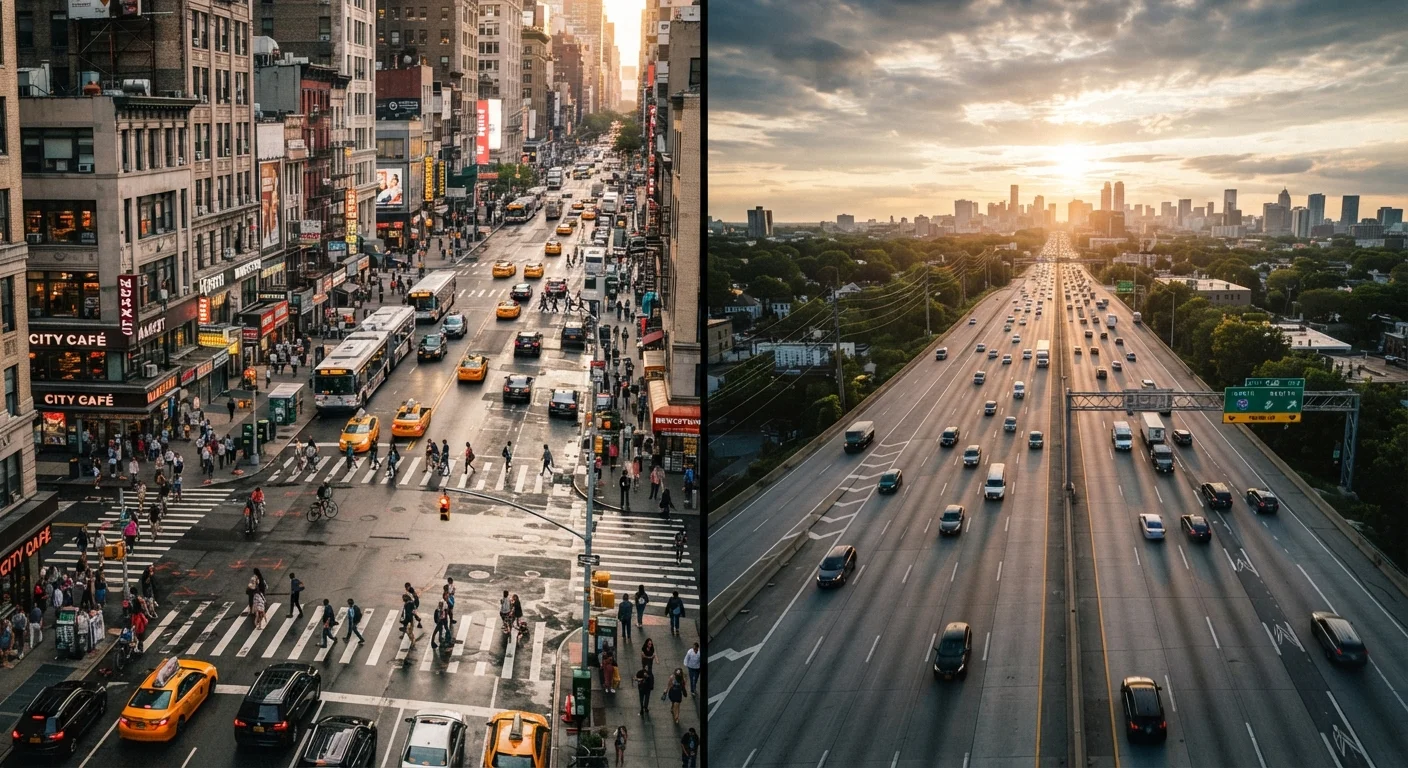
Two Environments, Two Completely Different Risk Profiles
Most drivers treat their vehicle controls the same whether they're navigating downtown traffic or cruising at 70 mph on an interstate. That consistency is the problem. Highway and city driving impose fundamentally different demands on attention, reaction time, and physical vehicle management - and the gap between what most drivers do and what each environment actually requires is where many crashes originate.
City driving is characterized by frequent stops, dense pedestrian activity, cycling infrastructure, complex intersections, and unpredictable lane changes at low to moderate speeds. Hazards are numerous but occur at speeds where braking time is more forgiving. Highway driving involves sustained high speeds, longer following distances, merging from on-ramps, and relatively few decision points - but the consequences of each lapse are far more severe.
Understanding this distinction is a foundation of defensive driving - anticipating hazards before they become emergencies.
| City Driving | Highway Driving | |
|---|---|---|
| Primary hazard type | Intersections, pedestrians, cyclists | High-speed lane changes, merges, fatigue |
| Attention demand | Fragmented, rapid-switching | Sustained, monotony-prone |
| Crash frequency | Higher - more frequent incidents | Lower - fewer but more severe |
| Crash severity | Generally lower impact speeds | Higher severity, greater injury risk |
| Recommended following distance | Situational; minimize gaps strategically | 4-6 seconds minimum at highway speed |
| Speed management challenge | Stop-and-go, frequent acceleration | Speed creep and post-exit over-speed |
| Key mental risk | Decision fatigue at intersections | Highway hypnosis, sustained inattention |
The Mental Demands: Fragmented Attention vs. Sustained Vigilance
City driving requires fragmented, rapid-switching attention. Within a single block, a driver may need to track a cyclist entering the lane, read a signal, check for pedestrians mid-crosswalk, and react to a double-parked delivery truck - all within seconds. This high cognitive load keeps most drivers alert, but it also increases the risk of attention fatigue and decision errors at intersections, which account for a disproportionate share of urban crashes.
Highway driving demands something almost opposite: sustained vigilance under conditions designed to reduce stimulation. Uniform lane markings, steady speeds, and long sight lines create monotony that the brain interprets as low risk. This is where highway hypnosis becomes a real concern - a state in which a driver continues operating the vehicle with reduced conscious awareness. The longer the drive, the more pronounced the effect.
Drivers transitioning from a busy urban environment onto a highway often carry residual alertness that fades gradually. Conversely, those moving from a long highway stretch into city traffic may underestimate how much more active scanning is now required. Driver fatigue and mental state also play a role here - for broader context on managing stress and mental load, see the mental wellbeing resources available on this site.
Reset Your Mental Mode When Road Type Changes
Treat a change in driving environment as a cue to actively recalibrate - not just physically, but mentally. Ask yourself: Am I scanning far enough ahead? Have I adjusted my following distance? Is my speed appropriate for where I am now, not where I just came from? A brief conscious check at transition points can interrupt automatic behavior that belongs to the previous context.
Physical Adjustments That Should Change - But Often Don't
Beyond the mental layer, there are concrete physical driving behaviors that should shift between environments:
- Following distance: The commonly cited 3-second rule is a minimum. At highway speeds of 65-70 mph, many safety experts recommend 4-6 seconds of following distance to allow adequate braking time. In city driving, the shorter distances are unavoidable, but drivers should be especially watchful when a vehicle ahead stops abruptly.
- Mirror use frequency: City driving benefits from checking mirrors every 5-8 seconds given the rapid movement of cyclists, motorcyclists, and adjacent vehicles. On the highway, the same frequency applies but with more attention to blind spots during lane changes at high speed.
- Speed management on entry and exit: One of the most dangerous city-to-highway transitions is the on-ramp - drivers who fail to reach highway speed before merging create significant collision risk. Equally, drivers exiting a highway into surface streets sometimes carry speed that feels normal from highway context but is excessive for a 25-35 mph zone.
- Cruise control use: On open highway stretches with light traffic, cruise control can reduce unintentional speed creep. It is generally inappropriate in city traffic. Understanding when cruise control is and isn't appropriate helps drivers use the tool correctly.
Crash Patterns: Frequency vs. Severity
City environments generate more crashes by volume. Stop-and-go traffic, frequent turns, and high pedestrian density all contribute to a higher rate of fender-benders, side-swipes, and intersection collisions. Most of these involve relatively low impact speeds.
Highway crashes occur less frequently but are statistically more likely to result in serious injury or fatality. Higher speeds mean longer stopping distances, greater energy transfer during impact, and less time for evasive maneuver. Multi-vehicle pile-ups, rollover events, and median crossover crashes are predominantly highway phenomena.
The risk calculus for vulnerable populations also shifts between environments. Older drivers navigating changing safety needs may find city driving taxing on divided attention, while highway driving can expose reaction-time changes during emergency maneuvers. Neither is straightforwardly safer - the relevant adjustment is awareness of which vulnerabilities each environment amplifies.
Drivers who frequently move between both environments should also be aware of aggressive driving patterns, which can escalate in both settings. Road rage and aggressive driving carry real safety consequences regardless of road type.
~40%
Urban share of all U.S. traffic fatalities
According to NHTSA data, a substantial proportion of traffic deaths occur on urban roads despite lower average speeds, reflecting the density of interactions.
2x
Higher fatality rate per crash on rural/highway roads
Research consistently finds that crashes on high-speed roads are roughly twice as likely to result in fatality compared to urban crashes, primarily due to impact forces.
~55%
Of fatal crashes involving driver inattention
NHTSA estimates that driver inattention, distraction, or fatigue is a contributing factor in a majority of fatal crashes across both road types.
Making the Transition Consciously
The adjustment most drivers don't make is a deliberate mental reset when the environment changes. Pulling onto an interstate after 20 minutes of city driving, or exiting a freeway into downtown, should prompt an active recalibration - not an unconscious continuation of the prior driving mode.
Practical ways to support this transition include:
- Briefly pausing (where safe) at a rest stop or gas station before a long highway segment if you've been in heavy city traffic - this allows agitation to settle before monotony sets in.
- Consciously extending your visual scan horizon when entering highway driving: city drivers tend to look closer ahead; highway driving requires scanning much farther down the road.
- Reducing speed deliberately and early when exiting a highway - not waiting for posted signage to force the adjustment.
- Recognizing that habits that quietly increase crash risk are often environment-specific patterns that feel automatic.
For those whose driving spans both rural and urban environments, the contrast in hazard types is even more pronounced. Rural and urban road hazards differ in ways that require their own separate awareness.