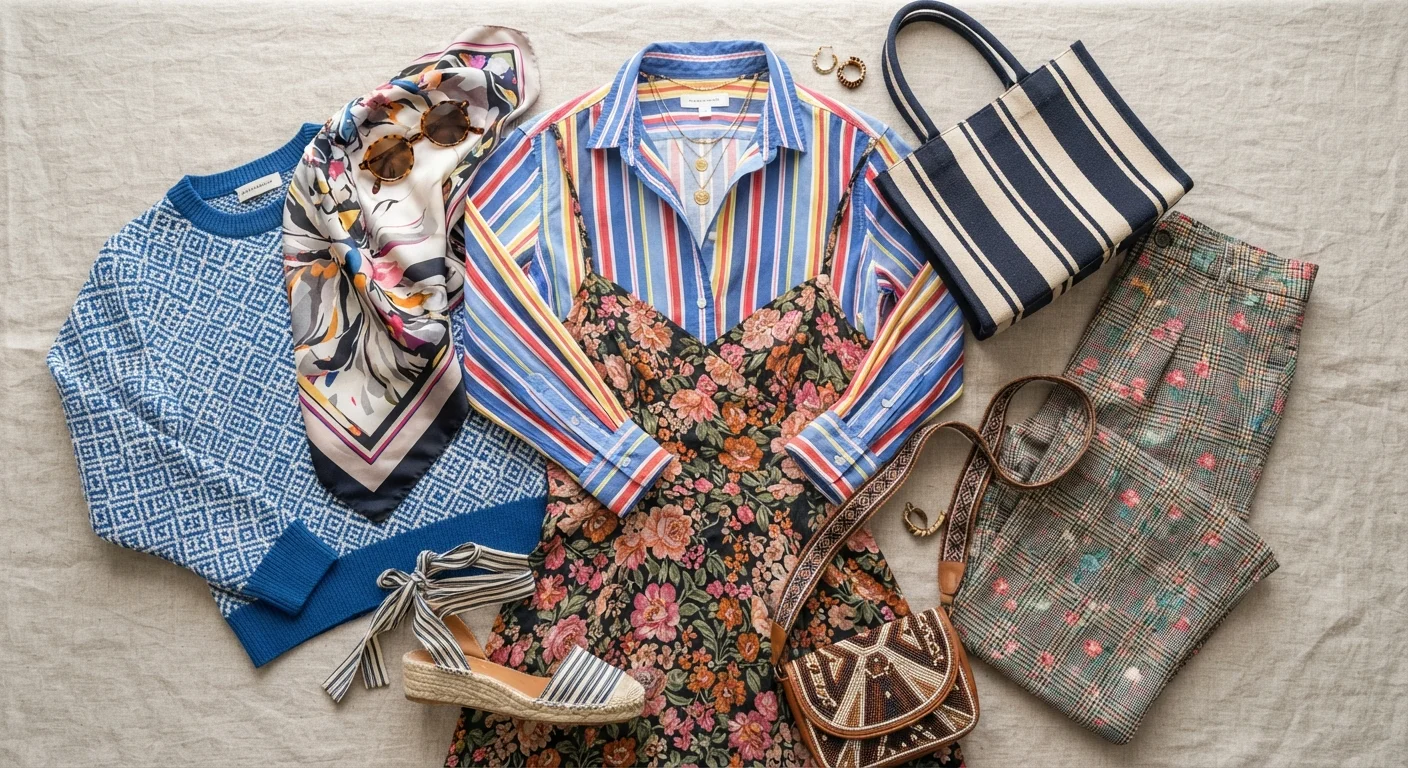
Why Pattern Mixing Feels Risky (and Why It Doesn't Have to)
Most people land in one of two camps: they avoid mixing prints entirely out of fear, or they throw patterns together and hope for the best. Neither approach gets you the effortlessly put-together look that stops people mid-conversation. The good news? There's genuine logic behind outfits that mix prints successfully, and it's learnable.
Pattern mixing works when the eye has something to follow - a thread of color, a rhythm of scale, or a visual anchor that holds competing elements together. Without that connective tissue, even beautiful prints create chaos. With it, the combination feels intentional and elevated rather than accidental.
Before diving into the steps, it helps to understand how color interaction plays into this. If you're new to that foundation, our color theory guide for everyday dressing breaks it down in accessible, wardrobe-ready terms. Pattern mixing and color literacy go hand in hand.
What you will need
How to Mix Prints Without Clashing
Follow these steps in order when building a mixed-print outfit from scratch. Skip around once the logic becomes second nature.
Choose a Dominant Print
Start with one statement pattern - the piece you're most excited about. This becomes the anchor of the outfit. It can be bold, large-scale, or colorful; it just needs to be the clear focal point. Everything else you add will support it rather than compete with it.
Vary the Scale of Your Second Print
Once your dominant print is chosen, select a second pattern that differs noticeably in scale. If your anchor is a large floral, reach for a fine stripe or a small geometric. If your anchor is a wide stripe, a petite ditsy print works well alongside it. The scale contrast is what keeps the eye moving pleasantly between the two rather than getting stuck.
Find a Shared Color Between the Two Prints
This is the single most reliable trick in pattern mixing. Look for at least one color that appears in both prints - even a neutral like cream, navy, or tan counts. That shared thread signals intention to anyone looking at the outfit, and it's what prevents the combination from reading as accidental.
Add a Solid or Neutral to Create Balance
Two active prints need breathing room. Introduce a solid - whether it's a shoe, a bag, an outer layer, or a bottom - in a neutral or a color pulled from one of your prints. This piece gives the eye a place to rest and keeps the overall look from feeling overwhelming.
Do a Mirror Check and Adjust
Step back and look at the full outfit in a mirror. Ask yourself: Does one element feel like it's shouting over the others? Is there a clear visual anchor? If the combination feels busy, swap one print for its solid-color equivalent and reassess. Trust your instinct - if something feels off, it usually is, and one small swap often resolves it.
Start With Prints You Already Own
You don't need to buy anything new to practice pattern mixing. Lay out what you already own and look for pieces with overlapping colors or contrasting scales. Many people already have a functional mixed-print outfit hiding in their closet - they just haven't put it together yet.
Once you've nailed the basics, you can start playing with texture as a third dimension - layering a woven print over a matte solid, for instance, adds depth that color alone can't achieve. Our piece on texture and fabric in everyday outfits explores exactly that.
For a broader look at how prints, solids, and neutrals each pull their weight in a finished look, see when to lean on prints, solids, or neutrals. And if you want ready-made frameworks that take the daily guesswork out of getting dressed, outfit formulas that actually work is worth bookmarking.
Common Mistakes and How to Sidestep Them
Even with the right principles in place, a few common missteps trip people up. Here's what to watch for:
- Matching scale too closely: Two medium-sized florals side by side compete for attention. Always reach for noticeable contrast in print size.
- Ignoring undertones: Two prints can share the same hue family but clash if one runs warm and the other runs cool. Check that your colors share a similar undertone before committing.
- Forgetting the neutral anchor: Even one solid, neutral piece - a belt, a shoe, a bag - can referee an otherwise hectic combination and tie everything together.
- Over-accessorizing: Bold earrings or a statement bag deserve space. If your outfit is already doing a lot of print work, keep accessories minimal.
Two Prints Can Be Enough
Resist the urge to add a third or fourth print until the two-print formula feels completely natural. More patterns require increasingly precise calibration, and the margin for error shrinks quickly. Build confidence at two before you experiment with three.
For a deeper look at the underlying principles - including examples of why some combinations that look wrong on paper actually work brilliantly in practice - check out the logic behind pattern mixing. It's a useful companion to these practical steps, especially if you're ready to move beyond the basics into more expressive territory.