Why Formulas Beat Starting From Scratch
Getting dressed shouldn't require a daily creative sprint. Outfit formulas - reliable combinations of silhouette, color, and occasion logic - do the decision-making heavy lifting so you can focus on the day ahead. Think of them as templates, not uniforms: they provide structure while still leaving room for personality. Once you internalize a handful of formulas that suit your lifestyle, getting dressed becomes something you do confidently rather than something that drains you before 8 a.m.
The key insight is that style consistency actually comes from repetition, not constant novelty. Capsule-wardrobe thinking and personal style research both point toward the same conclusion: a small number of combinations you trust will serve you better than a closet full of items that never quite click. For more on making this a sustainable habit, see our guide on styling habits that make getting dressed easier.
Start With What Already Works
Before building new formulas, look back at outfits you've actually felt good in. Photograph them or note the combinations. Chances are you already have two or three instinctive formulas - identifying them consciously means you can repeat and refine them rather than reinventing from scratch each morning.
Seven Formulas Worth Repeating
Straight-Leg Trousers + Tucked Top + Clean Sneaker
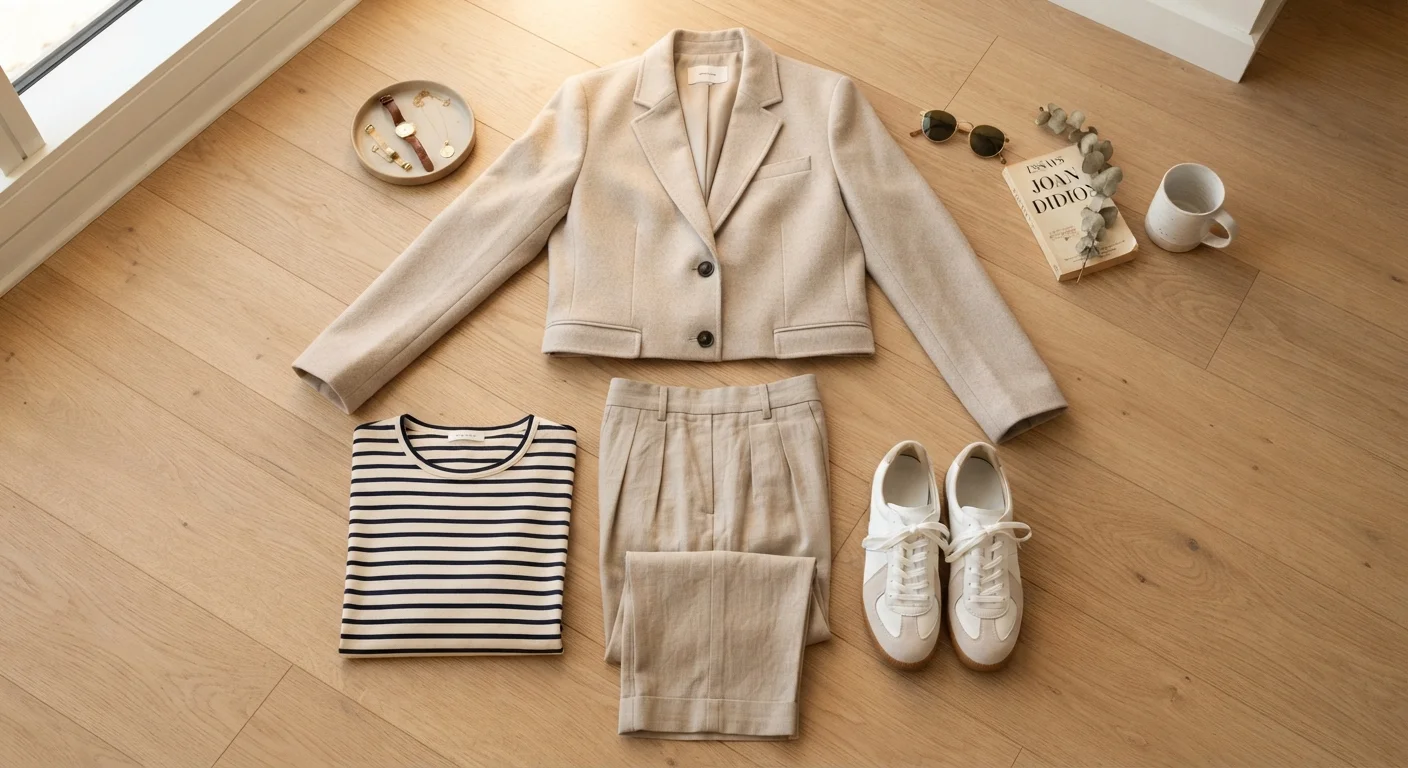
This is arguably the most versatile formula in everyday dressing. Straight-leg trousers in a neutral - navy, stone, charcoal, or black - paired with a simple tucked-in top creates an instantly put-together silhouette without looking stiff. Clean, low-profile sneakers keep it grounded and approachable. The tucked front (a full or half-tuck both work) defines the waist and signals effort. This formula transitions easily from a casual workplace to a weekend brunch depending on fabric choice.
A tucked top and straight-leg trouser combination signals polish without any real effort.
Monochromatic Tonal Dressing
Wearing one color or close shades of it head to toe creates a lengthening, cohesive effect that looks considered even when it's effortless. The formula works best when you vary texture - matte with sheen, woven with knit - to add visual interest. Tonal dressing is forgiving with fit because the eye reads the full silhouette rather than any single piece. It also pairs beautifully with a single statement accessory that anchors the look without competing.
Varying texture within one color family keeps tonal dressing from feeling flat.
Dark Wash Jeans + White or Cream Top + Structured Shoe
Dark-wash denim elevated with a crisp white or cream top is a formula that has endured across decades because the contrast is inherently sharp. The structural upgrade comes from footwear - a loafer, low block heel, or clean leather boot shifts this from casual to smart-casual almost instantly. This is one of the formulas worth understanding in depth if you're building a work wardrobe with personality, since many dress codes accommodate dark denim worn this way.
Dark jeans and a structured shoe can carry a simple white top into smart-casual territory.
Relaxed Blazer Over Everything
A well-fitted relaxed blazer is the single item most likely to make any outfit look intentional. Throw it over a T-shirt and jeans, a simple dress, or even a hoodie and straight-leg trousers - the formula works because a blazer signals structure regardless of what's underneath. Opt for a blazer in a neutral that coordinates with the bulk of your wardrobe, and you've instantly multiplied how many combinations you can build. The key word is relaxed: a slightly oversized, unstructured blazer reads modern rather than formal.
A relaxed blazer makes almost any combination underneath it look deliberate and complete.
Midi Skirt + Simple Knit + Ankle Boot
The midi skirt sits at a length that flatters a wide range of proportions and works across seasons. Pair it with a fitted or slightly cropped simple knit top and an ankle boot, and you've built a formula with clear visual proportion: a defined mid-section, flowing lower half, and grounded footwear. This works in florals, solids, or subtle prints. For those who want to push into pattern mixing, a printed midi with a textured solid knit is a natural starting point. Understanding shoe pairing principles helps here too - boot height relative to hem length genuinely affects the outcome.
A midi skirt, simple knit, and ankle boot is a proportion formula that flatters broadly.
Neutral Base + One Color Pop
Build an outfit entirely in neutrals - white, beige, grey, camel, navy - and then introduce one deliberately colorful piece or accessory. That single pop of color does all the work of making the outfit feel personality-driven without the risk of clashing combinations. The pop can come from a bag, a scarf, a shoe, or a top layer. This formula is especially useful for people who feel drawn to color but default to all-neutral because they're not sure how to use it without overthinking.
One color pop against a neutral base gives an outfit personality with almost zero coordination risk.
The Utility Layer Formula
A utilitarian layer - a chore coat, an overshirt, a lightweight field jacket - worn open over a simple two-piece base (fitted tee, straight trouser or jeans) creates effortless, relaxed dimension. The formula works because the utility layer functions like a blazer in terms of adding structure, but reads as more casual and relaxed. It's particularly useful for transitional weather dressing and for building a versatile everyday wardrobe that moves between errands, casual work settings, and informal social occasions.
An open utility layer adds dimension and structure without sacrificing a relaxed, casual feel.
Once you've identified the formulas that click for your body, lifestyle, and color preferences, the smartest move is to stop worrying about repeating outfits and lean into them deliberately. Repetition is not laziness - it's personal style in action.
Formulas Need Fit to Function
Even the most reliable outfit formula falls flat if the fit is off. Proportion and silhouette only communicate clearly when clothing sits the way it's meant to. A tailor can often fix fit issues inexpensively - a hem adjustment or taken-in seam can transform a piece from awkward to exactly right. Think of tailoring as part of the formula, not a luxury extra.
Making Formulas Your Own
Formulas are a starting point, not a finish line. Once a combination feels natural, you can stretch it: swap the footwear to shift from casual to polished, or introduce a print into one piece while keeping everything else solid. Our primer on mixing prints without clashing is a natural next step for anyone ready to push a reliable formula further. And if accessories still feel like guesswork, our piece on using accessories as the punctuation of an outfit explains how to use them as a deliberate, style-driving tool rather than an afterthought.
The goal isn't to look like everyone else who knows the same rules - it's to use those rules as a scaffold for expressing who you actually are. Start with one formula that already feels close to your instinct, wear it with intention, and build from there.