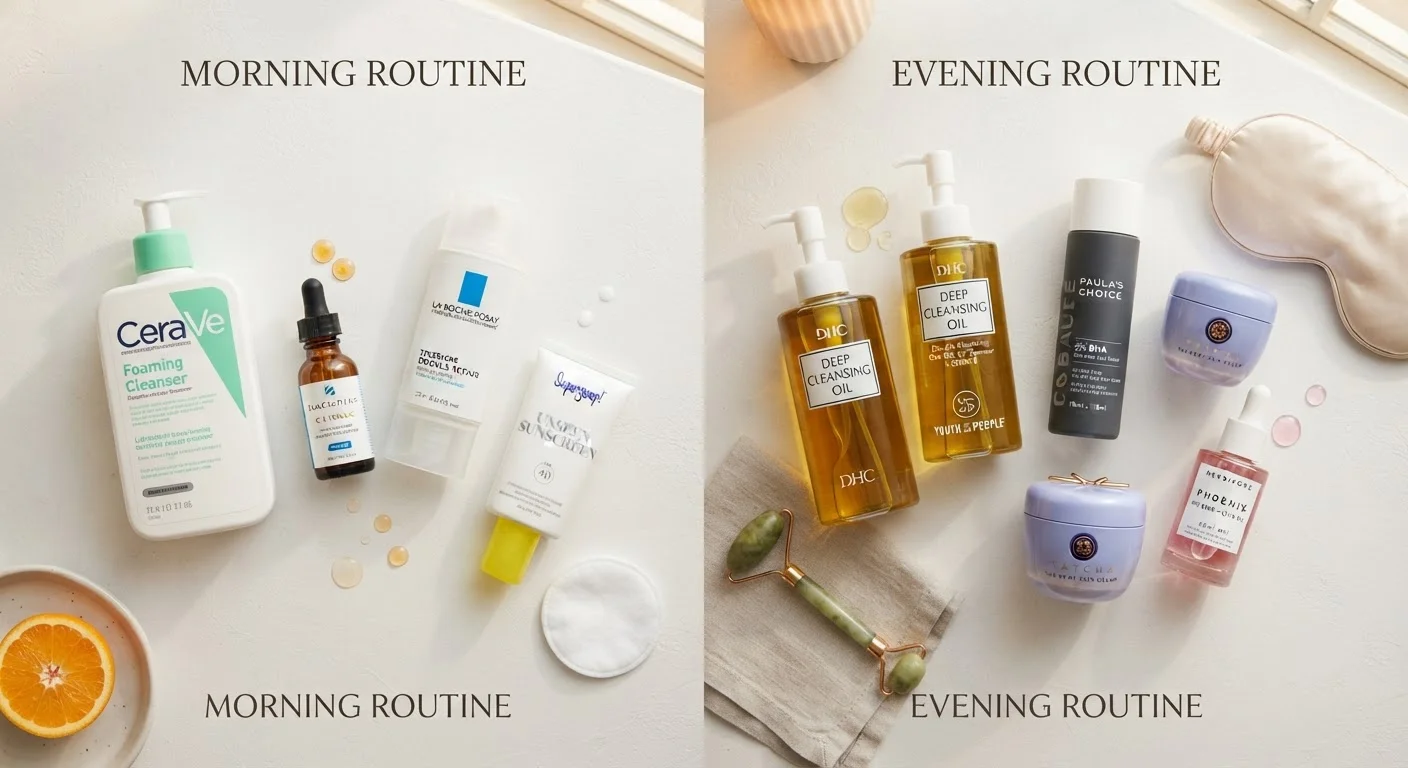
The Core Difference: Defense vs. Recovery
Think of your skin as working two very different shifts. During the day, it's in protection mode - fending off ultraviolet radiation, airborne pollutants, and the general stress of being out in the world. At night, once those external pressures ease up, it switches into repair mode, regenerating cells and rebuilding its barrier while you sleep.
This biological rhythm is real. Skin cell turnover peaks in the late evening and early nighttime hours, and blood flow to the skin increases during sleep - which is partly why the term "beauty sleep" has genuine physiological backing. Understanding these two modes is the foundation for building routines that actually work, rather than just applying the same products twice a day and hoping for the best.
For a broader look at how these routines fit into your overall daily habits, see this complete overview of daily beauty routine basics.
What the Morning Routine Is Actually Doing
Your AM routine has one non-negotiable job: get you ready to face the environment. That means applying SPF - every single morning, regardless of weather or season. Broad-spectrum sunscreen with at least SPF 30 is the most evidence-supported anti-aging and skin-protective step in any routine, full stop.
Beyond SPF, the morning is the time for lightweight, fast-absorbing products that layer comfortably under makeup or simply sit well on bare skin throughout the day. Think gentle cleansing (or even just a water rinse if your skin isn't particularly oily), a hydrating serum or toner, a light moisturizer, and then SPF as your final step.
Keep Your Morning Routine Streamlined
A common mistake is overloading the AM routine with actives that belong at night. If your morning step count is creeping up, ask yourself whether each product is genuinely protecting or simply preparing your skin for the day. A cleanser, hydrating layer, and SPF is a complete, effective morning routine for most people - no extras required.
What you generally want to avoid in the morning are potent actives like retinoids, strong exfoliating acids (AHAs and BHAs), and high-concentration vitamin C formulations - unless your specific product is explicitly formulated for daytime use with sun protection factored in. Most of these either degrade in sunlight or increase your skin's photosensitivity. Layering order matters here too - SPF should always be your final skincare step before going outside.
What the Nighttime Routine Is Actually Doing
Nighttime is your skin's opportunity to absorb, repair, and rebuild without interference from sunlight or environmental stressors. This is when heavier textures make sense - richer moisturizers, facial oils, overnight masks - and when your most active ingredients can do their best work.
Retinoids (a category that includes retinol), exfoliating acids like glycolic or lactic acid, and peptide-heavy treatments are all well-suited to PM use. They either break down in UV light, require the skin to be in a calm regenerative state to function optimally, or both. Thorough cleansing is also more important at night: removing the day's sunscreen, makeup, and accumulated pollutants before applying actives is essential so those ingredients can actually reach your skin.
| Morning Routine | Nighttime Routine | |
|---|---|---|
| Primary goal | Protect from UV and environment | Repair, renew, and rebuild |
| Cleansing intensity | Gentle or water rinse | Thorough removal of SPF, makeup, pollutants |
| SPF | Essential - final step always | Not needed or appropriate |
| Retinoids / AHAs / BHAs | Avoid - increase photosensitivity | Ideal - work best overnight |
| Texture preference | Lightweight, fast-absorbing | Richer, more occlusive formulas fine |
| Vitamin C serums | Lower concentrations tolerable | Higher concentrations or none at all |
| Facial oils | Generally avoid - can pill under SPF | Great for sealing in nighttime moisture |
If you're curious about how double-cleansing fits into this picture, this breakdown of cleansers vs. micellar water explains when a two-step cleanse is worth adding. And for a deeper look at whether every product in your routine is pulling its weight, a routine audit is a great next step.
Building Smarter, Not More Complex
You don't need a ten-step routine at either hour to see results. The most effective approach is understanding why each product is there, and whether it belongs in the morning, the evening, or both. A focused routine that plays to each time of day will consistently outperform a duplicate list of products used at AM and PM without any intentionality.
If you're working with a tighter budget or just starting out, a minimal, budget-conscious routine can still follow this AM/PM logic beautifully - it's the framework that matters, not the number of products. And since your skin's needs shift with age, hormones, and climate, it's worth revisiting your routines periodically. Your skin type isn't fixed, and neither should your routine be.
This article is for general informational and educational purposes only. It is not a substitute for professional dermatological or medical advice. If you have a skin condition or concerns about a specific ingredient, consult a qualified dermatologist or healthcare provider.