What an Extended Warranty Actually Is
The term "extended warranty" is a marketing phrase, not a legal classification. In practice, these are service contracts - agreements sold by retailers, manufacturers, or third-party administrators that promise to pay for certain repairs after the original manufacturer warranty expires. Understanding that distinction matters, because service contracts are governed by contract law and regulated at the state level, whereas manufacturer warranties are covered by federal law under the Magnuson-Moss Warranty Act.
Before assessing whether a plan is worth buying, it helps to know what you already have. Manufacturer warranties and extended warranties work very differently, and overlapping coverage periods - which are common - mean you may be paying for protection that duplicates what you already own. Also check whether your credit card provides automatic purchase protection or extended warranty benefits; many travel and premium cards do.
Federal Law Provides Some Baseline Protections
The Magnuson-Moss Warranty Act governs written warranties on consumer products sold in the U.S., but service contracts are treated separately under the same law. State "lemon laws" and insurance regulations may impose additional requirements on service contract sellers. Because rules vary by state, check with your state's consumer protection office if you have a dispute. Understanding your consumer rights is the first step in evaluating any post-purchase protection.
The Case For: When Extended Coverage Makes Sense
Limits exposure to large, unexpected repair bills
For consumers without a dedicated emergency fund, capping repair liability at a known premium cost provides real budget predictability, particularly for high-cost appliances.
Useful when manufacturer coverage is minimal
Refurbished items, certain imported electronics, and some appliance categories carry very short or no manufacturer warranties, making supplemental coverage more justifiable.
Can include perks like on-site service or loaner units
Some retailer-backed plans offer convenience benefits - in-home service visits, no-lemon replacements, or temporary loaner equipment - that the base manufacturer warranty does not.
Transferable plans may add resale value
A small number of service contracts are transferable to a subsequent owner, which can be a legitimate selling point when reselling an appliance or vehicle.
Extended warranties are not universally bad deals. The circumstances below shift the probability in the consumer's favor:
- High repair-cost items with known failure rates. Certain appliance categories - HVAC systems, refrigerators with complex electronics, dishwashers - have documented repair costs that can approach or exceed replacement value within five to eight years of use.
- Limited or no manufacturer coverage. Some product categories, including refurbished electronics and certain imported appliances, carry 90-day or no manufacturer warranties. A low-cost service contract closing that gap can be reasonable.
- No emergency fund buffer. If a $900 repair would cause real financial hardship, transferring that risk has real utility. Weigh that against setting aside your own repair fund - the self-insuring approach often wins mathematically over time.
The Case Against: Why the Odds Usually Favor Skipping It
Premiums typically exceed average repair payouts
Actuarially, service contracts are priced to be profitable, meaning the average buyer pays more in premiums than they receive in covered repairs over the contract term.
Exclusion lists undercut headline coverage
Common exclusions - power surge damage, cosmetic issues, consumable parts, and broadly defined "misuse" - can eliminate coverage precisely when a consumer expects it to apply.
Deductibles reduce net benefit on smaller repairs
A $75-$150 service call deductible can consume a significant portion of the benefit on a mid-cost repair, leaving the consumer with minimal net recovery after fees.
Third-party administrators carry insolvency risk
Unlike manufacturer warranties backed by the product company, third-party service contracts depend on the administrator remaining solvent, which is not guaranteed over a multi-year term.
Duplicate coverage is common and undetected
Many credit cards and some homeowner policies provide overlapping repair or replacement coverage, making an additional service contract redundant and wasteful.
Sold under high-pressure, low-information conditions
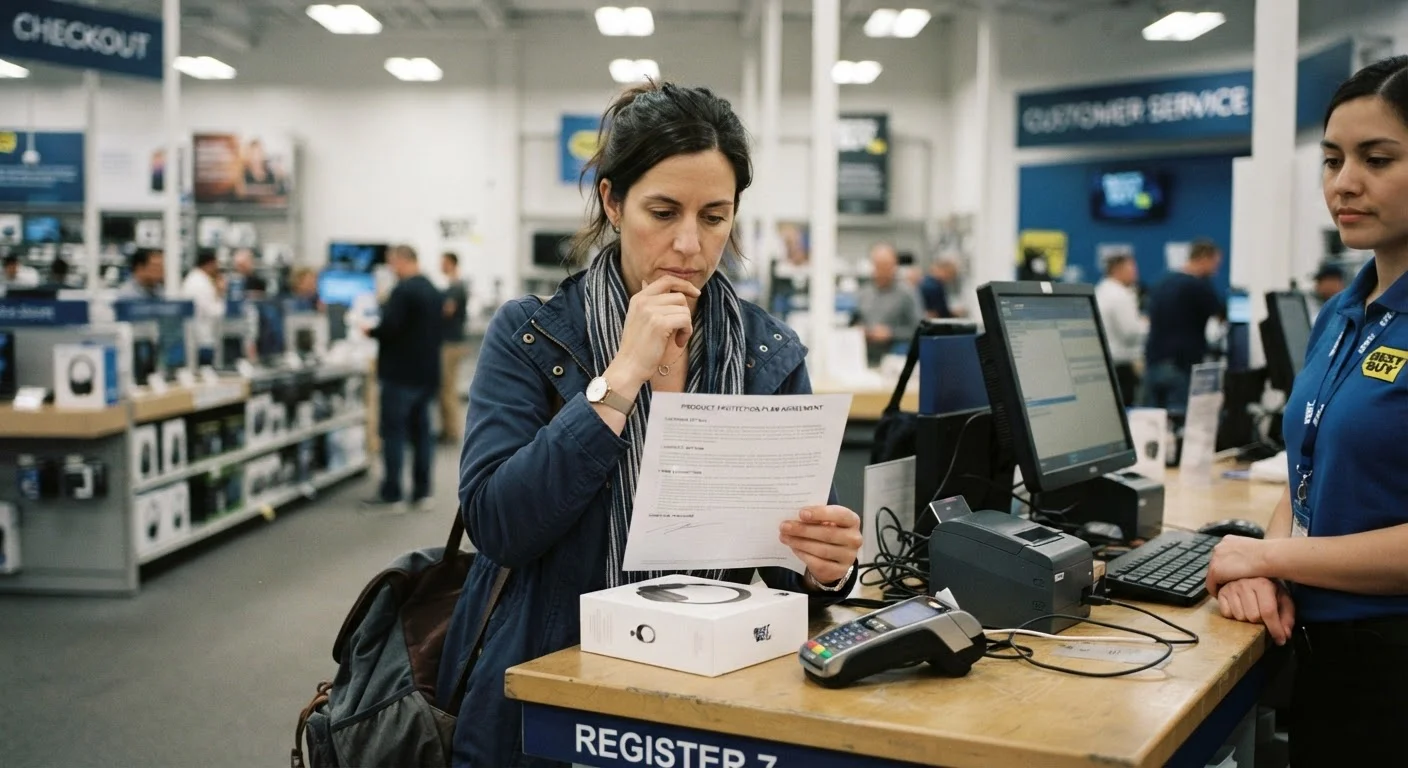
Extended warranties are most commonly offered at checkout, a moment of poor information access, time pressure, and post-purchase emotional vulnerability - conditions that favor impulse decisions over informed ones.
Consumer advocacy research and actuarial data consistently show that service contract premiums, in aggregate, exceed payouts to policyholders. That gap is how the product is profitable. Several structural factors compound the unfavorable odds:
- Exclusion lists are long. Most contracts exclude cosmetic damage, consumable parts, damage from power surges, and "misuse" - a category interpreted broadly by administrators.
- Deductibles and claim friction. A $100 service call deductible on a $300 repair means your net benefit is minimal, especially after the time cost of the claim process. See what a typical warranty claim actually requires before assuming the process is straightforward.
- Product reliability trends. Consumer electronics have become more reliable as component quality improves. A warranty priced as if failure is likely may not reflect actual failure rates for a given product category.
~80%
Consumers who never use their extended warranty
Consumer Reports has historically found that a large majority of extended warranty purchasers never file a claim, suggesting premiums are often paid without return.
2-4×
Markup on extended warranty retail price
Industry analyses have noted that retailers and third-party sellers often mark up service contracts significantly, reflecting the high-margin nature of the product.
A Practical Framework for Deciding
Rather than deciding at the register under time pressure, apply a short checklist before purchase:
- Calculate the break-even point. Divide the warranty cost by the likely repair cost for that product category. If you would need to file a significant claim within the first two years just to break even, that is a warning sign.
- Read the exclusion list, not just the headline coverage. Ask for the full contract terms before agreeing. If the retailer cannot provide them, that itself is informative.
- Check for overlap. Confirm the manufacturer warranty period, any credit card coverage, and homeowner or renter insurance that may cover theft or accidental damage. Return policies and warranties are not the same thing, but together they may provide adequate early coverage without additional cost.
- Assess the administrator's stability. Third-party warranty companies can and do close. A contract is only as good as the company behind it; check complaint histories with your state's insurance or consumer protection office.
For a deeper look at coverage distinctions, understanding what each plan actually covers versus what it excludes is essential before signing anything. And if you encounter common claims about warranty rules - such as the idea that third-party repairs automatically void coverage - several widespread warranty beliefs are simply wrong.