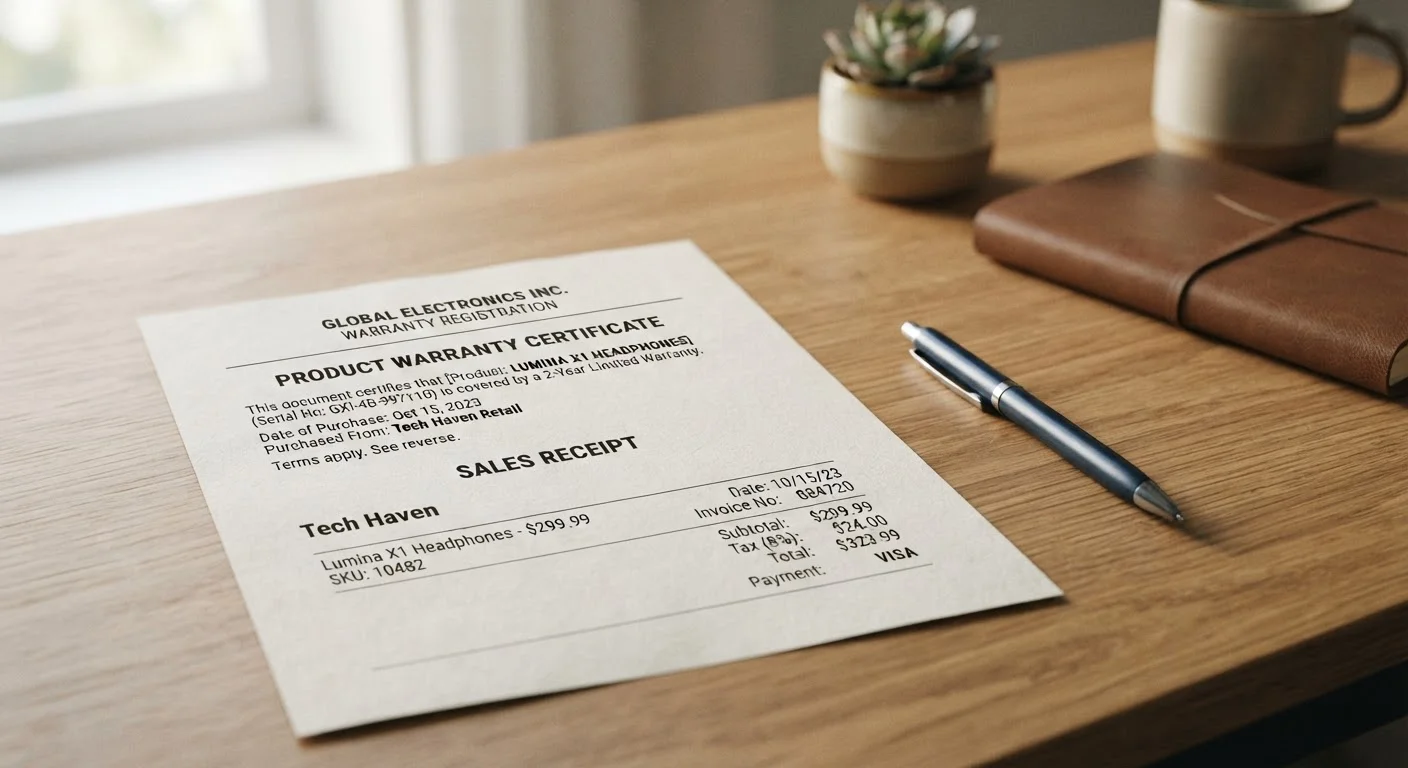
What Each Warranty Actually Is
Despite being sold in the same transaction, manufacturer warranties and extended warranties are fundamentally different instruments with different legal standings.
A manufacturer warranty is a written promise from the product's maker that it will function as intended for a defined period. In the U.S., these are governed by the Magnuson-Moss Warranty Act, a federal consumer protection law that sets minimum disclosure standards. If a manufacturer offers a written warranty, they must clearly state what it covers, how long it lasts, and what the consumer must do to obtain service.
An extended warranty - more accurately called a service contract in legal and regulatory terms - is a separate, paid agreement. It may be sold by the manufacturer, the retailer, or a third-party company. Because it's a contract rather than a warranty in the legal sense, its terms, exclusions, and enforceability depend entirely on the provider and the document you sign. See our guide on warranties vs. return policies for context on how these protections differ from a retailer's return window.
| Criterion | Manufacturer Warranty | Extended Warranty |
|---|---|---|
| Cost | Included in purchase price | Separate, paid premium |
| Legal classification | Legally a warranty (Magnuson-Moss) | Service contract, not a warranty |
| What triggers coverage | Defects in materials or workmanship | Varies; may include normal-use breakdowns |
| Duration | Fixed term (e.g., 1-3 years) | Variable; may overlap with manufacturer period |
| Exclusions | Accidental damage, wear and tear, misuse | Varies widely; often includes deductibles |
| Provider | The product manufacturer | Retailer, manufacturer, or third party |
| Transferability | Generally non-transferable | Sometimes transferable to new owner |
Coverage Scope and Common Exclusions
Manufacturer warranties typically cover defects in materials and workmanship - meaning the product broke because of how it was made, not because of how it was used. Accidental damage, normal wear and tear, and misuse are almost universally excluded.
Extended warranties often advertise broader coverage, potentially including mechanical breakdowns from normal use after the manufacturer's period ends. However, exclusions vary significantly. Common gaps include cosmetic damage, software issues, pre-existing conditions, and failures caused by power surges or improper installation. Deductibles per claim are also common.
One nuance consumers frequently miss: some extended warranties overlap with the manufacturer period rather than extending beyond it - meaning you may be paying for redundant coverage during those initial years. Always confirm whether the service contract begins on the purchase date or when the manufacturer warranty expires.
Overlap Is More Common Than You Think
Many extended warranties sold at the point of purchase begin on the purchase date rather than after the manufacturer warranty expires. This means you could be paying for coverage that duplicates protections you already have for one to three years. Always ask the seller to clarify the start date and compare it against your manufacturer warranty's end date before committing.
For a deeper look at when extended coverage makes financial sense, see when extended warranties make sense.
Your Rights and How to Use Them
Federal law provides meaningful protections that many consumers don't know about. Under the Magnuson-Moss Act, a manufacturer cannot void your warranty simply because you had the product serviced by a third-party technician or used aftermarket parts - unless the manufacturer can prove that the third-party work caused the specific defect. This is a common misconception worth knowing. What voiding a warranty actually means covers this in detail.
For extended warranties, your rights depend on the contract terms and your state's consumer protection laws. Some states require service contract providers to be licensed or to maintain reserves, which adds a layer of consumer protection. Before purchasing, verify the provider's reputation and check whether your state insurance commissioner oversees service contracts in your jurisdiction.
~55%
Consumers who purchased an extended warranty reported using it
According to Consumer Reports surveys, a majority of extended warranty purchasers never file a claim, raising questions about value for lower-cost products.
1-3 years
Typical manufacturer warranty duration for consumer electronics
Most major consumer electronics manufacturers offer between 90 days and 3 years of limited warranty coverage depending on the product category.
If a dispute arises under a manufacturer warranty, you may be able to file a complaint with the FTC or your state attorney general's office. For extended warranty disputes, small claims court is an option if the provider fails to honor its contract terms. Understanding the types of coverage available to consumers can help frame what protections you can reasonably expect from any agreement.
This article is for general informational purposes only and does not constitute legal or financial advice. For questions about specific warranty disputes or service contract terms, consult a qualified consumer protection attorney or your state attorney general's office.