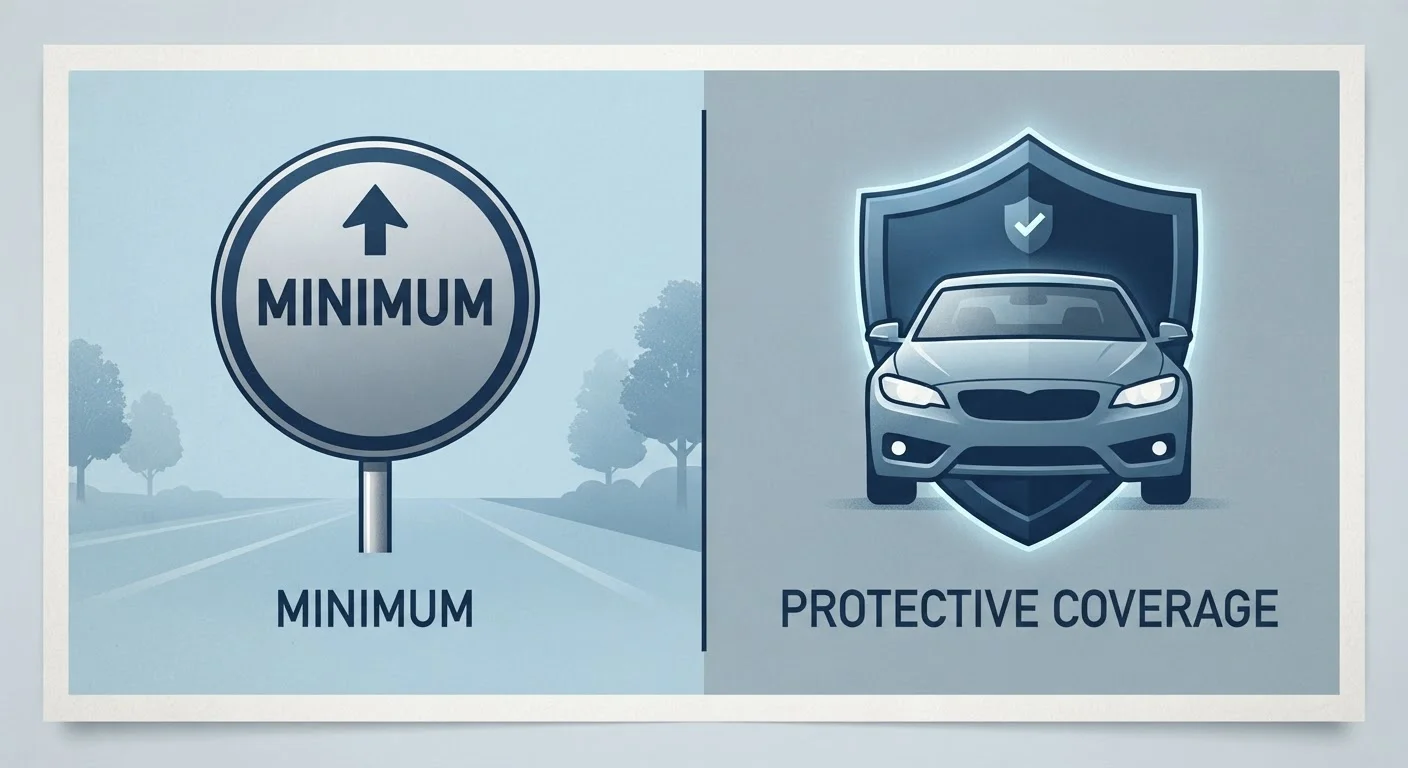
What State Minimum Insurance Actually Covers
Every state that requires auto insurance sets a floor - a minimum level of coverage drivers must carry to legally operate a vehicle. In most states, that floor is liability insurance, which splits into two components: bodily injury liability (which pays for injuries to other people when you are at fault) and property damage liability (which pays to repair or replace another person's vehicle or property).
What the minimum does not cover is equally important: your own vehicle, your own medical bills, and any situation where another driver is at fault but uninsured. If you cause a serious accident, your minimum limits may also be exhausted quickly - leaving you personally responsible for costs above the policy ceiling.
State minimums vary considerably. Some states mandate additional coverages such as Personal Injury Protection (PIP) or uninsured motorist coverage. To understand how these individual coverages work in detail, see our breakdown of auto insurance coverage types. For a plain-language introduction to each coverage layer, our guide on auto insurance coverage from the ground up is a useful starting point.
This article provides general information about auto insurance concepts and is not personalized insurance, financial, or legal advice. Coverage terms, limits, and requirements vary by state and insurer. Consult a licensed insurance professional and read your actual policy documents for guidance specific to your situation.
What 'Full Coverage' Informally Means
Despite how often agents and drivers use the phrase, 'full coverage' is not an official policy term - no insurer or regulator defines it precisely. In everyday usage, it refers to a policy that layers at least three types of coverage together: liability (required by law), collision (which pays to repair your vehicle after an accident regardless of fault), and comprehensive (which covers non-collision losses such as theft, fire, vandalism, and weather damage).
Some drivers also add medical payments coverage, uninsured/underinsured motorist protection, or roadside assistance - but none of these are universally included. Because the term is informal, two policies described as 'full coverage' can differ meaningfully in their actual protection. Our companion article explains why 'full coverage' isn't actually a policy term and what it can still leave out.
| Criterion | Minimum Auto Insurance | Full Coverage |
|---|---|---|
| Covers damage to others | Yes - up to state-set limits | Yes - up to chosen limits |
| Covers your own vehicle (accident) | No | Yes, via collision coverage |
| Covers theft, weather, fire | No | Yes, via comprehensive coverage |
| Required by lenders/lessors | No - often violates loan terms | Yes - typically required |
| Typical monthly premium | Lower | Higher |
| Out-of-pocket risk after at-fault crash | High - your vehicle not covered | Lower - subject to deductible |
| Definition in policy documents | Precisely defined by state law | Informal term; contents vary by insurer |
For a deeper look at how collision and comprehensive differ from each other, see our side-by-side breakdown of collision vs. comprehensive coverage.
Where the Real Financial Gap Lives
The gap between minimum and full coverage becomes concrete in specific scenarios. Consider two situations:
- At-fault accident: Minimum coverage pays for the other driver's repairs and medical bills up to your limits. Your own vehicle damage? Not covered. You absorb that cost entirely.
- Theft or weather event: Minimum liability coverage provides zero protection. Without comprehensive, replacing a stolen car is your financial burden alone.
For drivers with loans or leases, the stakes are higher still. If your vehicle is totaled and you owe more than it is worth, standard collision coverage only pays the car's actual cash value - which may not fully cover your loan balance. That remaining gap is addressed by a separate product; our article on what gap insurance actually covers explains when it applies.
1 in 8
Drivers who carry no auto insurance
According to the Insurance Research Council, roughly 12.6% of U.S. motorists were uninsured in a recent study period.
Varies by state
Minimum liability limits required
State-mandated minimums range widely - from as low as $10,000 per person in some states to significantly higher thresholds elsewhere.
$4,700+
Average collision claim cost
Industry data from the Insurance Information Institute indicates the average collision claim regularly exceeds several thousand dollars, illustrating the risk of carrying no collision coverage.
One commonly underestimated risk involves other drivers. Approximately one in eight drivers on American roads carries no insurance at all, according to the Insurance Research Council. If an uninsured driver hits you and you carry only the state minimum, you may have no coverage pathway for your own repairs or injuries. Uninsured and underinsured motorist coverage addresses exactly this gap.
How to Evaluate Which Level Fits Your Situation
Rather than defaulting to what an agent suggests or simply matching a neighbor's coverage, consider these practical factors on your own:
- Vehicle value: Look up your car's current market value. If the vehicle is worth less than roughly two to three times the annual cost of adding collision and comprehensive, the math may favor dropping those coverages.
- Loan or lease status: If you do not own your vehicle outright, your lender almost certainly requires collision and comprehensive. Driving without them violates your agreement and could trigger force-placed insurance, which is typically more expensive.
- Your financial cushion: Could you pay several thousand dollars out of pocket tomorrow if your car were damaged or stolen? If not, the lower premium from minimum coverage carries a hidden financial risk.
- Your driving environment: High-traffic commutes, areas with elevated vehicle theft, or regions prone to hail or flooding increase the probability that comprehensive coverage will be used.
For a fuller look at how liability-only policies compare to broader coverage in real scenarios, see how liability-only coverage differs from a full-coverage policy. And for context on what can happen when coverage lapses entirely, our article on driving without car insurance outlines the legal and financial consequences.
Coverage Requirements Vary by State
No two states share identical minimum insurance requirements. Some mandate personal injury protection (PIP), others require uninsured motorist coverage, and a small number use alternative frameworks. Always verify your specific state's requirements through your state's Department of Insurance website or a licensed agent - do not assume that what applies in a neighboring state applies to you.