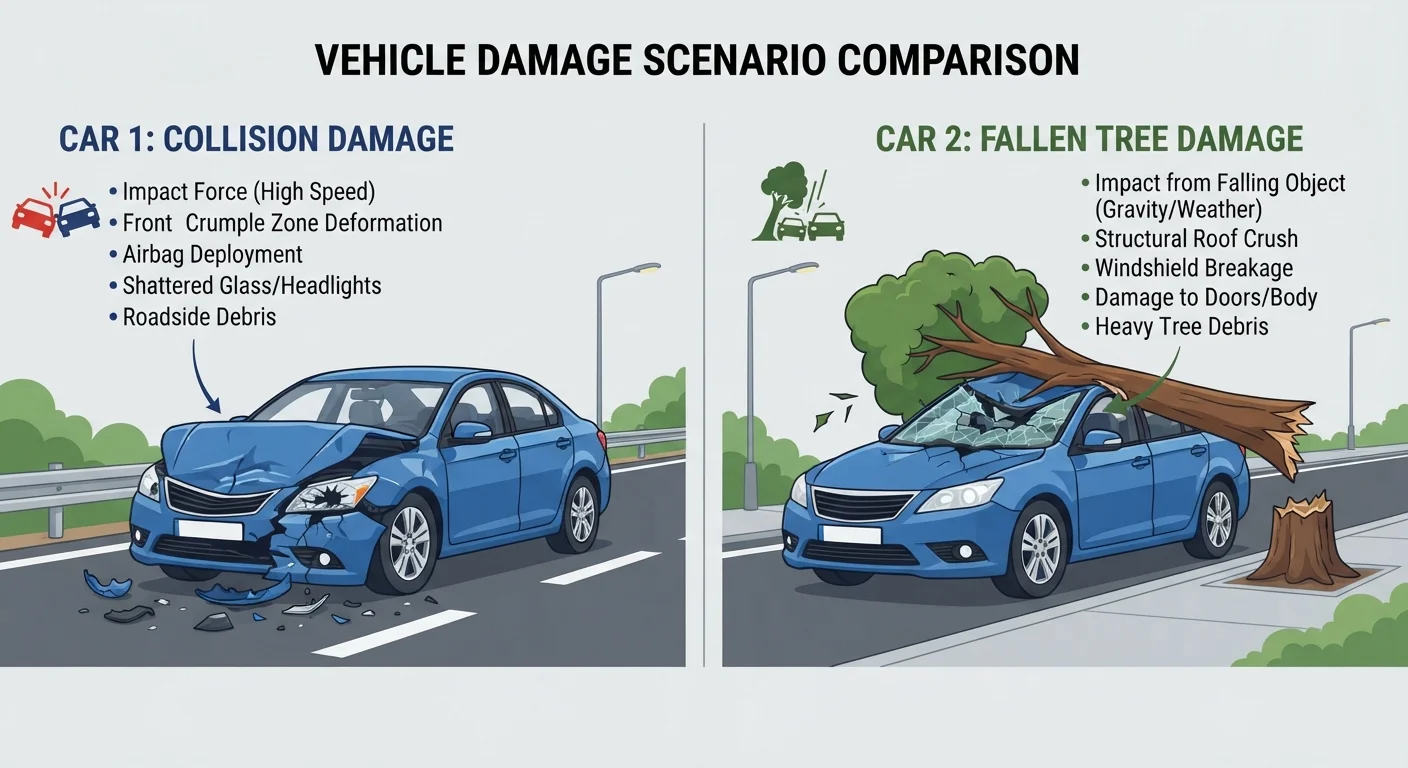
The Core Distinction: What Triggers Each Coverage
The single most useful question to ask is: What caused the damage? That answer tells you which coverage applies.
Collision coverage is triggered when your vehicle makes physical contact with another car, a guardrail, a pole, a fence, or any other object - whether you're at fault or not. It also applies if your car rolls over. The common thread is that movement and impact are involved.
Comprehensive coverage applies to a wide range of events that aren't collisions. This includes theft, vandalism, fire, hail, flooding, falling trees or debris, glass breakage from road gravel, and striking an animal (such as a deer running into the road). These are events largely outside a driver's control.
A useful mental shortcut: if your car was parked and something happened to it, comprehensive is almost certainly the relevant coverage. If you were driving and hit something, collision likely applies. There are nuances - hitting a deer, for example, is classified as a comprehensive claim in most policies, not collision, even though the car was moving.
Glass Damage: A Common Coverage Question
Windshield and window damage from road debris or gravel typically falls under comprehensive coverage, not collision. Some insurers offer a separate glass endorsement with no deductible for these claims. Check your policy's declarations page or contact your insurer directly to understand exactly how glass damage is handled under your specific policy terms.
Side-by-Side: How the Two Coverages Compare
Understanding what each policy element looks like in practice helps clarify the real differences. Both coverages share some structural similarities - they each have a deductible and pay out based on your vehicle's actual cash value - but the scenarios they cover are meaningfully distinct.
| Criterion | Collision Coverage | Comprehensive Coverage |
|---|---|---|
| Primary trigger | Impact with object or vehicle | Non-collision event (theft, weather, animal) |
| At-fault accidents | Covered | Not covered |
| Theft of vehicle | Not covered | Covered |
| Hail or flood damage | Not covered | Covered |
| Hitting a deer | Not covered | Covered |
| Rolling over | Covered | Not covered |
| Deductible required | Yes (set independently) | Yes (set independently) |
| Payout basis | Actual cash value of vehicle | Actual cash value of vehicle |
| Required by law | No (state minimums exclude it) | No (state minimums exclude it) |
| Required by lenders/lessors | Typically yes | Typically yes |
For a broader look at how these coverages fit into an overall auto policy, see Auto Insurance Coverage from the Ground Up. And if you're weighing whether adding either coverage makes sense given your current policy, Minimum Auto Insurance vs. Full Coverage explains how state minimums differ from broader protection.
Deductibles, Payouts, and the Actual Cash Value Rule
Both collision and comprehensive pay based on your vehicle's actual cash value (ACV) - what the car was worth on the open market at the time of loss, not what you paid for it or what it would cost to replace it new. Depreciation is always factored in.
Before your insurer pays, you'll cover your chosen deductible - the portion of the loss you agree to absorb. Deductibles for each coverage are set independently. A driver might carry a $500 collision deductible and a $250 comprehensive deductible, for example. Choosing a higher deductible typically lowers your premium, but increases what you'll pay out of pocket after a claim.
One practical consideration: if your vehicle's ACV is $3,000 and your collision deductible is $1,500, a claim nets you only $1,500 - before any premium increases that might follow. This math is worth doing, especially on older vehicles. What Insurance Coverage Actually Means digs deeper into how policy limits and exclusions shape what you actually receive.
~75%
Insured drivers who carry comprehensive coverage
According to the Insurance Information Institute, approximately three-quarters of U.S. drivers with auto insurance carry comprehensive coverage.
~72%
Insured drivers who carry collision coverage
The Insurance Information Institute also reports that roughly 72% of insured drivers in the U.S. carry collision coverage on their vehicles.
Common Misconceptions - and What They Cost Drivers
Several persistent myths lead drivers to make claims on the wrong coverage - or to go unprotected when they assumed they were covered.
- Myth: Comprehensive covers everything. Despite the name, comprehensive doesn't mean unlimited. It covers a defined list of non-collision perils. Mechanical breakdown, normal wear, and manufacturer defects are excluded from both coverages.
- Myth: Collision covers you if someone hits you. If another driver is at fault, their liability coverage typically pays for your damage. Your collision coverage can step in if the at-fault driver is uninsured or underinsured - but that scenario may involve a separate uninsured motorist property damage (UMPD) coverage depending on your state.
- Myth: You need both or neither. Some drivers carry comprehensive without collision - particularly those with paid-off older vehicles who want theft and weather protection but are willing to absorb collision risk. The reverse (collision without comprehensive) is less common but also possible.
For more on coverage myths that lead to costly misunderstandings, Myths About What Car Insurance Covers After an Accident.