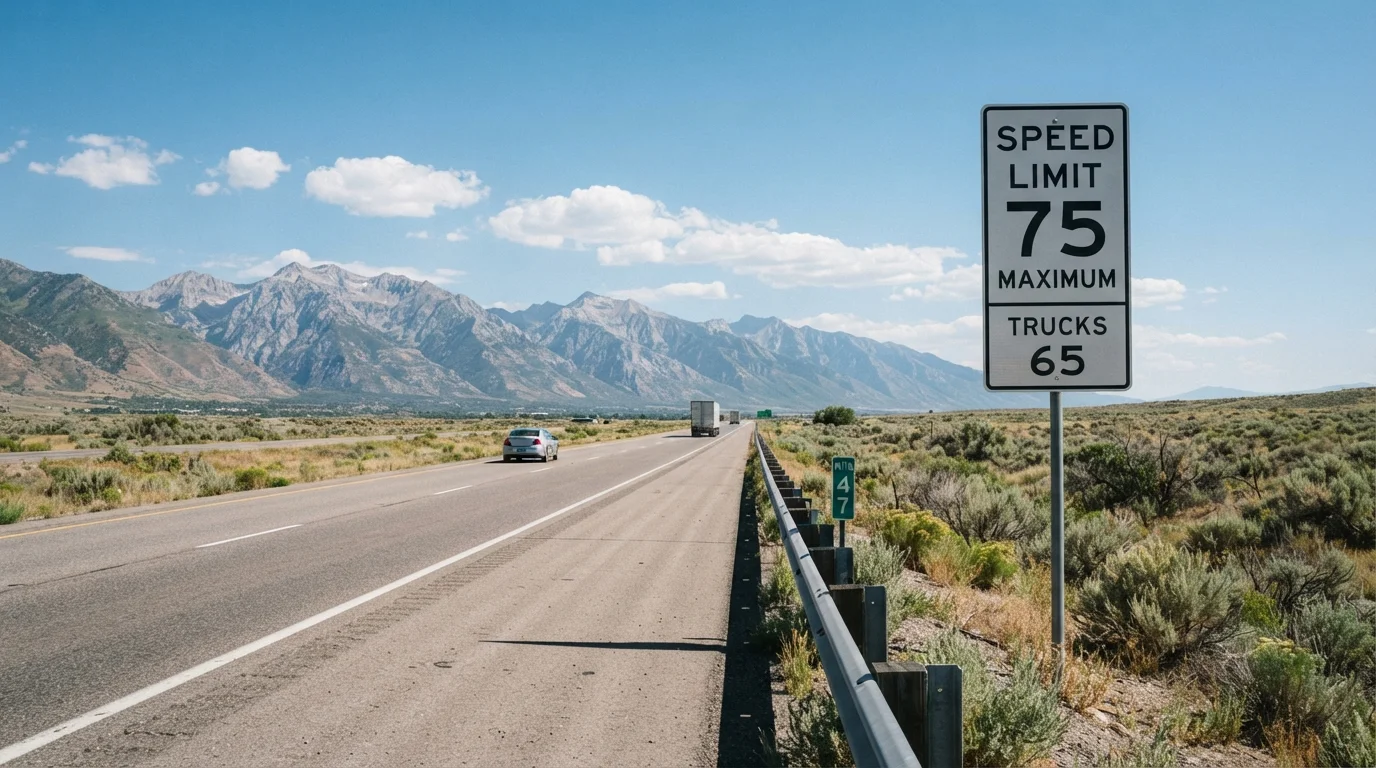
Two Types of Speed Limits: Absolute and Prima Facie
Most American drivers treat posted speed limits as a single, uniform rule: stay at or below the number and you're legal. In practice, U.S. speed law is more layered than that, and the distinction matters in a stop or a court appearance.
| Highest legal interstate speed in the U.S. | 85 mph (one corridor in Texas) (Texas DOT) |
| Most common U.S. interstate speed limit | 70-75 mph (Insurance Institute for Highway Safety (IIHS)) |
| States using prima facie speed principles | Small number, most notably California (State motor vehicle codes) |
| Typical school zone speed limit | 15-25 mph (when in effect) (Varies by state statute) |
| Basic speed law applicability | Nearly all 50 states (National Highway Traffic Safety Administration) |
Absolute limits are exactly what they sound like. If the posted maximum is 65 mph, driving 66 mph is a violation - period. No context, traffic condition, or road quality changes that. The majority of U.S. states use absolute limits on most public roads, particularly on interstates and major highways.
Prima facie limits (from the Latin meaning "on its face") work differently. The posted number is presumed reasonable, but a driver may argue in court that their actual speed was safe given the specific conditions at the time - clear roads, dry weather, low traffic. California is the most prominent state that applies prima facie principles to many of its speed statutes. The flip side also applies: in prima facie states, you can be cited for driving below the posted limit if conditions make that speed unsafe.
Understanding which framework your state uses is the foundation of knowing your legal exposure when speed is at issue.
Statutory Speeds, Posted Limits, and Where They Conflict
Every state maintains a set of statutory (or default) speed limits - legal maximums that apply even when no sign is posted. These vary by road type and jurisdiction. Common defaults include lower limits in residential areas, school zones, and business districts, and higher defaults on rural two-lane roads or interstate highways.
When a posted sign differs from the statutory default, the posted limit controls. Local governments often lower limits on specific corridors based on engineering studies - a practice called speed zoning. A road with a statutory 55 mph default might be posted at 40 mph through a dense residential stretch, and that posted figure is the enforceable one.
School zones are a notable case where statutory reductions automatically apply - often 15 or 25 mph - sometimes only during posted hours or when flashing lights are active. Drivers should know their state's specific trigger conditions, because the reduced limit isn't always in effect around the clock.
Similarly, road signs in construction zones carry their own speed reductions, frequently with doubled fines for violations when workers are present. These are statutory enhancements, not officer discretion.
The 'Reasonable and Prudent' Standard
A handful of states - Montana for rural roads during certain periods is the most cited historical example - have experimented with a "reasonable and prudent" speed standard rather than fixed numerical limits. Under this approach, speed is evaluated against conditions rather than a posted number.
This standard still exists in limited forms. Most states apply a reasonable-and-prudent obligation on top of absolute limits: even if you're driving at or below the posted maximum, you can be cited if your speed is unsafe for current conditions - heavy rain, ice, dense fog, or heavy pedestrian traffic. This is sometimes called the basic speed law, and it exists in virtually every state's traffic code.
Absolute speed limit
A fixed numerical speed maximum that cannot be exceeded regardless of road or weather conditions. Exceeding the limit by any amount constitutes a violation.
Prima facie speed limit
A posted limit that is presumed reasonable but can be challenged in court if the driver can demonstrate their speed was actually safe for the conditions present.
Basic speed law
A legal standard present in nearly every U.S. state requiring drivers to travel at a speed that is safe for current conditions, regardless of the posted maximum.
Variable speed limit (VSL)
An electronically displayed speed limit that changes in real time based on traffic volume, weather, or road incidents. VSLs are legally enforceable the same as static signs.
Speed zoning
The process by which a government authority posts a speed limit that differs from the statutory default on a specific road segment, typically based on an engineering or traffic study.
Statutory speed limit
A default speed limit established by state law that applies when no other speed limit is posted on a given road or road type.
The practical implication: the posted limit is a ceiling, not a guarantee of safety or legality. Driving 55 mph in a whiteout is a violation in most jurisdictions, even if 55 mph is the posted limit for that road. Emergency situations on the road similarly require speed adjustments regardless of what signs say.
Enforcement Variation and What Drivers Should Know
Speed enforcement in the U.S. is not uniform. States set their own limits, municipalities can further adjust them on local roads, and enforcement tools - radar, laser, point-to-point timing, and automated cameras - vary widely by jurisdiction. Some states restrict or ban automated speed cameras; others rely on them heavily in urban and school zones.
29%
Share of traffic fatalities linked to speeding
According to the National Highway Traffic Safety Administration, speeding is consistently a factor in roughly three in ten U.S. traffic deaths annually.
41 states
States with maximum interstate limits of 70 mph or higher
As reported by the Insurance Institute for Highway Safety, most U.S. states have raised rural interstate limits since federal speed limit controls were lifted in 1995.
2x-4x
Work zone fine multiplier in many states
Many state legislatures have enacted double or quadruple fine provisions for speed violations in active construction zones, particularly when workers are present.
A few practical realities every driver should carry:
- Interstate speed limits vary by state - the same trip might pass through states with limits ranging from 65 to 85 mph. Watch for signs at state lines and after major junctions.
- Minimum speed limits exist on many interstates and expressways. Driving too slowly in a lane can be cited as an obstruction or unsafe operation - relevant context for the left-lane rules many states enforce.
- Variable speed limits (VSL) are posted on electronic signs in some metro corridors and can change based on traffic, weather, or incidents. These carry the same legal weight as fixed signs and are enforceable.
- Work zone limits often apply 24 hours a day, even when no workers are present, depending on state law.
For unfamiliar routes, checking the state DOT website or a reliable driving reference before a long trip can surface local rules that signs alone won't convey. Understanding traffic signals and regulatory markings as a whole system - not just individual signs in isolation - gives drivers the clearest legal picture of the road ahead.
This article provides general educational information about U.S. speed limit laws and is not legal advice. Traffic laws vary by state and locality; consult your state's motor vehicle code or a qualified legal professional for guidance specific to your situation.