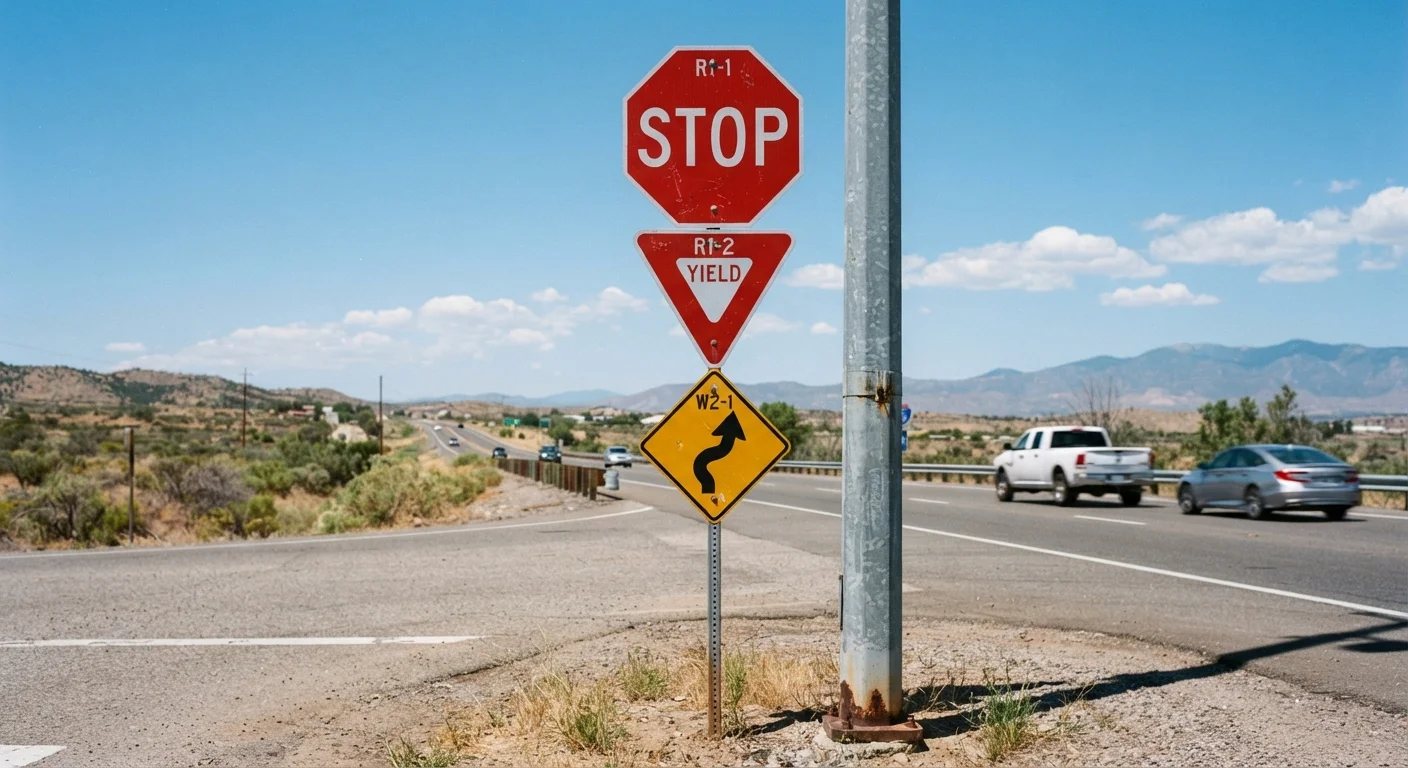
How the U.S. Sign System Is Organized
The U.S. road sign system is standardized through the Manual on Uniform Traffic Control Devices (MUTCD), published by the Federal Highway Administration. Every public road in the country must follow its specifications, meaning the signs you see in Maine carry the same meaning in Arizona.
Three attributes - color, shape, and symbol - communicate meaning independently. A driver who can't read the text can still interpret a red octagon as a stop command, or an orange diamond as a construction warning. This layered design is intentional: it works across language barriers and low-visibility conditions.
| Federal standard governing signs | Manual on Uniform Traffic Control Devices (MUTCD) (Federal Highway Administration) |
| Number of sign shape categories | 9 distinct shapes in active use (MUTCD, 11th Edition) |
| Primary warning sign color | Yellow (standard); Orange (work zones) (MUTCD color coding system) |
| Sign literacy benefit | Shapes convey meaning before text is readable (FHWA driver education guidance) |
| Regulatory sign background color | White (most); Red (stop, yield, prohibition) (MUTCD, 11th Edition) |
Understanding this structure is the first step toward reading signs automatically rather than consciously decoding them - a key element of defensive driving.
Sign Categories: Regulatory, Warning, and Informational
U.S. signs fall into three broad functional categories, each with distinct visual conventions.
Regulatory Signs
These signs communicate laws and rules that drivers are legally required to follow. They use white or red backgrounds with bold text or symbols. The stop sign (red octagon), yield sign (red-and-white downward triangle), and speed limit signs (white rectangles) are the most common. Running a regulatory sign is a traffic violation - not a suggestion to ignore. For a deeper look at how posted speed limits interact with state law, see U.S. speed limit laws.
Warning Signs
Diamond-shaped and typically yellow (or orange in work zones), warning signs alert drivers to upcoming hazards: sharp curves, pedestrian crossings, railroad crossings, merge lanes, or slippery surfaces. They don't require a specific action by law, but they signal that a driver should reduce speed or increase caution. Ignoring them consistently is a common factor in preventable crashes.
Guide and Informational Signs
Green signs provide route guidance and distance information on highways. Blue signs indicate services such as fuel, food, and lodging. Brown signs mark recreational areas and cultural sites. These signs don't carry legal commands but are essential for navigation, especially when exits approach quickly at highway speeds.
MUTCD
The Manual on Uniform Traffic Control Devices - the federal standard published by the FHWA that governs the design and placement of all traffic signs, signals, and pavement markings on U.S. public roads.
Regulatory Sign
A sign that communicates a legal requirement drivers must obey, such as speed limits, stop signs, and no-turn restrictions. Violating these signs is a traffic offense.
Warning Sign
A sign - typically diamond-shaped and yellow or orange - that alerts drivers to a potential hazard ahead, such as a sharp curve, merge, or school zone. No specific legal action is mandated, but increased caution is expected.
Work Zone (Construction) Sign
Orange versions of standard warning signs used in active construction or maintenance areas. Fines for violations in work zones are often doubled under state law.
Guide Sign
Typically green rectangular signs that provide route numbers, distances, and directional information to help drivers navigate - especially on highways and interstates.
Yield
A legal requirement to slow down and give right-of-way to oncoming or crossing traffic. Unlike a stop sign, a full stop is only required if traffic is actually present.
Shape and Color as a Quick-Reference Language
Before you can read the words on a sign, its shape and color have already delivered a message. Memorizing this system helps in low-light, high-speed, or partially obstructed conditions.
- Octagon (red): Stop - full stop required
- Inverted triangle (red/white): Yield - give right-of-way
- Diamond (yellow or orange): Warning or work zone hazard
- Rectangle (vertical, white): Regulatory (speed limits, turn restrictions)
- Rectangle (horizontal, green): Route guidance
- Pentagon (yellow-green): School zone or pedestrian crossing
- Circle (black/yellow): Railroad grade crossing advance warning
Color reinforces shape: red always signals prohibition or required action; yellow and orange signal caution; green signals permitted movement or guidance; blue signals services. This color logic also applies to traffic signals - for a full breakdown, see traffic signal meanings beyond basic colors.
Fines Often Double in Work Zones
Most U.S. states impose doubled or enhanced fines for moving violations committed in active construction or maintenance zones, indicated by orange signage. These rules apply whether or not workers are physically present. Check your state's specific statutes, as penalty structures vary.
For a broader perspective on how sign literacy fits into overall road safety, the complete picture of road safety in the U.S. covers the full range of habits and knowledge that reduce crash risk.