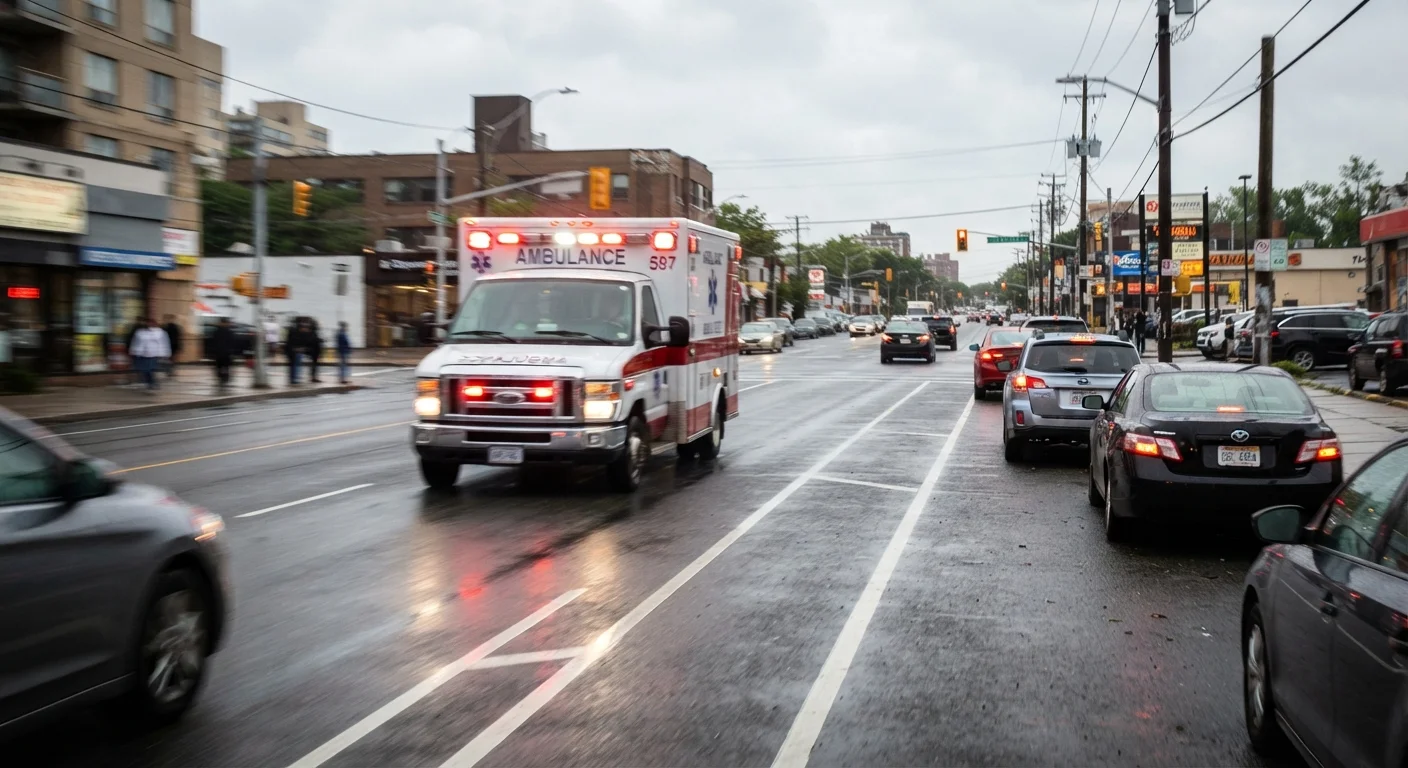
What the Law Actually Requires
Most drivers know they're supposed to pull over when an emergency vehicle approaches with lights and sirens. Fewer know the specific legal mechanics behind that obligation - or how often they get it wrong.
In every U.S. state, traffic law requires drivers to yield the right-of-way to authorized emergency vehicles displaying lights and/or audible signals. The standard procedure is:
- Pull as far right as safely possible - ideally to the shoulder or curb.
- Stop completely - slowing down is not enough in most states.
- Remain stopped until the emergency vehicle has passed and it is safe to re-enter traffic.
One common error: drivers who pull left toward the median, blocking emergency vehicles that are using the left lane to pass. Always pull right unless a one-way road or physical barrier makes that impossible.
Understanding lane discipline on multi-lane roads matters here too - see how left-lane rules interact with emergency vehicle passage for context.
Move Over Laws: More Than a Highway Rule
All 50 states have enacted some form of a Move Over law, but the specifics vary considerably. These laws were originally designed to protect roadside workers and stopped emergency vehicles - not just actively responding ones.
The core requirement: when approaching a stationary emergency vehicle, law enforcement vehicle, tow truck, or roadside assistance vehicle with lights flashing on a multi-lane road, drivers must either:
- Move over one full lane away from the stopped vehicle, or
- Significantly reduce speed (often 20 mph below the posted limit, or to a speed deemed safe for conditions) if a lane change is not safely possible.
Many drivers don't realize Move Over laws have expanded beyond police and fire to include utility trucks, highway maintenance vehicles, and in some states even vehicles displaying hazard lights. Penalties for violations range from fines to license suspension and, in cases where a worker is injured, criminal charges.
Move Over Coverage Varies by State
While all 50 states have Move Over laws, the categories of vehicles protected - and the penalties for violations - differ. Some states cover only emergency vehicles; others include tow trucks, utility crews, and any vehicle with hazard lights activated. Drivers should review the specific law in each state they regularly drive through, particularly if they travel interstate frequently.
For a broader picture of how yielding rules apply across different road scenarios, our guide on right-of-way rules drivers most frequently get wrong is worth reviewing.
Intersections, Expressways, and Edge Cases
Certain situations catch drivers off guard because standard yielding advice doesn't cleanly apply.
At a Red Light or Stop Sign
If an emergency vehicle is approaching from behind while you're stopped at a red light, do not run the red light to get out of the way. Wait for a gap in cross-traffic and pull forward safely into the intersection before clearing to the right - or hold position if pulling forward would push you into cross-traffic. Creating a second collision while yielding defeats the purpose.
On a Divided Highway
Drivers on the opposite side of a divided highway (separated by a median or barrier) are generally not required to stop for an emergency vehicle traveling in the other direction. However, state laws vary, and some require slowing even across a divided roadway. Know your state's specific language.
Tunnels and Bridges
If safely pulling over is impossible - as in a tunnel or on a narrow bridge - slow down significantly and proceed carefully to the nearest safe exit point before stopping. Stopping mid-tunnel can create hazards of its own.
Safe gap management applies in these situations just as it does on open roads. See our explainer on stopping distance and following distance to understand how quickly you may need to react.
50
U.S. states with Move Over laws on the books
All 50 states have enacted some form of Move Over legislation, though coverage and penalties differ significantly by state.
~150
Roadside worker and responder fatalities annually
The National Highway Traffic Safety Administration has documented that roadside fatalities involving responders and workers remain a persistent concern on American roads.
What Happens if You Don't Comply
Failure to yield to an emergency vehicle or to comply with Move Over laws carries real consequences. Depending on the state and circumstances:
- Traffic fines typically range from $100 to over $500 for a first offense.
- Points on your license - which can affect your driving record and, in turn, your insurance premiums.
- License suspension in cases of repeat violations or if an incident results from non-compliance.
- Criminal charges if failure to yield results in injury or death to an emergency worker.
Beyond the legal stakes, the safety stakes are stark. Emergency responders are injured and killed on American roads every year by drivers who fail to move over or who misjudge their stopping ability near stopped vehicles.
Safe road behavior extends across all shared-road interactions - the same attentiveness applies when sharing the road with cyclists and pedestrians or navigating school zones and bus stops.
Move Over Law
State legislation requiring drivers to move one lane away from stationary emergency or service vehicles displaying warning lights, or to slow to a safe speed if a lane change is not possible.
Authorized Emergency Vehicle
A vehicle legally designated to use lights and sirens when responding to emergencies, typically including police cars, fire engines, ambulances, and in some states, certain utility or maintenance vehicles.
Right-of-Way
The legal right of one vehicle or road user to proceed before another in a given traffic situation. Emergency vehicles with active lights and sirens hold right-of-way over all other traffic.
Hazard Lights
A vehicle's four-way flashing turn signals activated simultaneously, used to signal a stopped or disabled vehicle. Some Move Over laws extend protections to any vehicle displaying hazard lights on a roadway.