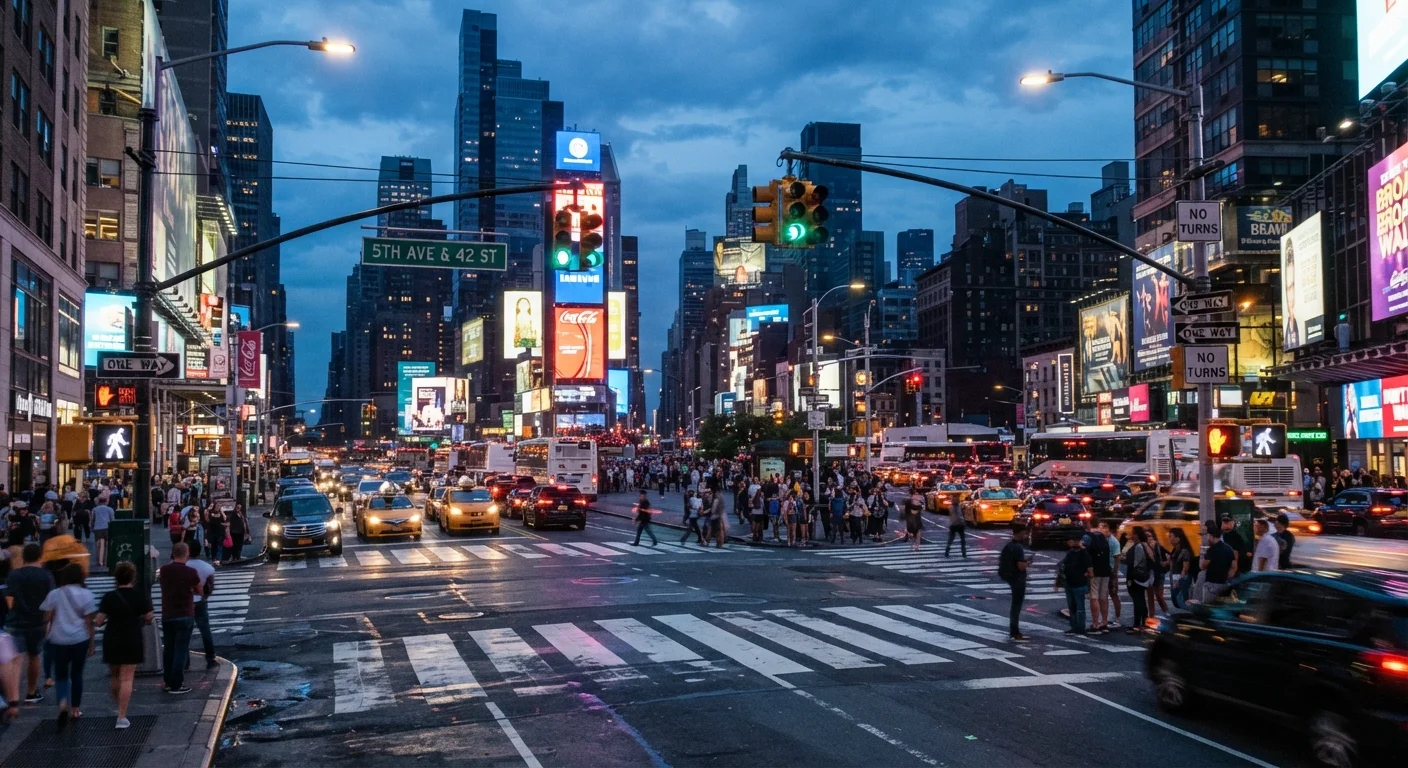
The Signal System Is More Complex Than Most Drivers Realize
Most American drivers learn the basics - red means stop, green means go, yellow means prepare to stop - and leave it there. But today's traffic signal systems include flashing lights, arrow phases, pedestrian countdowns, and specialized indicators that carry distinct legal meanings. Misreading any of them can lead to a moving violation, a collision, or both.
This reference covers the signals you'll encounter on American roads beyond the standard three-color sequence, what each one legally requires, and how to respond safely. For a broader look at road markings, signs, and symbols, see our reference guide for U.S. drivers.
| Flashing red signal rule | Treat as a stop sign - full stop required (Manual on Uniform Traffic Control Devices (MUTCD)) |
| Flashing yellow arrow meaning | Permissive turn - yield to oncoming traffic (MUTCD, Federal Highway Administration) |
| Red arrow vs. circular red | Red arrow generally prohibits turns on red unless signed otherwise (Varies by state jurisdiction) |
| Overhead red X | Lane closed - do not enter or continue (MUTCD) |
| Pedestrian countdown timer purpose | Indicates seconds left in crossing phase; not a driver acceleration cue (FHWA pedestrian signal guidelines) |
Flashing Signals: What Each Color Means
Flashing signals appear when a standard signal is temporarily out of full operation - often overnight, during low-traffic periods, or after a malfunction. The color determines how you respond:
- Flashing red: Treat exactly as a stop sign. Come to a complete stop, yield to cross traffic and pedestrians, and proceed only when safe. All drivers at a four-way flashing-red intersection take turns.
- Flashing yellow: Proceed with caution. Slow down, check for cross traffic, and be prepared to yield. This is not a yield sign - it signals a hazard or advisory condition.
- Flashing yellow arrow: Used in left-turn lanes. You may turn left, but you must yield to oncoming traffic and pedestrians. This is distinct from a solid green arrow, which indicates a protected turn.
Protected turn phase
A signal phase during which a turning driver has the right of way because conflicting traffic is held by a red light. Indicated by a solid green arrow.
Permissive turn
A turn allowed by a signal - typically a flashing yellow arrow - during which the driver must still yield to oncoming vehicles and pedestrians.
Lane control signal
An overhead signal using arrows and X symbols to indicate in real time whether a specific lane is open, closing, or closed to traffic.
MUTCD
The Manual on Uniform Traffic Control Devices, the federal standard governing the design and use of traffic signs, signals, and road markings across the United States.
Pedestrian countdown timer
A numeric display on pedestrian signal heads showing the seconds remaining in the walk or clearance phase, helping pedestrians decide whether to begin crossing.
Arrow Signals and Protected vs. Permissive Turns
Arrow signals govern turns at intersections and fall into two categories that carry very different right-of-way implications:
- Solid green arrow: A protected turn. Oncoming traffic has a red light, and you have the right of way. Pedestrian crossing signals for the conflicting path should also be showing a stop hand. Proceed at a safe speed.
- Flashing yellow arrow: A permissive turn. Oncoming traffic may be moving. You must yield before turning.
- Solid red arrow: Stop and do not turn in the indicated direction. Unlike a circular red light, a red arrow generally prohibits turns on red unless a sign explicitly permits it - and many jurisdictions post such signs only selectively.
- Solid yellow arrow: The protected phase is ending. Begin preparing to stop; do not accelerate to beat the light.
Understanding the difference between protected and permissive turns is especially relevant for new drivers. Our article on the Graduated Licensing System explains how these concepts are introduced during early driver training.
40%
Of U.S. crashes occur at intersections
According to Federal Highway Administration intersection safety data, roughly 40 percent of all traffic crashes in the U.S. happen at or near intersections.
3,000+
Signalized intersections use flashing yellow arrows
The FHWA has deployed flashing yellow arrow signals at thousands of intersections nationwide to reduce left-turn conflicts while maintaining traffic flow.
Pedestrian Signals and Countdown Timers
Pedestrian signals communicate crossing permission at signalized intersections and are relevant to drivers as well:
- Walking figure (white): Pedestrians have the right of way and may begin crossing. Drivers turning through the crosswalk must yield.
- Flashing orange/red hand: Pedestrians already crossing should complete their crossing; those waiting should not start. Drivers should anticipate pedestrians still in the roadway.
- Steady orange/red hand: Do not cross. Drivers can generally assume the pedestrian phase is ending and the signal cycle is transitioning.
- Countdown timers: Display the seconds remaining in the pedestrian crossing phase. Drivers use this information to gauge how soon the signal will change - but do not use a countdown as a cue to accelerate before your light turns green.
Pedestrian phases near school zones have specific protections layered on top of standard signal rules. Review school zone traffic laws for those distinctions.
Signal Meanings Can Vary by Jurisdiction
While the MUTCD establishes federal standards, individual states may adopt variations or supplements. For example, right-turn-on-red rules, specific arrow signal configurations, and lane control practices can differ by state or municipality. Always consult your state's driver handbook for locally applicable rules, and pay attention to posted supplemental signs at intersections.
Lane Control and Overhead Signals
On certain roadways - reversible lanes, high-occupancy vehicle lanes, and managed arterials - overhead lane control signals tell drivers which lanes are open or closed in real time:
- Green downward arrow: The lane directly below is open for travel in your direction.
- Red X: The lane is closed. Do not enter or continue traveling in it. Doing so is a moving violation in most states and is a documented cause of head-on crashes on reversible-lane roads.
- Yellow X: The lane is transitioning - typically closing soon. Move out of that lane when safe.
- White diagonal arrow: Directs you to merge into the lane indicated by the arrow's direction before the lane closes.
Lane control signals are increasingly common in congestion-managed corridors and tunnels. Treat a red X with the same seriousness as a red light - the consequences of ignoring it can be severe. Practicing defensive driving habits helps drivers respond correctly to dynamic signal systems like these.