Why These Laws Exist - and Why They're Strictly Enforced
Traffic laws around schools and school buses aren't arbitrary inconveniences - they reflect a straightforward reality: children are among the most vulnerable road users, and the areas where they gather are among the most dangerous. Pedestrian crashes involving school-age children spike during morning arrival and afternoon dismissal windows, making the hours around school schedules a recognized high-risk period.
Every state has enacted specific statutes governing speed near schools and driver behavior around school buses. The details vary by jurisdiction, but the underlying obligation is universal: drivers must slow down, stop when required, and stay alert. Violations carry steep fines, license points, and in serious cases, criminal charges. Understanding these rules isn't just good citizenship - it's a legal and practical necessity.
For a broader view of how speed law works across jurisdictions, see our guide to U.S. speed limit laws.
School Zone Rules: Speed, Signals, and Timing
A school zone is a designated stretch of road adjacent to a school, typically marked by posted signs, flashing yellow beacons, and reduced speed limit postings. The reduced speed limit - commonly 15-25 mph, though it varies by state and municipality - is generally active during school hours or when the flashing beacon is lit. In many jurisdictions, the reduced limit applies only when children are present, a phrase that courts have interpreted broadly.
Key obligations for drivers in school zones include:
- Obey posted speed limits - radar enforcement and automated speed cameras are increasingly common in school zones. Fines are often doubled compared to standard speeding violations.
- No passing - passing other vehicles in a school zone is prohibited in most states.
- Crosswalk priority - yield to children and crossing guards at all marked crosswalks. Do not proceed until the crossing is fully clear.
- No cell phone use - many states impose enhanced handheld device restrictions in school zones, sometimes regardless of general hands-free laws.
Automated enforcement (speed cameras) is authorized in school zones in a growing number of states. Tickets issued via camera typically attach to the registered vehicle owner, regardless of who was driving.
School zone
A designated road segment adjacent to a school where reduced speed limits and additional traffic restrictions apply during specified hours. Boundaries are marked with posted signs and often flashing beacons.
Stop arm
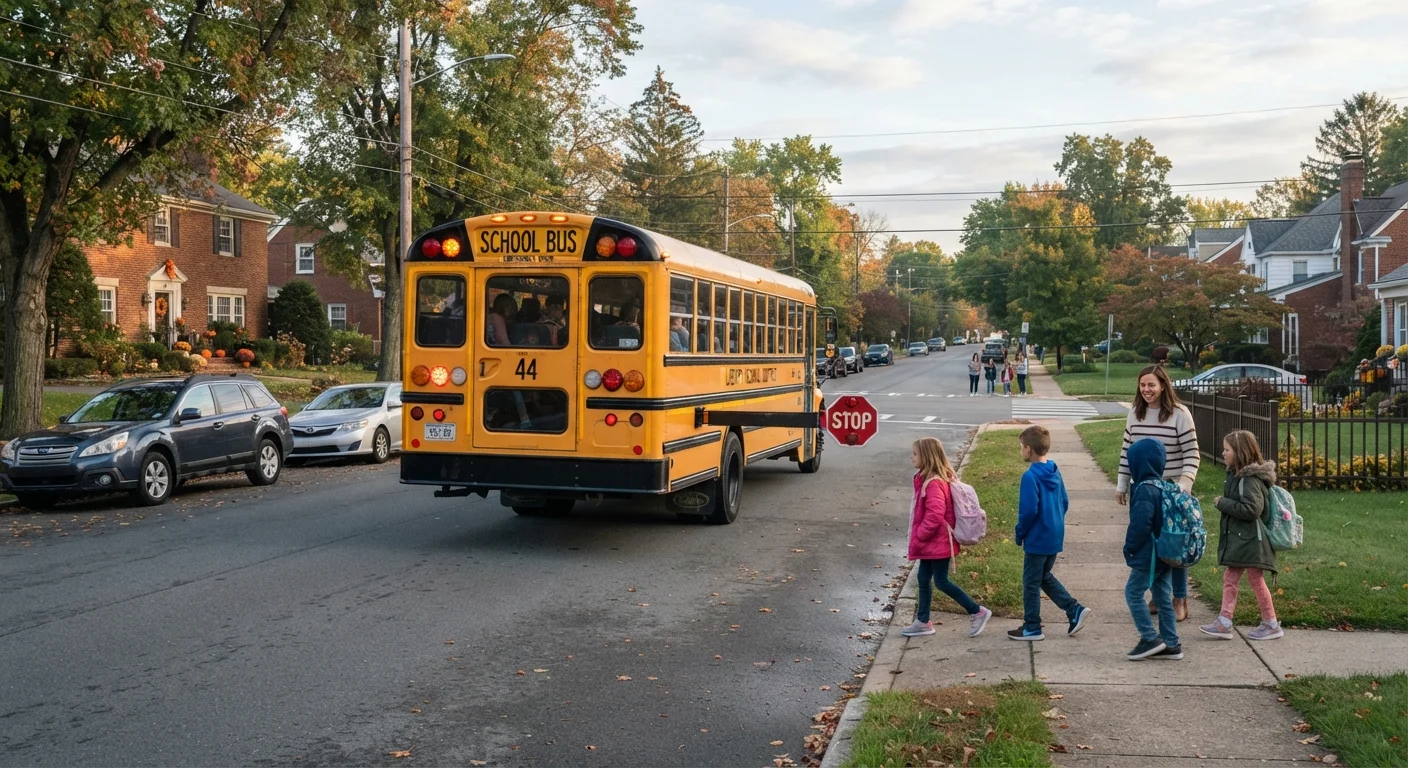
The retractable arm on the left side of a school bus that extends outward when the bus is loading or unloading students. Vehicles must remain stopped while the arm is extended and red lights are flashing.
Divided highway
A road on which opposing lanes of traffic are physically separated by a raised median, barrier, or similar structure - as distinct from a painted centerline, which does not create a division for stop-arm law purposes in most states.
Crossing guard authority
The legal power granted to authorized crossing guards to direct vehicle traffic at school crossings during designated hours. Driver compliance with crossing guard signals is generally required by law.
Automated speed enforcement
Camera-based systems that photograph and record vehicles exceeding the speed limit, often used in school zones. Violations are typically issued to the registered owner of the vehicle.
The School Bus Stop Law: What Drivers Must Do
The obligation to stop for a school bus is one of the most consistently misunderstood traffic rules in the United States. Here is the baseline rule that applies in every state: when a school bus has its red lights flashing and its stop arm extended, all traffic traveling in the same direction must stop and remain stopped until the arm retracts and the lights stop flashing.
The more frequently misapplied scenario involves divided highways. On roads with a raised median or physical barrier separating opposing lanes, most states exempt oncoming traffic from the stop requirement. However, on undivided roads - including two-lane roads with only a painted centerline - traffic in both directions must stop. Drivers often incorrectly assume the painted line creates the same exemption as a raised median. It does not in most states.
The Divided Highway Exception - Read Carefully
Many drivers assume that any road with lanes going opposite directions exempts oncoming traffic from stopping. This is incorrect. The exemption applies only when lanes are separated by a physical barrier, raised median, or similar structure - not a painted centerline. On a standard two-lane road, traffic in both directions must stop for an extended stop arm. If you are unsure about your state's specific rule, check with your state's Department of Motor Vehicles or equivalent agency.
Penalties for illegally passing a stopped school bus are severe in most states - fines commonly range from $250 to $1,000 or more for first offenses, with license suspension possible for repeat violations. Some states treat repeated violations as misdemeanor offenses.
Drivers should also be aware that many school districts now equip buses with external cameras that automatically capture the license plates of vehicles that illegally pass. Citations can be issued days after the event based on video evidence.
For related right-of-way situations that drivers frequently mishandle, see our article on right-of-way rules American drivers most frequently get wrong.
Crossing Guards and School Crossings
Crossing guards - sometimes called school safety officers - hold legal authority to direct traffic at school crossings during authorized hours. In most states, drivers are legally required to obey a crossing guard's signals in the same way they would obey a traffic signal or law enforcement officer. Failing to yield when a guard is directing pedestrians across the road is a traffic violation.
The same pedestrian priority rules that apply generally at crosswalks are amplified in school crossing contexts. Drivers should not enter a crosswalk even after a guard signals them forward if children are still completing the crossing.
Children's unpredictable movement - darting between parked cars, chasing dropped items, or crossing mid-block - means that situational awareness near schools must go beyond simply following the signals. Keeping a finger off the gas and being ready to stop is the appropriate posture when driving anywhere near an active school.
Our guide to sharing the road with cyclists and pedestrians covers the broader rules governing interactions between vehicles and vulnerable road users.
This article provides general educational information about traffic laws in the United States. Laws vary by state and municipality. Always verify the specific rules in your jurisdiction with official state or local transportation authorities.