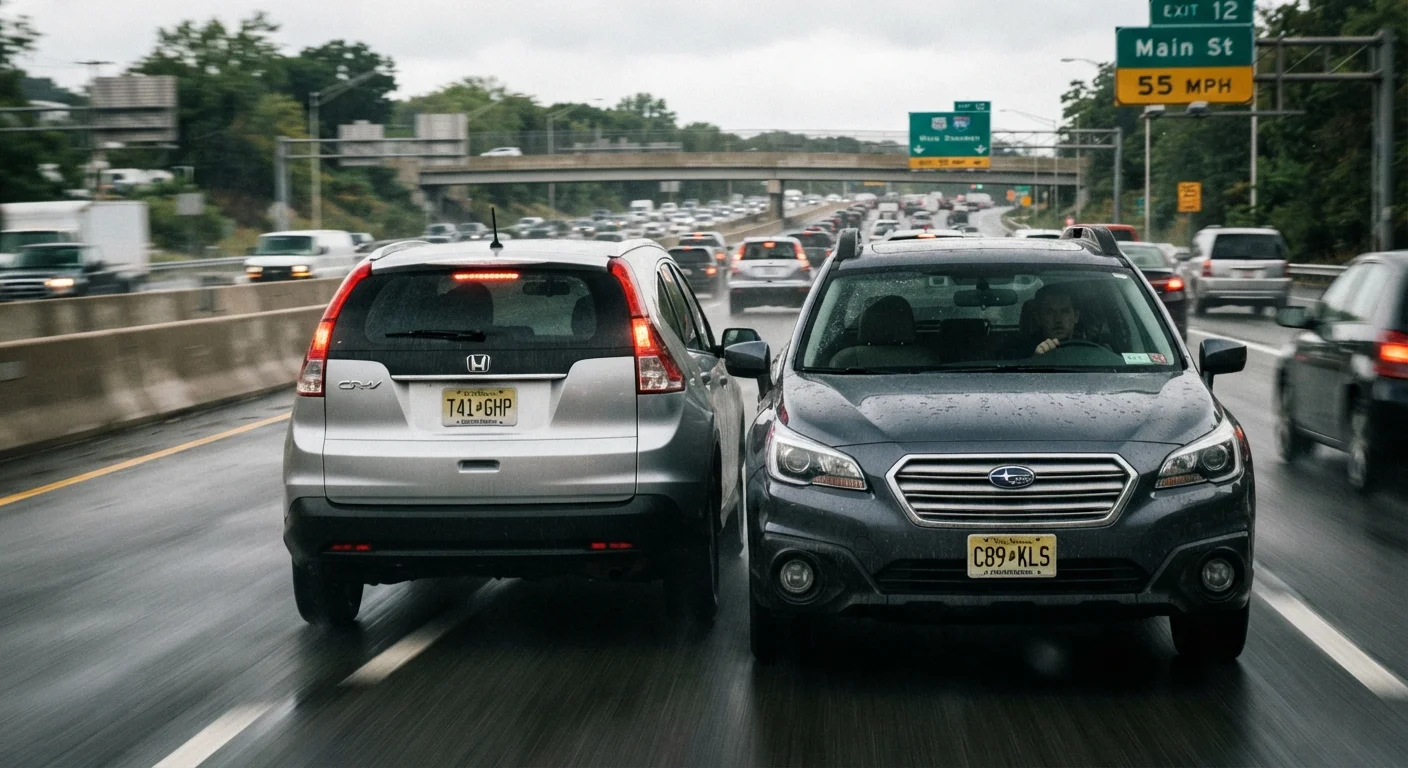
The Physics Behind Why Tailgating Is So Risky
Most drivers underestimate how much road they need to stop a vehicle safely. The process from perceiving a hazard to bringing a car to a full stop involves two distinct phases: reaction distance and braking distance. Together, these form total stopping distance - and both are longer than most people intuitively expect.
Reaction time for an alert driver averages roughly 1.5 seconds. At 60 mph, that alone translates to about 132 feet of travel before the brakes are even touched. Add braking distance on dry pavement, and a vehicle traveling at 60 mph may need well over 300 feet to come to a complete stop. A driver following two car lengths behind has nowhere near that margin.
Speed makes this worse exponentially, not proportionally. Doubling your speed roughly quadruples your stopping distance. For a deeper look at how these distances interact, see our explainer on stopping distance and following distance.
~29%
Share of all U.S. crashes that are rear-end collisions
According to the National Highway Traffic Safety Administration (NHTSA), rear-end crashes consistently represent roughly one in four to one in three of all reported collisions.
1.5 sec
Average driver reaction time before braking begins
Traffic engineering research cites 1.5 seconds as a commonly used average perception-reaction time for alert drivers under normal conditions.
300+ ft
Approximate stopping distance at 60 mph on dry pavement
This figure combines average reaction distance with braking distance for a standard passenger vehicle and varies by vehicle, tires, and road surface.
What "Safe Following Distance" Actually Means
The widely taught two-second rule - choosing a fixed point, watching the car ahead pass it, and counting two seconds before you reach that same point - offers a useful starting framework. But it represents a minimum under ideal conditions: dry roads, good visibility, alert driver, standard passenger vehicle.
Conditions that require more space include rain, snow, or ice; reduced visibility from fog, glare, or darkness; higher speeds; and heavier vehicles with longer braking profiles. If you're towing a trailer, your stopping distance increases substantially - four seconds or more becomes a reasonable baseline. The two-second rule also has limitations worth understanding; our analysis of what the two-second rule gets wrong covers the broader picture.
Increase Your Gap in Poor Conditions
On wet roads, double your following distance to at least four seconds. On snow or ice, consider extending it further still - braking distances on ice can be ten times longer than on dry pavement. When visibility is poor, extra space gives you extra time to perceive hazards.
Tailgating as Aggressive Driving - and Its Legal Consequences
Tailgating isn't always intentional aggression, but it is always a hazard. When it is deliberate - used to pressure a driver to speed up or move over - it crosses into aggressive driving territory. Aggressive driving and road rage are legally and behaviorally distinct, but both create serious risks for everyone on the road.
From a legal standpoint, following too closely is a moving violation in every U.S. state. In a rear-end collision, the following driver is presumptively at fault in most jurisdictions, which carries implications for insurance claims and potential civil liability. The combination of a citation and an at-fault collision can meaningfully affect insurance premiums.
Tailgating is also part of a broader pattern of risky habits. Our overview of driving habits that increase crash risk places following distance in context alongside other common behaviors that elevate danger without drivers always recognizing it.
Practical Steps to Maintain a Safe Gap
Maintaining adequate following distance is a skill that benefits from deliberate practice. A few reliable approaches:
- Use the time-gap method: Pick a fixed roadside marker. When the vehicle ahead passes it, count seconds until you reach the same point. Adjust your speed until you consistently achieve two seconds minimum - more in poor conditions.
- Account for what's behind you: Following distance isn't only about the vehicle ahead. Leaving extra space in front gives you room to brake more gradually, which reduces the risk of being rear-ended by the driver behind you.
- Recognize distraction as a contributing factor: Many drivers tailgate not out of aggression but because their attention has drifted. Phone use, in-car screens, and fatigue all reduce the cognitive bandwidth needed to monitor and maintain safe gaps.
- Adjust for vehicle size and load: Large trucks, vehicles with trailers, and heavily loaded SUVs need considerably more stopping room than an empty compact car.
Being aware of blind spots also matters when maintaining spacing - particularly when following large trucks, where the driver ahead may not see your vehicle at all if you're too close.
Following Distance and Commercial Vehicles
Federal Motor Carrier Safety Administration (FMCSA) regulations require commercial truck drivers to maintain greater following distances than passenger vehicle drivers, because loaded trucks can take significantly longer to stop. If you're following a large truck closely, keep in mind the truck driver may not even be able to see your vehicle in their mirrors.