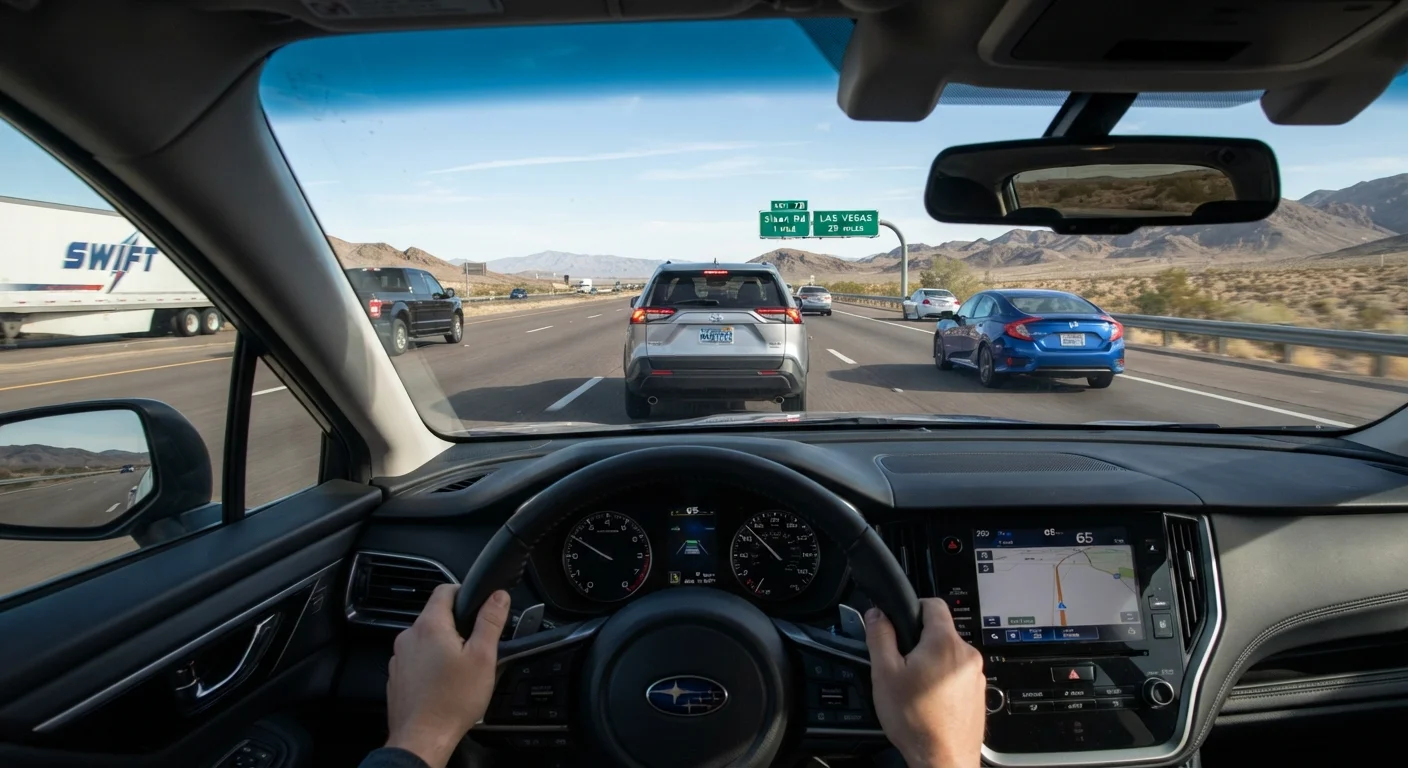
The Two Components of Stopping Distance
When a hazard appears ahead of you, stopping your vehicle is a two-phase process - and understanding both phases is fundamental to safe driving.
Phase 1: Perception-reaction distance. This is the ground your car covers from the moment you perceive a threat to the moment your foot makes contact with the brake pedal. For most alert drivers under normal conditions, reaction time runs roughly 1.5 seconds. At 60 mph, that means traveling about 132 feet before the brakes even engage.
Phase 2: Braking distance. This is the distance your vehicle continues forward while the brakes work to shed speed. At 60 mph on dry pavement, a typical passenger car needs approximately 180 feet to stop after braking begins. Combined with reaction distance, total stopping distance at 60 mph approaches 300 feet - nearly the length of a football field.
Reaction time at higher speeds is a separate but closely related factor - speed compresses the time you have to perceive and respond before a collision becomes unavoidable.
~300 ft
Total stopping distance at 60 mph
This approximate figure combines reaction distance and braking distance for a typical passenger car on dry pavement, per standard driver education references.
4×
Braking distance increase from doubling speed
Because braking distance scales with the square of velocity, doubling speed from 30 to 60 mph roughly quadruples the braking distance component alone.
50%+
Braking distance increase on wet roads
Wet pavement significantly reduces tire-to-road friction; traffic safety research consistently shows braking distances increase by 50% or more in wet conditions.
How Following Distance Relates - and Why the Gap Matters
Following distance is your buffer - the deliberate space you maintain between your front bumper and the rear of the vehicle ahead. For that buffer to be meaningful, it must be at least as long as your total stopping distance under current conditions.
The widely taught two-second rule asks you to choose a fixed marker and count two seconds between the moment the car ahead passes it and the moment you do. It is a practical field estimate, but it has real limits. What the two-second rule misses about safe following distance is worth understanding before you treat two seconds as a universal standard - speed, weather, and vehicle type each shift the threshold.
A helpful reframe: instead of thinking of following distance as a fixed number, think of it as a continuously adjusted variable. As speed increases, as road surfaces worsen, or as visibility drops, your required gap grows.
Use a Three-Second Count as Your Starting Point
Pick a stationary roadside marker - a sign, overpass, or lane marking. When the vehicle ahead passes it, count 'one-thousand-one, one-thousand-two, one-thousand-three.' If you reach the marker before finishing the count, you are following too closely. In adverse conditions, aim for four seconds or more.
Factors That Extend Stopping Distance Beyond the Baseline
Several real-world variables push stopping distance well beyond the textbook numbers:
- Speed: Because braking distance scales with the square of speed, going from 30 mph to 60 mph doesn't double braking distance - it roughly quadruples it. This is the most consequential variable most drivers underestimate.
- Road surface and weather: Wet, icy, or gravel-covered roads dramatically reduce tire friction. Wet pavement alone can extend braking distance by 50% or more; ice can multiply it several times over.
- Vehicle load: A fully loaded pickup or SUV carries significantly more kinetic energy than the same vehicle empty. Cargo trailers compound this further and can also affect brake system performance.
- Tire condition: Worn tread reduces grip on all surfaces. Underinflated tires change contact dynamics and can extend stopping distances even in dry conditions.
- Brake condition: Worn brake pads, overheated brakes (common on long mountain descents), or brake fade all reduce the braking force available, extending the distance required to stop.
- Driver alertness: Fatigue, distraction, and impairment lengthen reaction time - directly adding to the perception-reaction distance component.
Stopping Distance Figures Are Ideal-Condition Estimates
Published stopping distance numbers typically assume alert drivers, properly maintained brakes and tires, and dry pavement. Real-world conditions routinely differ from this baseline. Treat published figures as a floor, not a ceiling, and build in additional margin whenever any variable deviates from ideal.
Applying This Knowledge in Everyday Driving
The practical takeaway is straightforward: adjust your following distance upward any time conditions diverge from ideal. On a clear, dry highway at posted speeds with a well-maintained vehicle, three seconds is a reasonable starting point. Add at least one additional second for rain, low light, or unfamiliar roads. Add more for heavy loads, trailer towing, or high-speed interstate travel.
Being cut off by another driver is a common frustration when maintaining larger gaps. Resist the urge to close the gap to deter merging. Re-establish your cushion calmly - it costs you almost no additional travel time but preserves your ability to stop.
For situations where emergency vehicles or sudden road changes require rapid adjustments, knowing your baseline stopping distance helps you anticipate rather than react. See also: the rules drivers often overlook when emergency vehicles approach, where reduced following distance can leave you without options when you need to yield quickly.
This article provides general driver education information. Consult your state's driver handbook for jurisdiction-specific requirements regarding following distance and road safety regulations.