Where the Two-Second Rule Comes From - and What It Assumes
The two-second rule is a widely taught rule of thumb: pick a fixed point on the road, and make sure at least two seconds pass between when the car ahead passes it and when you do. It's simple, speed-independent in theory, and easy to apply without math. Driver's education programs have taught it for decades, and for low-speed suburban driving in clear conditions with a well-maintained passenger vehicle, it offers a reasonable cushion.
But the rule was never intended to be a universal prescription. It assumes good weather, dry pavement, a car (not a truck), attentive driving, and average reaction time. The moment any of those conditions change - and on American roads, they regularly do - the two-second gap can become dangerously inadequate. Understanding what goes into stopping distance is the real foundation of safe following. See our explainer on stopping distance vs. following distance for a deeper look at the physics involved.
Myth
Two seconds of following distance is always enough to stop safely, regardless of speed or conditions.
Fact
Two seconds is a minimum baseline for ideal conditions only - wet roads, higher speeds, or heavy vehicles can require three to four seconds or more.
The two-second rule was designed for moderate speeds on dry roads with an alert driver in a standard passenger vehicle. At highway speeds of 65-70 mph, two seconds translates to roughly 190 feet - but actual stopping distance (including reaction time) in an emergency can exceed 300 feet. Add rain, worn tires, or a heavy load, and the gap grows further. Treating two seconds as a universal ceiling rather than a floor is a common and dangerous mistake.
Myth
If you can see the car ahead of you clearly, you have enough room to stop in time.
Fact
Visual proximity is not the same as safe stopping distance - you need measurable time-space, not just visibility.
Drivers often rely on intuitive visual judgment to assess following distance, but the human eye is poorly calibrated for relative speed and gap estimation at highway speeds. A gap that looks comfortable at 40 mph may be entirely insufficient at 65 mph, even though it looks similar in the mirror. Using a fixed landmark and counting seconds removes the guesswork and reflects actual elapsed time - not perceived space.
Myth
Larger vehicles like SUVs and trucks stop faster because they're heavier and more powerful.
Fact
Heavier vehicles require more distance to stop, not less - their greater mass means more momentum to overcome, even with powerful brakes.
Braking power scales with vehicle size to a degree, but stopping distance is governed by momentum - the product of mass and velocity. A fully loaded pickup truck or SUV carries significantly more inertia than a compact car traveling the same speed. Research from the Insurance Institute for Highway Safety consistently shows that larger, heavier vehicles have longer stopping distances than lighter passenger cars under equivalent conditions. Drivers of trucks or SUVs should increase their following gap accordingly.
Myth
The two-second rule accounts for your reaction time, so you don't need to add extra space for distraction.
Fact
The rule assumes an instantaneous reaction - it does not build in any buffer for inattention, fatigue, or delayed perception.
Average alert-driver reaction time is approximately 1.5 seconds, but that figure assumes full attention, readiness, and clear situational awareness. Any distraction - even a momentary glance at a phone or instrument panel - can add another second or two before braking begins. Since the two-second rule provides only two seconds of total lead time, a 1.5-second reaction already consumes nearly all of it. Distracted or fatigued drivers should apply a substantially larger following gap as a practical safety margin.
Conditions That Demand More Space Than Two Seconds
Speed amplifies the gap between what two seconds looks like and what actually protects you. At 30 mph, two seconds is roughly 88 feet. At 65 mph, it's about 191 feet - but your stopping distance in an emergency has grown far more steeply. Kinetic energy increases with the square of speed, meaning a vehicle traveling at 65 mph doesn't just need more room than one at 30 - it needs dramatically more.
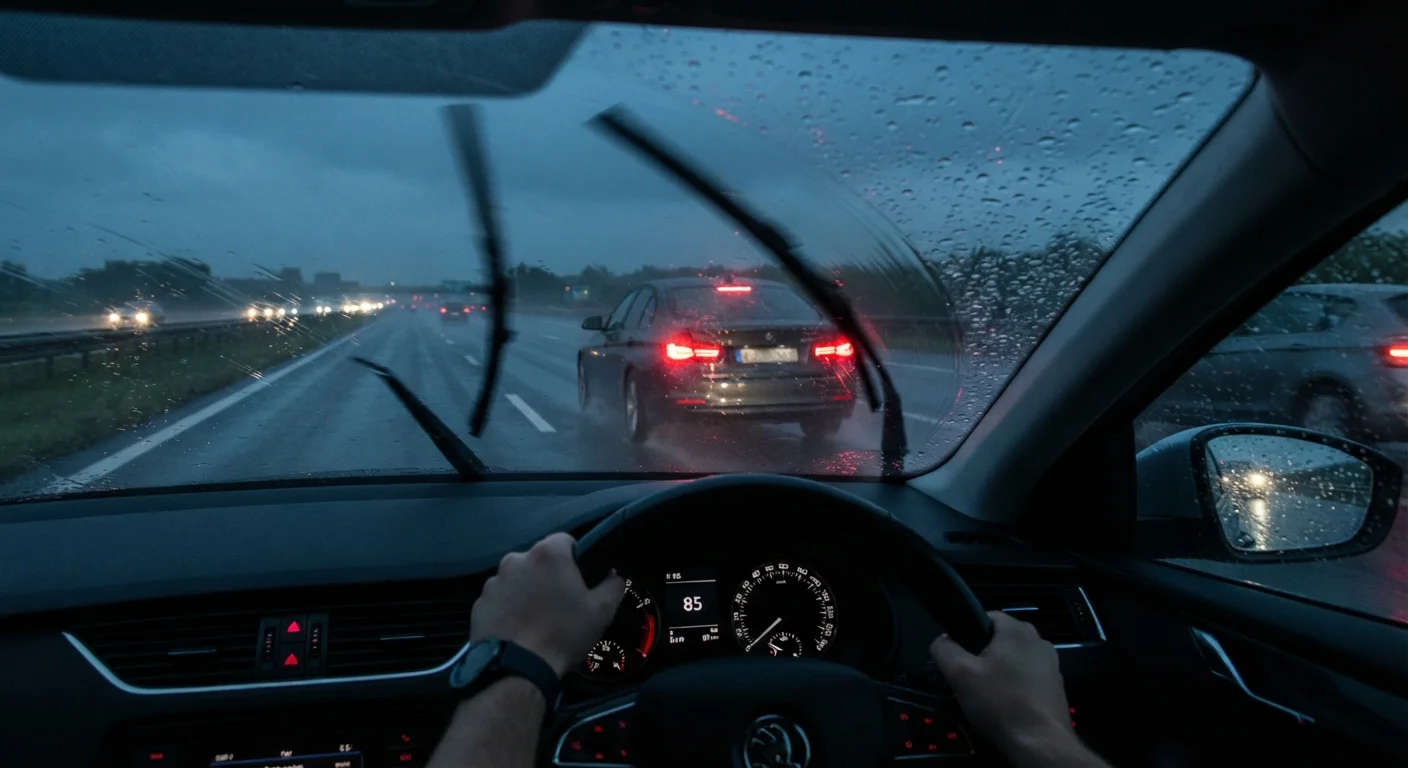
Rain and wet pavement are equally important multipliers. Water reduces tire-to-road friction significantly, extending stopping distances by 50% or more depending on tread depth and road condition. In rain, most safety guidance shifts to a three-second minimum; in snow or ice, four seconds or more is commonly recommended. And if you're driving a pickup truck loaded with cargo, an SUV towing a trailer, or any commercial vehicle, add more still - heavier vehicles simply require longer to stop.
~50%
Increase in stopping distance on wet pavement
Road safety research consistently estimates wet roads extend stopping distances by roughly 50% compared to dry conditions, depending on tire condition and road surface.
1.5 sec
Average driver reaction time before braking
Transportation safety research places average perception-reaction time at approximately 1.5 seconds for an alert driver under normal conditions.
~40%
Of all rear-end crashes involve following too closely
Studies examining crash causation data from the National Highway Traffic Safety Administration have identified following-too-closely as a factor in a substantial share of rear-end collisions.
Distraction is another factor the rule doesn't account for. The two-second gap assumes you begin braking the instant the car ahead does. In reality, average driver reaction time is roughly 1.5 seconds. If you're glancing at navigation or reaching for a drink, that delay grows - and eats directly into the cushion you thought you had. As detailed in our article on why tailgating is more dangerous than most drivers realize, even a brief lapse in attention at highway speeds can be catastrophic.
Don't Let Traffic Pressure Override Your Judgment
On busy highways, drivers are often pressured - implicitly or explicitly - to close gaps to avoid vehicles cutting in. Maintaining a proper following distance may feel socially awkward, but surrendering it to keep pace with aggressive traffic is a genuine safety risk. If someone tailgates you, the safest response is a gradual, controlled lane change when it's safe - not accelerating beyond your own comfort gap.