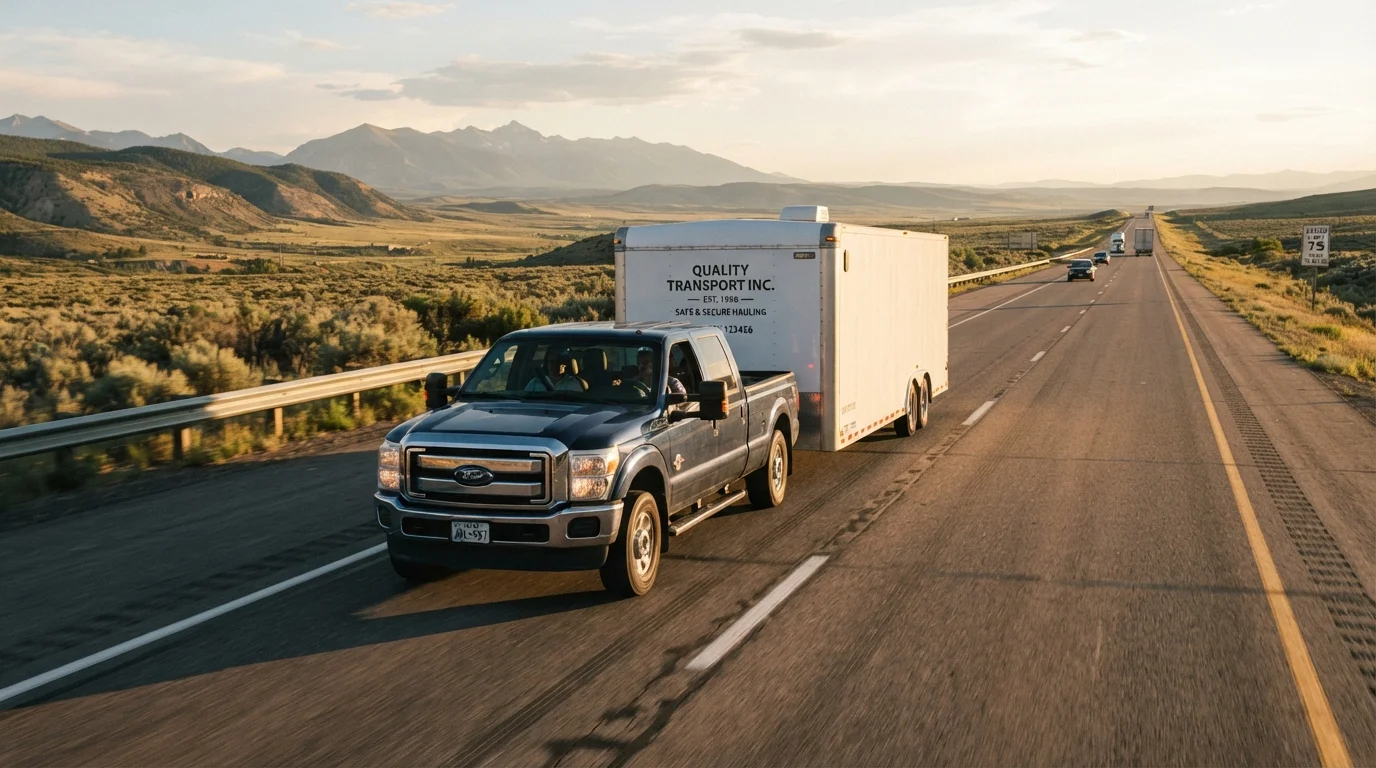
How a Trailer Changes Your Vehicle's Physics
Attaching a trailer to your vehicle doesn't just add weight - it fundamentally changes how your vehicle responds to your inputs. The extra mass shifts the center of gravity rearward, reduces your powertrain's available thrust-to-weight ratio, and introduces a pivot point at the hitch that your vehicle's original engineering never anticipated.
The most immediate effect is on braking. A loaded trailer can add thousands of pounds behind your rear axle. Because those wheels may have no brakes of their own (on lighter trailers), your tow vehicle's brakes are doing disproportionate work. Stopping distances that feel routine can double or triple depending on load and speed. This makes increased following distance non-negotiable - see our look at why following distance matters more than most drivers realize for context on the physics involved.
Turning is also affected. Your trailer tracks a tighter arc than your tow vehicle through corners - a behavior called off-tracking - meaning the trailer's wheels cut inside your tow vehicle's path. This requires wider turns than you're accustomed to, especially through intersections and parking lots.
2-3×
Increase in stopping distance when towing
Automotive safety engineers broadly cite that a fully loaded trailer can double or triple a vehicle's stopping distance compared to unloaded conditions at highway speeds.
60%
Trailer weight that should sit forward of axle
Industry towing guidelines consistently recommend placing approximately 60% of trailer cargo weight ahead of the trailer axle to minimize sway risk.
Understanding Trailer Sway and How to Respond
Trailer sway - sometimes called fishtailing - occurs when the trailer begins oscillating side to side faster than the driver and vehicle can counteract it. Once sway begins, driver overcorrection is a leading cause of jackknifing and rollover. Sway is triggered by crosswinds, being passed by large trucks, improper weight distribution, or excessive speed.
The counterintuitive but correct response to trailer sway is to not steer into it and not apply the brakes aggressively. Instead, ease off the accelerator smoothly and allow the rig to slow naturally. If your trailer has a manual brake override (a brake controller), applying it gently - without braking the tow vehicle - can help stabilize sway. Many modern trucks and SUVs equipped with trailer sway control use electronic stability systems to automatically brake individual wheels and dampen oscillation.
“The biggest mistake inexperienced towers make is trusting their instincts during a sway event. Every instinct says steer and brake - both can make it catastrophically worse. The trailer has to be slowed, not steered.”
— Commercial Vehicle Safety Alliance, North American organization focused on commercial and recreational vehicle safety standards
Prevention matters more than reaction. Keeping speed under 55 mph in crosswind conditions, loading heavier cargo forward of the trailer axle, and not overloading your trailer tongue are the most reliable sway-prevention measures available.
Pre-Tow Preparation: The Checks That Actually Matter
Safe towing begins well before you leave the driveway. A rushed hitch-up is one of the most common sources of towing incidents.
Verify your vehicle's tow rating and never exceed it
Every vehicle has a Gross Combined Weight Rating (GCWR) - the maximum allowable total weight of the tow vehicle, passengers, cargo, and trailer combined. Exceeding it overstresses the brakes, transmission, and frame in ways not immediately visible but genuinely dangerous.
Distribute trailer cargo with 60% of the weight forward of the axle
Rear-heavy trailer loading is the primary cause of trailer sway. When more weight sits behind the axle, the trailer becomes a pendulum that resists correction. Front-biased loading creates a stabilizing downward force on the hitch ball.
Perform a full walk-around safety check before every departure
Hitch pins, safety chains, and trailer lights can work loose or fail between trips. A two-minute check eliminates the most common mechanical causes of towing incidents.
Check and match trailer tire pressure before each trip
Trailer tires are often underinflated because they're out of sight and infrequently checked. An underinflated trailer tire runs hot, wears unevenly, and is significantly more prone to blowout - which can trigger sudden, violent trailer sway.
Use trailer mirrors appropriate for your rig's width
A trailer that's wider than your tow vehicle creates blind spots that standard side mirrors cannot cover. Extended tow mirrors allow you to see alongside and behind the full width of the trailer, which is critical for safe lane changes.
Your tow vehicle's health is just as important as the trailer itself. Tire condition, brake wear, and fluid levels all work harder under towing loads. Our guide to tire care habits covers inflation and wear checks relevant to towing loads, and our pre-trip checklist applies directly to any towing journey.
Check Trailer Brakes Before You Need Them
Trailers over a certain weight threshold - commonly 3,000 lbs gross, though this varies by state - are legally required to have their own braking system. A brake controller in your tow vehicle lets you adjust trailer brake sensitivity to match your load. Test the manual override in a safe, empty lot at low speed before reaching the highway to confirm the system is responding correctly.
On the Road: Driving Habits That Keep You Safe
Once you're moving, every habit that makes a good everyday driver becomes more critical when towing.
Uphill grades stress your transmission and cooling system - use lower gears rather than letting the engine lug. On downgrades, engine braking is your friend; avoid riding the brakes continuously, which can cause brake fade. Lane changes should be signaled early and executed slowly, giving other drivers time to account for your rig's total length.
If something feels wrong - unusual vibration, a pulling sensation, or rhythmic swaying - safely exit the highway at the earliest opportunity and inspect the rig. A full vehicle safety inspection before towing season is a sound investment for anyone who tows regularly.
This article is for general informational purposes only. Always consult your vehicle's owner's manual and a qualified mechanic regarding your specific towing capacity and equipment requirements.