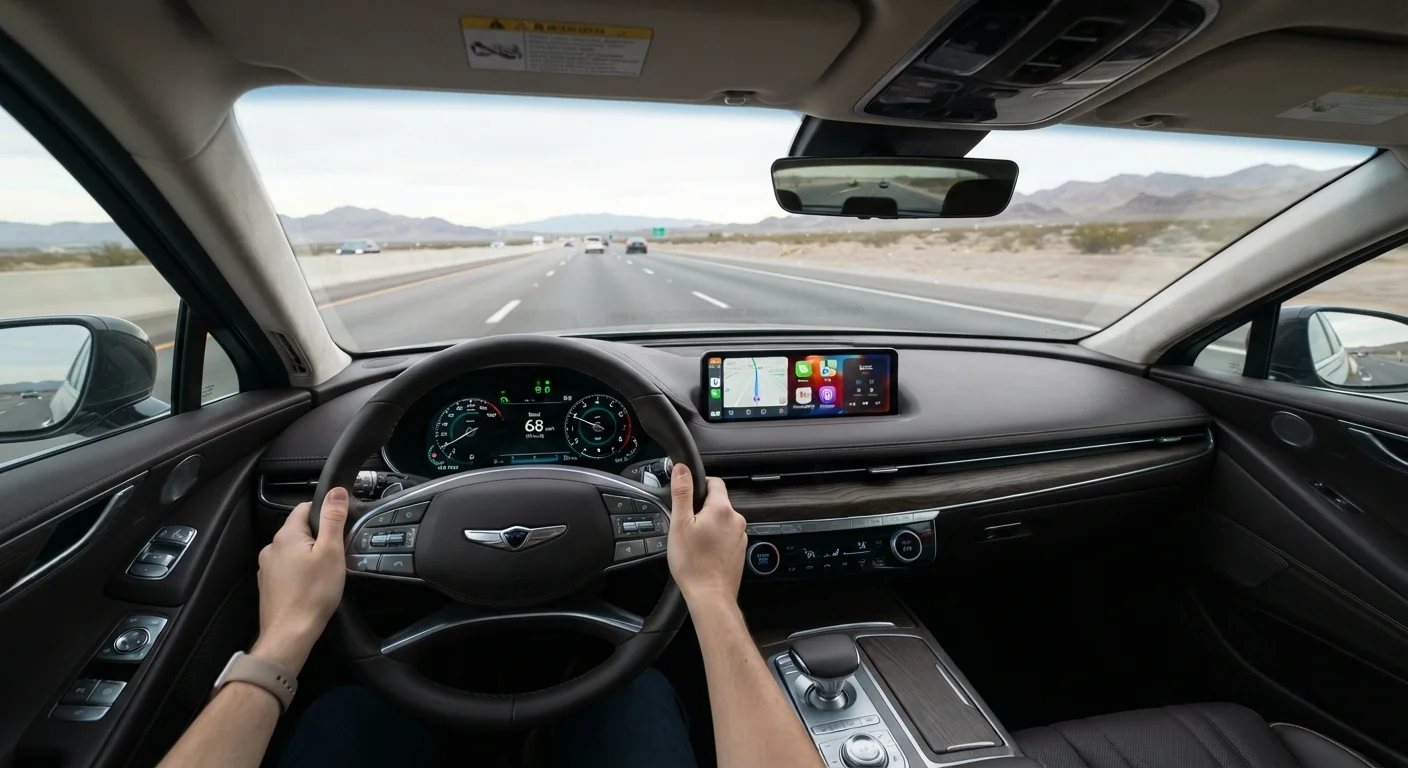
How Standard Cruise Control Works
Standard cruise control, introduced on consumer vehicles in the late 1950s, does one thing: it holds your vehicle at a driver-set speed. Once activated, the system maintains that speed by electronically managing the throttle. It does not know whether there is a vehicle 50 feet ahead of you or an open road for miles.
That distinction matters enormously in practice. If traffic slows, the driver must brake manually - the system applies no deceleration on its own. On a clear, uncrowded interstate with consistent speed limits, this is manageable. In variable traffic, it creates a hazard because the cognitive burden of monitoring closing distances falls entirely on the driver while the foot remains off the pedals.
Standard cruise control is also inappropriate on curves with significant grade changes, in rain or ice that reduces traction, or any time traffic density varies. For a fuller picture of how adverse conditions change driving demands, see our guide on driving in rain, snow, ice, and fog.
How Adaptive Cruise Control Works - and Where It Falls Short
Adaptive cruise control (ACC) adds forward-looking sensors - typically radar, lidar, cameras, or a combination - to monitor the distance and relative speed of the vehicle ahead. When traffic slows, ACC reduces your speed to maintain a driver-selected following gap. When the road clears, it accelerates back to the set speed.
This makes ACC far more useful in real-world highway conditions. It reduces the need for constant throttle and brake adjustments in flowing traffic, which research consistently associates with lower driver fatigue over long trips. Some systems also integrate with lane-keeping assistance and automatic emergency braking, making them part of a broader driver-assistance suite. Vehicle safety technology that has meaningfully reduced crash rates examines the broader data on these systems.
However, ACC has well-documented limitations. Most systems do not respond reliably to stationary objects, pedestrians, or vehicles that cut sharply into your lane at close range. They can also behave unpredictably in heavy rain, snow, or fog when sensors are obstructed. Critically, ACC is a driver-assistance tool - not automation. The driver remains responsible for vehicle control at all times.
ACC Is Not Autonomous Driving
Adaptive cruise control is classified as a Level 1 or Level 2 driver-assistance feature under SAE definitions - it supports the driver but does not replace the driver. Taking your eyes off the road or your hands fully off the wheel while ACC is active dramatically increases crash risk. No current production ACC system is approved for unsupervised operation.
Side-by-Side: Key Differences That Affect Safety
The table below summarizes how the two systems compare across criteria that matter most to everyday safety decisions.
| Standard Cruise Control | Adaptive Cruise Control | |
|---|---|---|
| Speed management | Holds fixed speed only | Adjusts speed to match traffic flow |
| Responds to vehicles ahead | No | Yes, via radar/camera sensors |
| Braking capability | None - driver must brake manually | Partial - slows to maintain gap |
| Best environment | Open, low-traffic highway | Moderate to heavy highway traffic |
| Weather suitability | Poor - no traction awareness | Poor - sensors degrade in rain/snow |
| Driver attention required | Full - no traffic response | Full - not a self-driving system |
| Availability | Standard on most vehicles since 1980s | Increasingly standard on newer vehicles |
The practical takeaway is that ACC's sensor-driven following management addresses the single biggest hazard of standard cruise - the failure to respond to slowing traffic ahead. But neither system is suited to city driving, tight merges, construction zones, or weather that reduces road grip. Highway and city driving demand different adjustments that neither system can make on your behalf.
Common Misuse Patterns - and the Risks They Carry
Driver overreliance on cruise technology is among the driving habits that quietly increase crash risk. The most common misuse patterns include:
- Using standard cruise in moderate traffic: Any car ahead braking unexpectedly becomes the driver's sole responsibility with no system support - reaction time is often insufficient.
- Treating ACC as hands-free driving: ACC does not steer, does not see pedestrians reliably, and cannot handle complex merges. Eyes-off-road incidents increase when drivers assume the car is managing more than it is.
- Engaging either system in poor weather: Wet or icy roads can hydroplane a vehicle regardless of speed settings. On slick surfaces, cruise-maintained speed removes a key driver feedback loop. See our article on hydroplaning causes and recovery for why speed management is critical in wet conditions.
- Setting following distance too short in ACC: Most ACC systems allow the driver to select gap size. Choosing the shortest setting in fast-moving traffic leaves inadequate margin if the system reacts slowly to a sudden stop.
Set a Longer Following Gap in ACC
When using adaptive cruise control, select the longest available following-distance setting rather than the default. This gives the system - and you - more time to respond to sudden stops ahead. In faster highway traffic, the difference between a short and long gap setting can be the difference between a near-miss and a collision.
Both systems should be treated as tools that reduce workload in appropriate conditions - not substitutes for active, engaged driving.