What Actually Separates the Two
The words inspiration and imitation get used almost interchangeably in style conversations, but the gap between them is meaningful. Style inspiration is an active, interpretive process - you notice something that resonates, you ask yourself why it appeals to you, and you translate that feeling into choices that suit your own body, lifestyle, and personality. Imitation, by contrast, is passive reproduction: you see a look and replicate it as closely as possible, often without considering whether it actually fits who you are.
Neither approach is inherently shameful, but they lead to very different places. Inspiration compounds over time into a coherent, personal aesthetic. Sustained imitation fragments your wardrobe and can quietly erode your sense of self. The good news? Most people slip between the two constantly - recognising the difference is itself a form of style growth. For a deeper look at building something original from the ground up, see our guide to finding your style identity from scratch.
| Criterion | Style Inspiration | Style Imitation |
|---|---|---|
| Core process | Observe, interpret, adapt | See, replicate, repeat |
| Reference sources | Multiple diverse sources | One dominant voice or figure |
| Personal filter | Strong - asks "does this suit me?" | Weak or absent |
| Long-term outcome | Evolving personal aesthetic | Fragmented, borrowed identity |
| Relationship to trends | Selective, intentional engagement | Reactive, often uncritical |
| Emotional result | Confidence and coherence | Disconnect or constant comparison |
How Imitation Creeps In (And Why It's So Easy)
Social media has made imitation almost frictionless. Algorithms serve up aspirational images in a continuous loop, and the line between admiring a look and wanting to replicate it exactly narrows quickly. Research into social comparison theory - well-established in psychology - suggests that we naturally evaluate ourselves against visible peers and aspirational figures, which makes us more susceptible to uncritical copying when we feel uncertain about our own tastes.
The result is a wardrobe that might be technically on-trend but doesn't feel like you. Clothes feel costumes rather than expressions. You might find yourself buying pieces that photograph well but that you never actually reach for. That disconnect is a signal worth paying attention to.
88%
Social media users who compare their appearance online
According to survey data cited by the American Psychological Association, the vast majority of regular social media users report comparing their appearance or style to what they see in feeds.
3-5 sources
Recommended style references for healthy inspiration
Style educators and personal stylists generally advise drawing from at least three to five distinct reference points to avoid unconsciously mirroring a single aesthetic.
Style icons and influencers are genuinely useful - but as reference points, not blueprints. Our article on using style icons as reference, not a blueprint walks through how to extract lessons without losing your own perspective.
Using Inspiration Without Losing Yourself
Healthy inspiration has a few reliable hallmarks. First, it draws from multiple sources rather than one dominant voice - diversity of reference prevents your taste from calcifying into someone else's aesthetic. Second, it passes through a personal filter: before adopting something you admire, ask whether it works with what you already love, fits your real daily life, and reflects a value or feeling you actually want to embody.
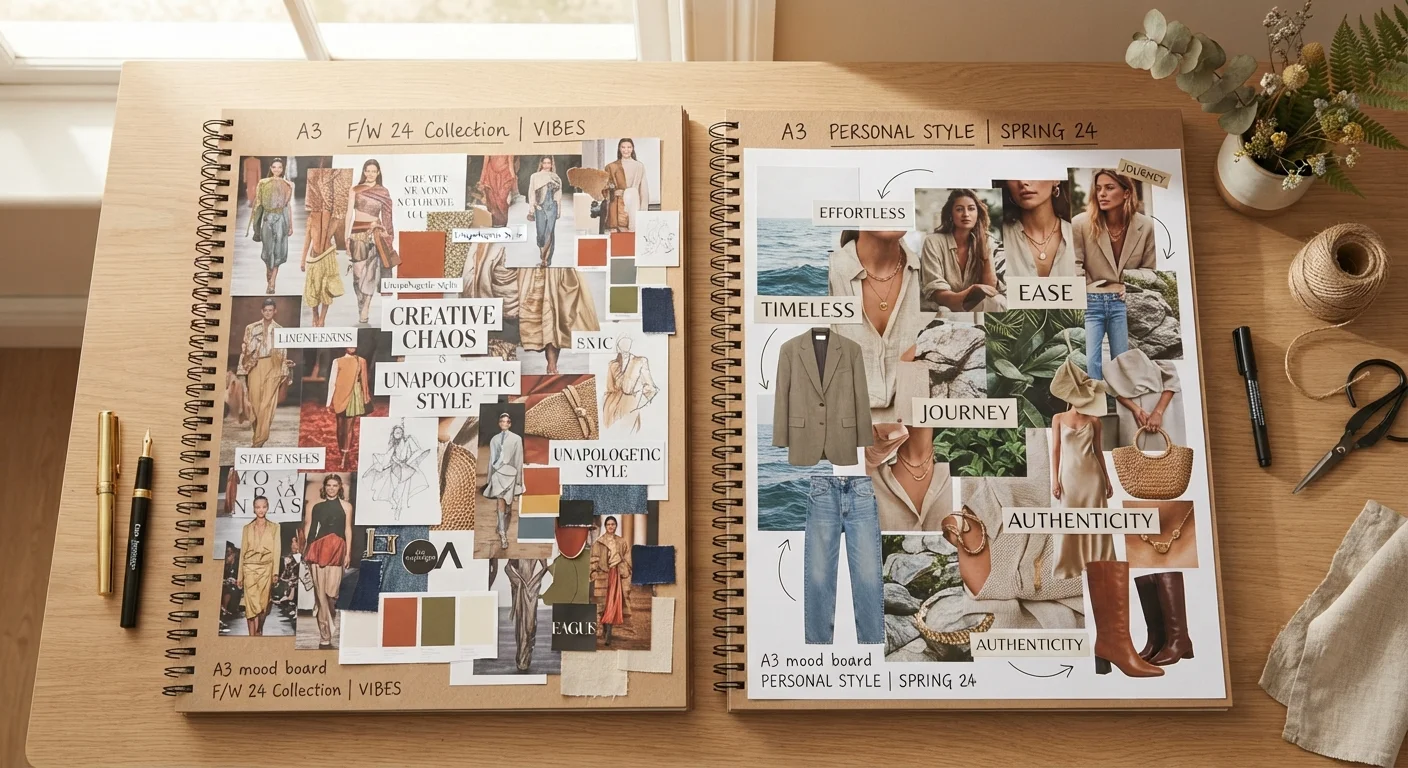
Mood boards are one of the most practical tools for this. When you collect images over time and step back to look at them together, genuine patterns emerge - recurring colours, silhouettes, textures - that reveal your actual preferences rather than borrowed ones. Our style mood board guide shows you exactly how to build one that translates into real outfits.
It also helps to understand the bigger picture: personal style and fashion trends are not the same thing, and recognising that distinction keeps you anchored to your own voice even when trends shift.
Imitation Isn't Always a Bad Starting Point
If you're early in your style journey and feel genuinely lost, consciously trying on different aesthetics - including closely referencing looks you admire - can be a valid exploratory phase. The problem arises when imitation becomes the default long-term strategy rather than a temporary experiment. Think of it as training wheels: useful briefly, but worth outgrowing as your own preferences become clearer.
Building a Signature Style That's Actually Yours
A signature style isn't a uniform - it's a recognisable sensibility that shows up consistently across different occasions and outfits. Getting there means being honest about your lifestyle (what do you actually do on most days?), your proportions (what silhouettes feel good on your body?), and your values (do you care about sustainability, craftsmanship, colour, comfort?).
Once you have that foundation, inspiration becomes genuinely useful rather than destabilising. You can look at a maximalist editorial spread and extract one lesson - a layering technique, a bold colour pairing - without feeling obligated to adopt the entire aesthetic. Our piece on minimalist vs. maximalist style philosophies is a helpful lens for working out which direction resonates with your instincts.
Finally, remember that style confidence comes from dressing for yourself, not for external validation. Dressing for confidence rather than approval is a practice - and it's one that becomes easier the more clearly you know your own aesthetic. Your style should feel like coming home, not like wearing a costume borrowed from someone else's life.