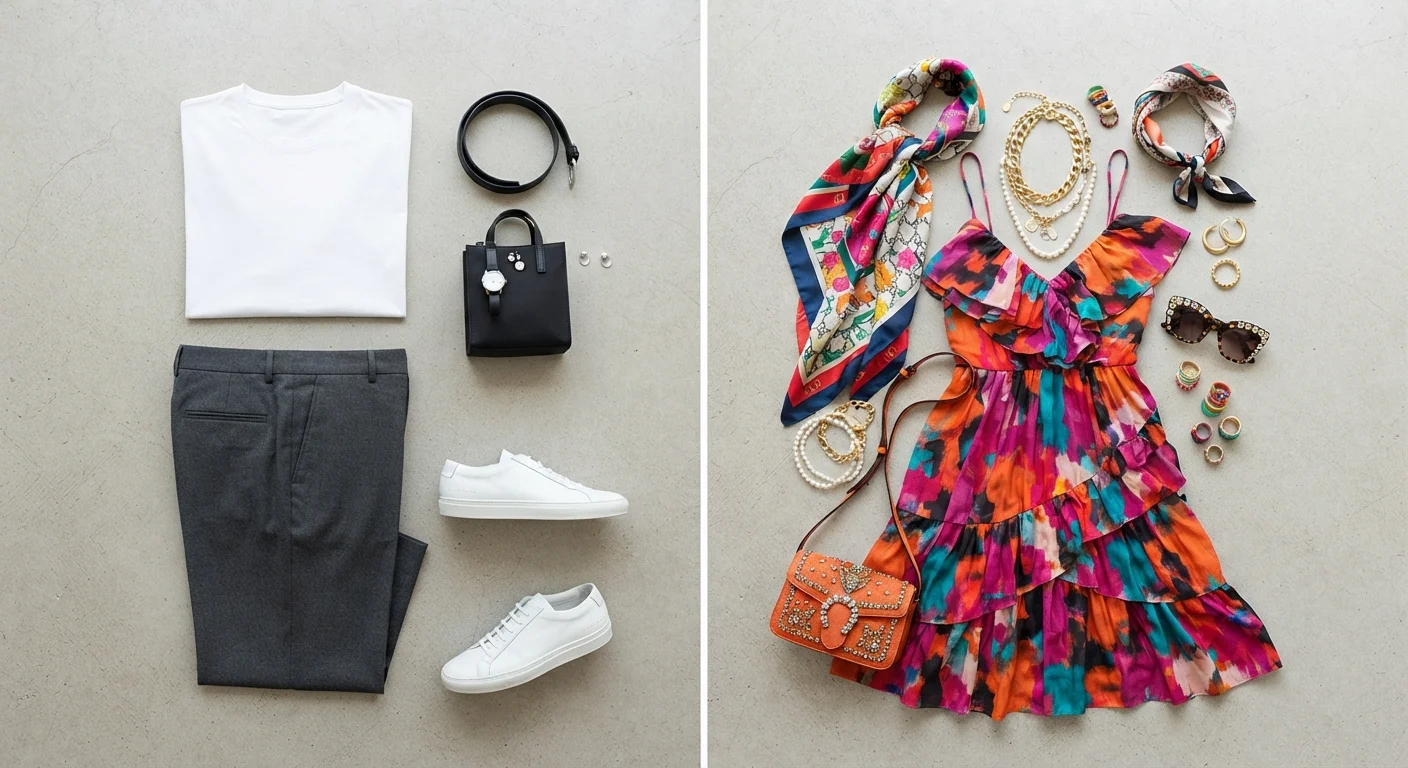
What Each Philosophy Actually Stands For
Style philosophies aren't about having the "right" wardrobe - they're about the values that guide how you dress. Minimalism, in style terms, is built on the principle of intentionality: every piece earns its place, outfits are coherent, and clutter is quietly edited out. It tends toward neutral palettes, clean silhouettes, and a capsule-style approach where items work interchangeably. The goal isn't blandness - it's clarity.
Maximalism operates from a completely different premise. More is considered more: layered textures, statement prints, bold color combinations, and expressive accessories all coexist deliberately. Where minimalism asks "do I need this?", maximalism asks "does this excite me?" Both are legitimate frameworks; they simply measure value differently.
It's worth separating style philosophy from economic status. Neither approach requires significant spending. Developing a strong personal aesthetic is about clarity and intention, not price tags - whether you're editing down to a capsule or building an eclectic, layered wardrobe.
| Criterion | Minimalist Style | Maximalist Style |
|---|---|---|
| Core principle | Edit ruthlessly; less is more | Layer boldly; more is more |
| Wardrobe size | Smaller, highly curated | Larger, eclectic mix |
| Color palette | Neutrals and tonal ranges | Bold, varied, and mixed |
| Getting-dressed effort | Low - pieces mix naturally | Higher - intentional composition |
| Visual identity | Understated, cohesive | Expressive, immediately distinctive |
| Trend sensitivity | Lower - classic pieces dominate | Can be higher - open to novelty |
| Risk of wardrobe regret | Impulsive buys disrupt the edit | Unfocused accumulation feels chaotic |
The Real Trade-Offs: What Each Costs You (and Gives You)
Minimalist dressing offers practical advantages - outfit assembly becomes faster, packing is simpler, and visual cohesion is nearly automatic when pieces are chosen with intention. The psychological benefit often cited is reduced decision fatigue: fewer choices made with more care tend to feel more satisfying. The trade-off is that minimalist wardrobes demand discipline during curation. One impulsive, ill-fitting purchase can disrupt an otherwise tight edit.
Maximalism gives you creative range and immediate visual identity. When done with a genuine internal logic - even if that logic is joyful chaos - maximalist dressing can feel deeply authentic. The challenge is that without some guiding sensibility, it can tip into a wardrobe of unrelated pieces that don't quite speak to each other. The question isn't how much you own, but whether your choices feel coherent to you.
~30%
Clothing the average person never wears
Industry estimates suggest roughly a third of most people's wardrobes goes unworn, regardless of wardrobe size or style orientation.
2-3x
Average outfit combinations from a capsule wardrobe
Style researchers note that a well-chosen 30-piece minimalist wardrobe can theoretically generate hundreds of distinct outfit pairings.
Both philosophies also interact differently with trends. Minimalism tends to sidestep fast-trend cycles more naturally, while maximalism can embrace them enthusiastically - but neither has to be trend-driven. For a deeper look at how classic, trendy, and eclectic dressing compare, it helps to see where your instincts naturally land.
Finding Your Genuine Position on the Spectrum
Most people don't live at the extremes. You might be drawn to the calm of a neutral base wardrobe while still craving one maximalist statement piece per outfit. Or you may love expressive dressing but need practical simplicity during busy seasons. Neither is a contradiction - style is allowed to be nuanced.
A useful starting point: look at what you actually reach for rather than what you think you should wear. If your go-to outfits are consistently streamlined and low-key, that's real data. If your favorite days are the ones where you pile on earrings and a printed blazer, that tells you something too. The goal is to develop a signature style that reflects your actual personality, not an aesthetic you admire from the outside.
This distinction matters. Drawing inspiration from others is healthy; building a wardrobe entirely in someone else's image often results in a closet full of clothes that don't quite feel like yours. Whether you're leaning minimalist or maximalist, the most important filter is authenticity - and that's a question only you can answer.
Style Evolves - And That's Normal
Your aesthetic instincts in your twenties may look quite different from your thirties or beyond, and that's not inconsistency - it's growth. Many people naturally move between periods of simplification and periods of more expressive dressing depending on life stage, mood, and context. The difference between timeless style and simply playing it safe is worth revisiting as your tastes mature. Give yourself permission to evolve without feeling like you need to commit permanently to a single philosophy.