Why Accessories Do More Than Finish a Look
Accessories are where personality lives. Your clothes set the structure, but the accessories are where you sign the look. A simple white shirt and dark jeans read entirely differently depending on whether they're finished with a silk scarf and gold hoops, a chunky chain and sneakers, or a structured tote and clean studs. The same base outfit; three entirely different people. That's the power of accessories used with intention.
Think of them the way a writer thinks about punctuation. A comma slows the pace. A period brings finality. An exclamation mark adds energy. Accessories operate the same way - they control emphasis, pace, and tone. Without them, even the most well-constructed outfit can feel like an unfinished sentence. With too many, it becomes a run-on.
This is why developing a thoughtful approach to accessories is one of the most effective things you can do for your personal style. For a broader framework on building a coherent wardrobe, see Dressing With Intention. And if you're exploring how accessories can stretch your wardrobe without adding new clothes, Accessories That Change an Outfit Without Changing Your Clothes is worth your time.
Build From a Signature Piece
Identify one accessory - a watch, a specific style of earring, a belt you always reach for - and let it anchor your choices. Building from a signature piece makes getting dressed faster and gives your overall style a recognizable thread. It becomes your style's exclamation point.
What You'll Need Before You Start
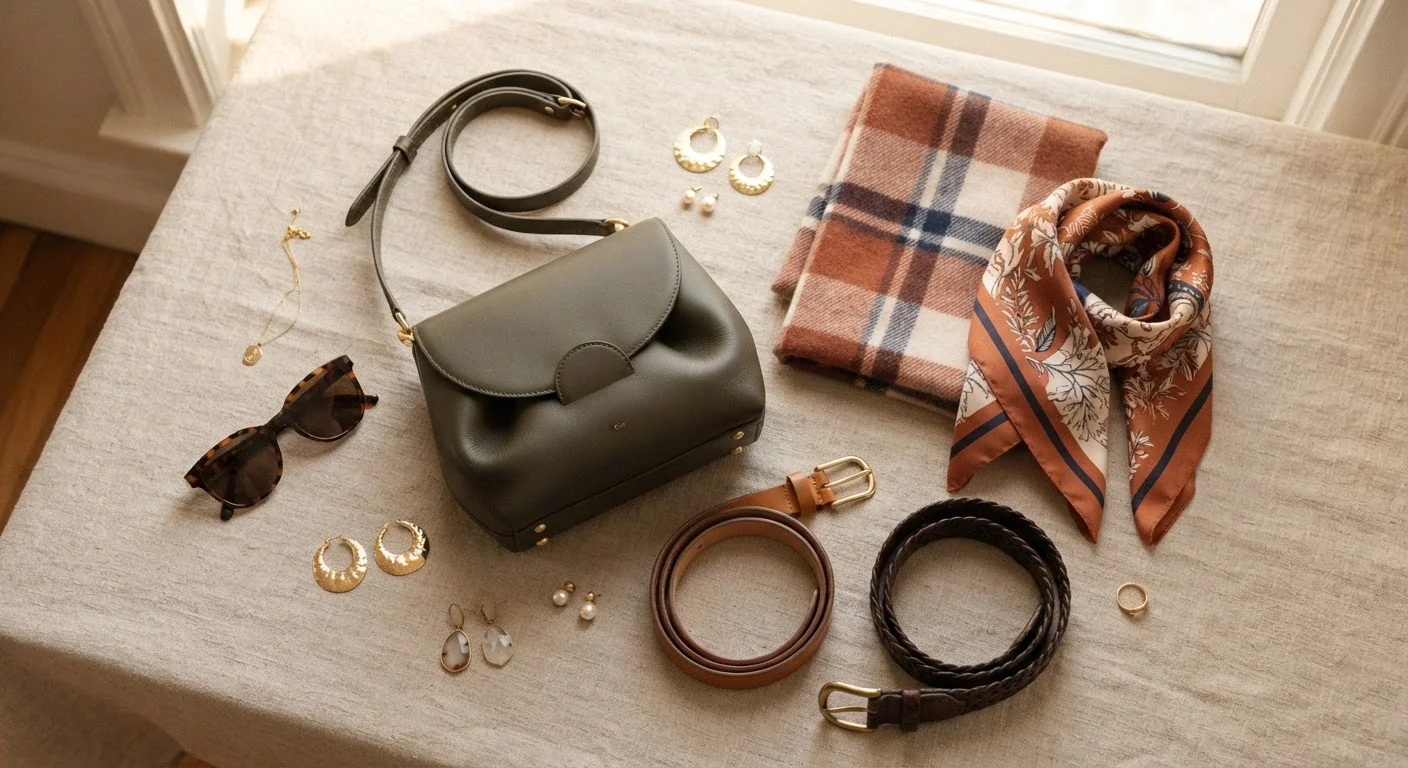
You don't need a large collection to accessorize well - you need the right starting points. Below are the tools and pieces that make this process easier and more repeatable.
A neutral-toned belt
Defines the waist, adds structure, and bridges tops and bottoms across dozens of outfit combinations.
A versatile scarf or wrap
Functions as a neck accessory, hair wrap, or bag accent, adding texture and color with minimal effort.
A set of simple stud earrings
Provides a clean, polished finishing touch that works across casual and professional settings alike.
One structured bag
Grounds a look and signals intentionality - the shape and color of a bag dramatically affects overall outfit tone.
A full-length mirror
Lets you assess proportion and balance before leaving the house, catching overcrowding or imbalance in your accessories.
What you will need
Once you have even a modest foundation, the steps below will help you make deliberate, confident choices every time you get dressed. For broader outfit-building strategies that work alongside these accessory principles, explore Outfit Formulas That Actually Work.
More Is Not Always More
Layering every accessory you own rarely reads as confident - it often reads as uncertain. Accessories compete for attention when there are too many, and that competition undercuts the whole look. Aim for one statement piece or a cohesive set of quieter ones, not both at once.
How to Accessorize With Intention
Follow these steps each time you're putting together a look - especially when something feels off or unfinished. With practice, this process becomes instinctive.
Start with the outfit's mood, not the accessories
Before reaching for a single accessory, read what your outfit is already communicating. Is it relaxed and easy? Structured and professional? Playful and colorful? Accessories should amplify that message, not contradict it. Lay out your clothing and ask: what punctuation does this need - a period, an exclamation mark, or a question mark?
Choose a single focal point
Decide where you want the eye to travel first. Statement earrings draw attention to the face. A bold belt anchors attention at the waist. An eye-catching bag creates a mid-body moment. Pick one focal point and let everything else play a supporting role. Competing focal points dilute the effect of each.
Check proportion against your silhouette
Proportion matters as much as color or style. Chunky, oversized jewelry can overwhelm a delicate or petite frame, while tiny pieces can disappear against bold patterns or voluminous shapes. Hold the accessory up against the garment before committing. The goal is balance - the accessory should feel like it belongs to the same visual weight class as the clothing.
Repeat a tone or texture for cohesion
One of the simplest tricks in accessorizing is tone repetition: echo a color, metal finish, or texture already present in your outfit. If your top has warm amber tones, a cognac leather belt or gold-toned earrings reinforces the palette without looking matchy-matchy. This technique makes a look feel considered rather than assembled.
Edit down before walking out
Once you've added your accessories, take one last look in a mirror. Then ask yourself if anything can come off. The final edit is where personal style really sharpens. Removing one element often makes the rest feel more intentional and confident. Less is frequently more - not because minimalism is the rule, but because clarity is always in style.
Avoid Mismatched Energy Levels
Pairing highly formal accessories - like a structured pearl necklace - with extremely casual clothes can feel jarring rather than intentional. Contrast can be powerful, but the gap needs to be deliberate and confident, not accidental. When in doubt, match the occasion's energy before experimenting with contrast.
Footwear is its own accessory category with its own set of principles - if you want to sharpen that part of the equation, Shoes and Outfits: The Pairing Principles That Simplify Getting Dressed breaks it down clearly. For a full end-to-end guide on developing your personal style, including how accessories fit into the larger picture, see The Complete Approach to Developing a Personal Style.