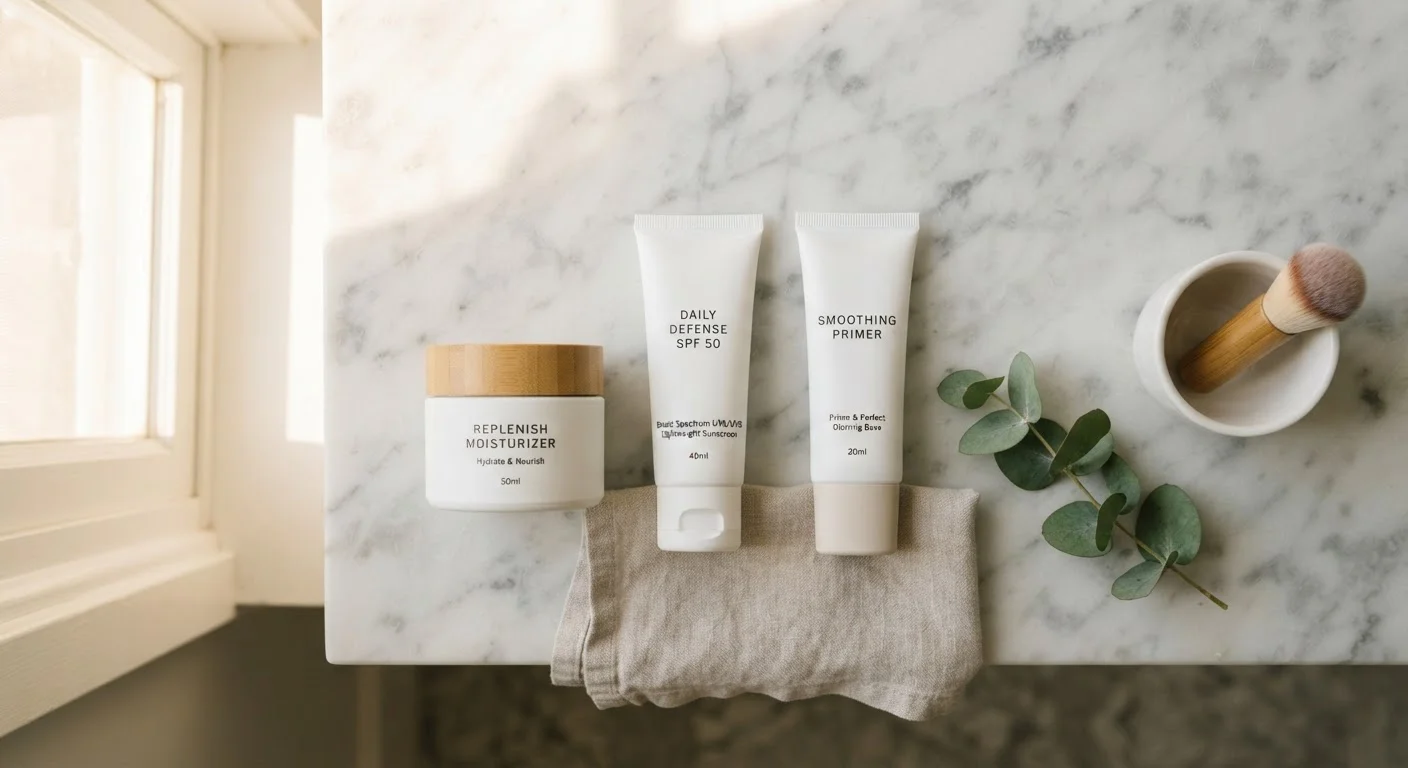
Why Skin Prep Matters More Than Foundation Formula
You can own the most flawless, skin-like foundation on the market and still watch it separate, settle into fine lines, or disappear by noon - all because what went on underneath wasn't working. Skin prep is the invisible architecture of every makeup look. It determines whether foundation melts into your skin or sits on top of it, whether your concealer clings or creases, whether the whole look holds for eight hours or eight minutes.
The good news: effective prep doesn't require a ten-step routine or expensive products. It requires understanding what each step actually does - and applying them in the right order. For a deep dive into sequencing, check out our guide to layering skincare correctly. This article focuses specifically on the prep window that bridges skincare and makeup application.
Always moisturize before foundation, even on oily skin days
Skipping moisturizer leaves skin dehydrated, which causes foundation to cling unevenly to dry patches and emphasize texture. Even lightweight gel formulas provide the surface cohesion foundation needs to apply smoothly. Well-hydrated skin also means you can use less product for full coverage.
Apply a dedicated broad-spectrum SPF after moisturizer, before primer or foundation
Foundation with SPF is applied too thinly in practice to deliver the labeled protection level. A standalone sunscreen ensures you're actually protected. Applying it as a distinct layer also means you can choose your foundation purely based on finish and coverage rather than SPF value.
Choose primer based on your specific skin concern, not as a generic step
A pore-blurring primer addresses texture but may feel heavy on dry skin. A hydrating primer adds slip and glow but won't help with oil control. Matching primer type to your actual concern means it does a real job rather than just adding an extra layer.
Allow each prep layer to absorb before applying the next
Layering products too quickly - especially SPF over moisturizer - can cause pilling, where products ball up on the skin's surface. This disrupts the smooth canvas that makes foundation look seamless. Sixty seconds of patience between layers costs nothing and solves a common frustration.
Customize your prep routine to your skin type rather than following a universal formula
Oily skin benefits from lighter textures and oil-controlling primers; dry skin needs richer moisturizers and hydrating primers; combination skin may need a split approach. Treating prep as adaptable rather than fixed produces better results than rigidly following a standard routine.
The Core Steps - and What Each One Does
Think of skin prep as a three-act sequence: cleanse (or at minimum, don't skip overnight residue), treat and hydrate, then protect and prime. Every step has a distinct job.
Moisturizer is non-negotiable regardless of skin type. Even oily skin needs hydration - skipping it often triggers excess oil production. A well-moisturized surface is pliable, which means foundation spreads evenly and blends with less effort. Dry patches and dehydrated areas act like Velcro, grabbing product unevenly and emphasizing texture.
SPF deserves its own moment before makeup hits your face. Relying entirely on SPF-infused foundations means you'd need to apply far more product than is practical to reach the labeled protection level. A dedicated broad-spectrum sunscreen applied after moisturizer handles protection properly. Allow it to set for at least a minute before moving on.
Primer is the most misunderstood step. It's not required for everyone, but when chosen to match a specific concern - extended wear, minimizing texture, controlling oil - it genuinely earns its place. Think of it as the bridge between skincare and color cosmetics. For a complete picture of daily routine structure, see our complete daily beauty routine overview.
“The canvas matters more than the paint. Every makeup artist knows that the real work happens before the first drop of foundation is applied.”
— A working makeup artist's axiom, Widely cited principle in professional makeup education
Smart Habits That Make Prep Work Better
Even the right products underperform if the habits around them are off. These quick wins make a measurable difference without adding extra products or time.
One often-overlooked factor: don't apply makeup immediately after moisturizer or SPF. Giving each layer sixty seconds to absorb means your foundation won't slide around on a still-tacky surface. This single habit eliminates a lot of the "my foundation just doesn't sit right" frustration.
If you're curious whether your routine is more complex than it needs to be, our balanced look at multi-step skincare routines is worth a read. And if budget is a concern, skincare on a simpler budget shows how a focused minimal routine covers the essentials. Once your prep is dialed in, the rest of your makeup - from foundation application to finishing with setting powder or spray - simply works better.
~30%
More even foundation coverage on hydrated skin
Dermatology research broadly supports that well-hydrated skin reduces the appearance of texture and allows for more uniform product distribution.
1-2 min
Recommended wait time between SPF and makeup
Most sunscreen formulation guidelines and dermatologist recommendations suggest allowing this window for the SPF film to set before layering cosmetics.