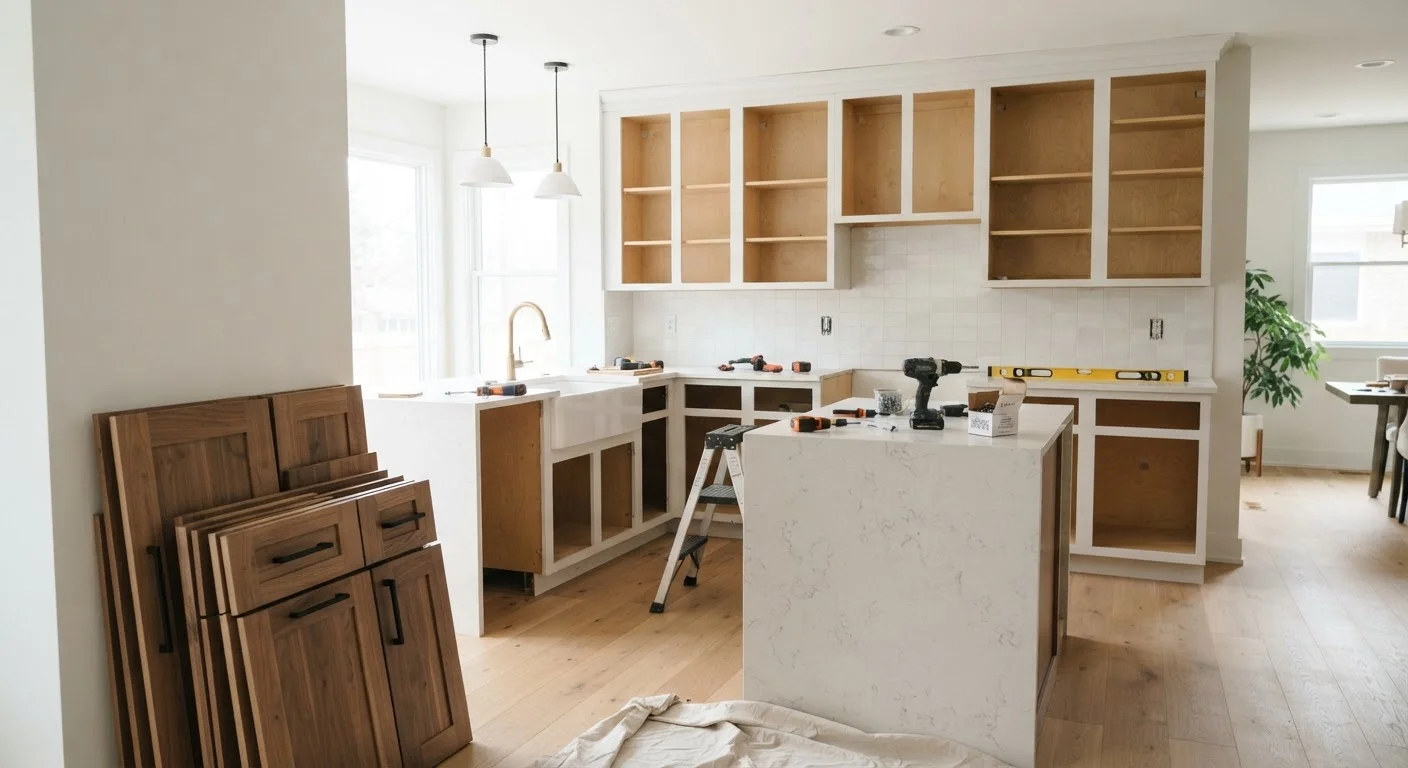
What Each Approach Actually Involves
Cabinet refacing keeps your existing cabinet boxes in place and replaces only what's visible: doors, drawer fronts, and hardware. A veneer or laminate is applied to the exterior of the boxes themselves to match the new doors. The result looks like a brand-new kitchen without removing the structural carcase from the wall.
Cabinet replacement, by contrast, involves tearing out everything - boxes, doors, and hardware - and installing entirely new cabinetry from the wall studs outward. This opens the door to changing cabinet height, depth, configuration, or the overall layout of the space. It's a significantly larger project in scope, time, and cost.
Understanding this distinction matters before you make any decisions. If you're weighing other large-scale home investments at the same time, the guidance in our article on hidden renovation costs is worth reviewing before you commit to a budget.
| Criterion | Cabinet Refacing | Cabinet Replacement |
|---|---|---|
| Typical Cost Range | $4,000-$10,000 | $8,000-$25,000+ |
| Project Timeline | 2-4 days | 1-3 weeks |
| Layout Changes Possible | No | Yes |
| Fixes Damaged Boxes | No | Yes |
| Disruption Level | Low | High |
| Interior Storage Upgrades | Limited | Full flexibility |
| Cosmetic Result | New look, same footprint | Fully customizable |
Cost, Timeline, and Disruption
On average, cabinet refacing runs between $4,000 and $10,000 for a typical kitchen, though costs vary by region, material choice, and kitchen size. Full replacement often falls in the $8,000 to $25,000 range or higher for custom cabinetry. These are general ranges - always get multiple quotes from licensed contractors for your specific project.
~50%
Typical cost savings with refacing vs. replacement
Industry estimates from the National Kitchen & Bath Association suggest refacing commonly costs 40-50% less than full cabinet replacement in similar kitchens.
2-4 days
Average refacing project duration
Most professional refacing jobs on a standard kitchen are completed within two to four working days, minimizing household disruption.
15-20 years
Expected lifespan of quality new cabinetry
Well-constructed replacement cabinets, properly installed and maintained, typically last 15 to 20 years or more before needing significant attention.
Timeline is another meaningful difference. Refacing is generally complete in two to four days, meaning your kitchen is back in service quickly. Replacement can take one to three weeks once materials arrive, and lead times for semi-custom or custom cabinets can add weeks to the pre-construction phase.
Disruption matters for families who rely on their kitchen daily. Refacing causes minimal mess - no demolition, no debris hauling, no wall repair. Replacement creates construction-level disruption: dust, noise, and a fully unusable space while work is in progress. Those planning a broader kitchen renovation should read our overview on planning a kitchen renovation to understand how cabinet work fits within a larger project sequence.
Where Refacing Falls Short
Refacing has real limitations that homeowners sometimes underestimate. The most important: it cannot fix a bad layout. If your kitchen lacks a pantry, has poorly placed upper cabinets, or suffers from a workflow that doesn't suit your household, refacing changes nothing functional.
It also can't rescue damaged boxes. If cabinet frames have been exposed to a slow leak, harbor mold behind walls, or have lost structural integrity, applying new veneer and doors over them creates a cosmetic fix while the underlying problem continues. In those cases, replacement isn't just preferable - it's necessary.
Interior storage is another area where refacing offers nothing. Box dimensions stay the same, so if you need deeper drawers, pull-out shelves, or additional cabinet runs, those upgrades require new cabinetry. Homeowners comparing this decision to other room improvement trade-offs may find our analysis of room addition versus finishing existing space a useful framing exercise for thinking about where renovation dollars deliver the most value.
Permits and Professional Licensing
Cabinet refacing generally does not require a permit because it involves no structural or mechanical changes. Full cabinet replacement may require permits if it involves moving plumbing, electrical outlets, or load-bearing elements. Requirements vary by municipality - always check with your local building department before work begins, and hire licensed contractors for any work that touches utilities or structure.
Making the Call: A Practical Decision Framework
Start by honestly assessing your existing cabinet boxes. If boxes are square, solid, and free of moisture damage, refacing is a legitimate option. If they show warping, soft spots, persistent odors, or pest damage, replacement is the more responsible path regardless of cost.
Next, evaluate whether the layout works. Stand in your kitchen and think about flow - do you move efficiently between prep, cooking, and cleanup zones? If the answer is yes and storage volume is adequate, refacing can deliver a meaningful refresh. If the layout frustrates you daily, replacement allows you to fix it.
Finally, think about your time horizon. If you're staying in the home for a decade or more, replacement may justify its higher cost through longevity and functionality. If you plan to sell within a few years, refacing often delivers a stronger return on dollars spent. Similar cost-versus-benefit thinking applies to large financial decisions in homeownership - a principle discussed in our article on when refinancing a mortgage makes sense. For bathroom cabinet decisions, the same logic applies - see our comparison of bathroom remodel versus refresh for parallel guidance.
This article is for general informational purposes only and does not constitute professional contracting, financial, or legal advice. Costs and timelines vary by region and project. Consult licensed professionals before beginning any renovation work, and verify local permit requirements with your municipality.