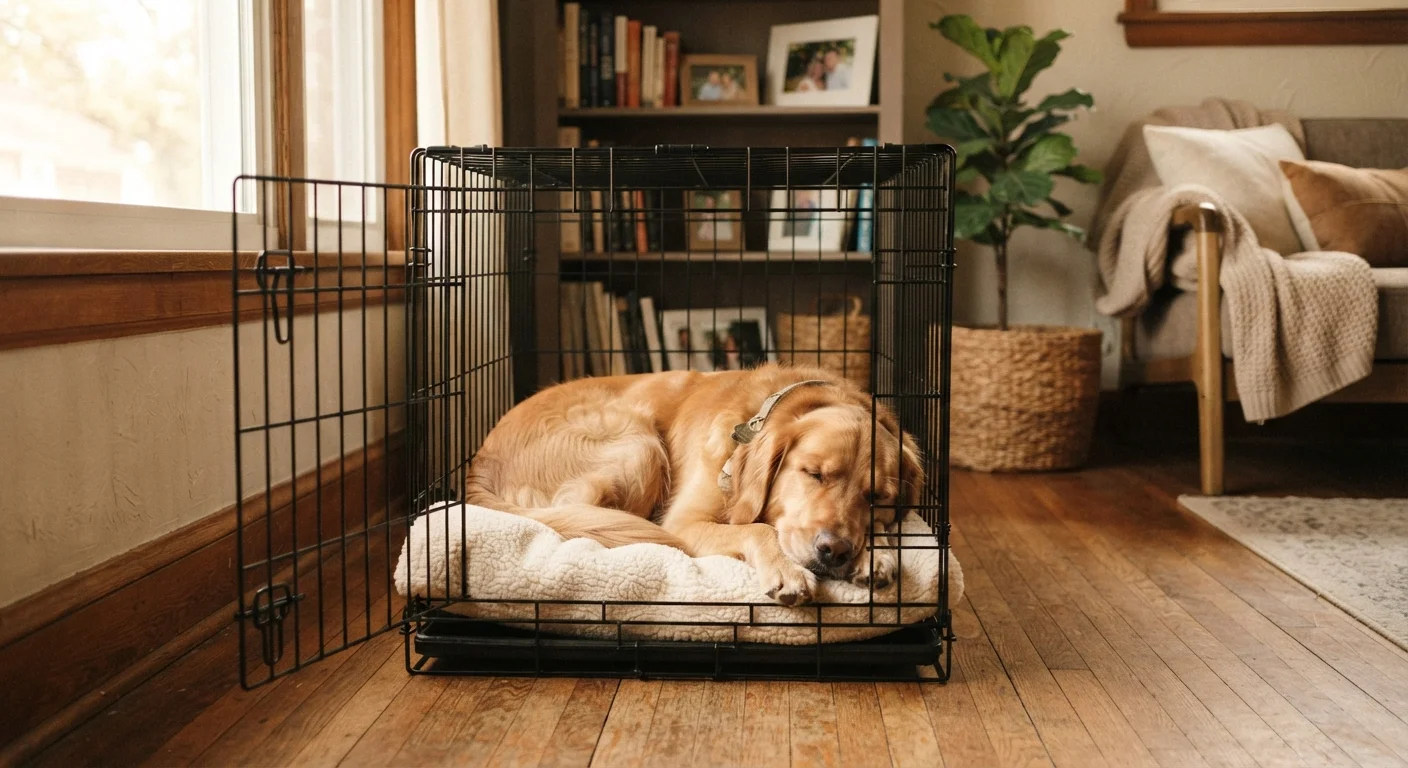
What Crate Training Is Actually For
Crate training is one of the most misunderstood tools in dog ownership. Critics picture confinement; proponents picture chaos prevented. Both reactions miss the point. At its core, crate training uses a dog's natural preference for a defined, enclosed resting space - sometimes called den instinct - to establish safety, routine, and housetraining structure.
Dogs do not generalize rules the way humans do. A puppy left loose in a home while unsupervised will investigate, chew, eliminate, and rehearse behaviors that become habits. A crate limits those rehearsals during the short windows when supervision isn't possible. It also gives dogs a predictable place of their own - somewhere they can decompress away from household activity.
For housetraining specifically, the crate works because most dogs are reluctant to soil where they sleep. That reluctance builds bladder and bowel control incrementally. The crate doesn't teach the dog where to go; it simply reduces the opportunity to go in the wrong place while the owner builds a consistent outdoor schedule. See our puppy training roadmap for how the crate fits into a broader early-training plan.
Crates Support Housetraining - They Don't Replace It
A crate reduces accidents by limiting unsupervised access to the home, but it works only when paired with a consistent outdoor elimination schedule. Take your dog outside immediately after every crating period, meal, nap, and play session. The crate manages opportunity; the schedule builds the habit.
Choosing the Right Crate
Size is the most consequential decision. The crate should be just large enough for your dog to stand, turn around, and lie down comfortably. If it is too large, a puppy may use one end as a bathroom - eliminating the housetraining benefit entirely. For growing puppies, many wire crates include a divider panel that can be moved as the dog grows, avoiding the cost of buying multiple crates.
Material and style matter for different situations:
- Wire crates offer ventilation and visibility, which many dogs prefer once acclimated. They fold flat for storage and transport.
- Plastic travel crates feel more enclosed, which suits dogs that prefer a darker, den-like environment. They are also required for airline travel.
- Soft-sided crates are lightweight and convenient for calm, already-trained dogs, but are easily damaged by dogs still in the chewing or escape-attempt phase.
Placement within your home shapes how a dog feels about the crate. Position it in a low-traffic but family-adjacent area - somewhere the dog isn't isolated but isn't overwhelmed either. Review our guide on setting up your home environment to support training goals for broader management strategies.
~40%
Dog owners who use a crate regularly
Surveys conducted by the American Pet Products Association have consistently found that a significant minority of dog owners rely on crates as a routine management tool.
4-6 hrs
Maximum recommended daytime crating for adult dogs
Veterinary and animal behavior organizations generally advise that adult dogs should not be confined in a crate for more than four to six consecutive hours during the day.
The Step-by-Step Introduction Process
The single rule governing crate introduction is this: the dog should always feel that entering the crate is its own choice, made because good things happen there. Coercion - pushing a dog in, locking the door before it's ready, or using the crate as a time-out - creates a negative association that is very difficult to undo.
Phase 1: Open-Door Exploration
Place the crate in its designated spot with the door propped open. Toss treats or a favorite toy near the entrance, then just inside. Let the dog investigate at its own pace. Do not push it in or hover. Most dogs begin stepping in voluntarily within one to three sessions.
Phase 2: Feeding Near and Inside
Begin feeding meals near the crate, then just inside the door, then with the bowl placed at the back. Meals create strong positive associations quickly. At this stage, the door stays open during eating.
Phase 3: Brief Door Closures
Once the dog eats comfortably inside, close the door gently while it finishes. Open it immediately after. Gradually extend the closed period by seconds, then minutes, while you remain in the room.
Phase 4: Duration and Distance
Begin leaving the room for short periods while the dog is crated. Increase duration slowly - never jump from five minutes to an hour. Use a stuffed food toy to give the dog something to do during these sessions. Refer to our pre-session readiness checklist to ensure your dog is in the right state before each practice period.
Place a worn T-shirt or piece of your clothing inside the crate during the early introduction phase. Your scent is genuinely calming for most dogs and can accelerate positive association without any training work required.
Olfactory familiarity has a documented settling effect on dogs; this low-effort addition supports the process without any additional training burden on the owner.
End every crating session before the dog shows any sign of distress - not after. It is far easier to build duration incrementally from a calm baseline than to repair anxiety that has already been rehearsed.
Behavioral conditioning research consistently shows that pairing a neutral stimulus (the crate) with a neutral or positive emotional state builds the strongest and most durable associations.
How Long Crate Training Takes
There is no universal timeline, but realistic benchmarks help owners stay patient. Most puppies with consistent daily practice tolerate short crating periods (30-60 minutes) within one to two weeks and can hold calmly for several hours by weeks three to four. Adult dogs with no prior crate experience often move faster because they have better impulse control and longer bladder capacity.
Key variables include the dog's temperament, prior experiences (rescue dogs with confinement trauma may need significantly more time), the consistency of the owner's approach, and how much exercise and enrichment the dog receives outside the crate. A dog that is under-exercised will be harder to settle regardless of how well the introduction goes.
Age Affects Bladder Control - Plan Accordingly
Young puppies physically cannot hold their bladder for long periods, regardless of how well crate training is going. A general guideline is one hour per month of age, up to a maximum of four to five hours. Expecting a 10-week-old puppy to hold for four hours will result in accidents that are not a training failure - they are a physiological reality. Adjust your schedule and expectations to match your puppy's developmental stage.
Understand that setbacks are normal. A dog that suddenly resists the crate after accepting it may be signaling a health issue, an overly long confinement period, or a change in household routine - not a training failure. Revisit the earlier phases briefly rather than pushing through resistance.
Common Mistakes That Stall Progress
Even well-intentioned owners fall into patterns that slow or reverse crate training progress. These are the most frequently observed:
- Moving too fast. Skipping phases because the dog seems fine is a common error. Apparent tolerance is not the same as genuine comfort.
- Using the crate as punishment. If the crate is where the dog goes when it misbehaves, it will associate confinement with correction - the opposite of the intended outcome.
- Crating for too long. General guidance holds that puppies should not be crated longer than their age in months plus one hour (up to a maximum of four to five hours during the day). Exceeding these limits causes distress and undermines housetraining. Adult dogs should not be crated more than four to six hours routinely without exercise breaks.
- Responding to protest vocalizations. Opening the crate when a dog whines teaches whining as an exit strategy. Wait for a pause in vocalization before opening, so the dog learns that quiet - not noise - earns release.
- Skipping enrichment inside. A bare crate with nothing to do turns confinement into tedium. A food puzzle or chew extends calm behavior and makes the crate worth entering.
For a broader look at how these issues connect to behavioral vocabulary, the training glossary explains concepts like extinction bursts - the temporary increase in unwanted behavior when a previously reinforced behavior stops being rewarded.
Never Use Confinement to Address Separation Anxiety
Dogs with separation anxiety experience genuine fear when left alone - confining them in a crate can escalate that distress into a panic response, causing injury and worsening the underlying condition. If your dog shows destructive behavior, excessive vocalization, or elimination specifically when left alone, consult a veterinarian or certified behaviorist before introducing any confinement method.
When the Crate Is Not the Right Tool
Crate training is a widely supported method, but it is not appropriate for every dog or every situation. Dogs with severe separation anxiety may experience genuine panic in confinement - a crate can amplify rather than soothe that distress. These dogs need a structured behavior modification plan, ideally developed with guidance from a veterinary behaviorist or certified applied animal behaviorist, before confinement is introduced.
Dogs that have been confined punitively or for extreme durations in the past may carry aversion that requires substantial desensitization work. Similarly, a crate is not a solution for a dog that is eliminating indoors due to a medical condition - ruling out health causes through a veterinary visit should always come first.
When the crate isn't the right fit, alternatives like exercise pens, baby-gated rooms, or a combination of management strategies can serve similar functions. Our overview of training tools for dogs covers a range of management options and their appropriate use cases.
Ultimately, the goal of crate training is not permanent confinement - it is a temporary scaffold that supports learning. Most dogs, once reliably housetrained and past the destructive-chewing phase, can be given progressively more freedom as trust is established.
This article is for general informational and educational purposes only and does not constitute veterinary or professional behavioral advice. Consult a licensed veterinarian or certified animal behaviorist for guidance specific to your dog's health or behavior.