Why Training Tools Matter - and What They Can't Do
Training tools are physical aids that influence how a dog moves, where their attention goes, and how much freedom they have during a session or walk. Used well, they make learning clearer and safer. Used poorly - or without accompanying skill-building - they become a crutch that doesn't produce lasting change.
A tool manages behavior in the present moment. Teaching the dog what to do instead is the trainer's job. Before choosing a tool, it helps to understand what each one actually does mechanically, and how that aligns with your dog's size, temperament, and training goals. For an overview of core training concepts, the training glossary explains foundational behavioral science vocabulary every owner should know.
Flat Collars: The Default Starting Point
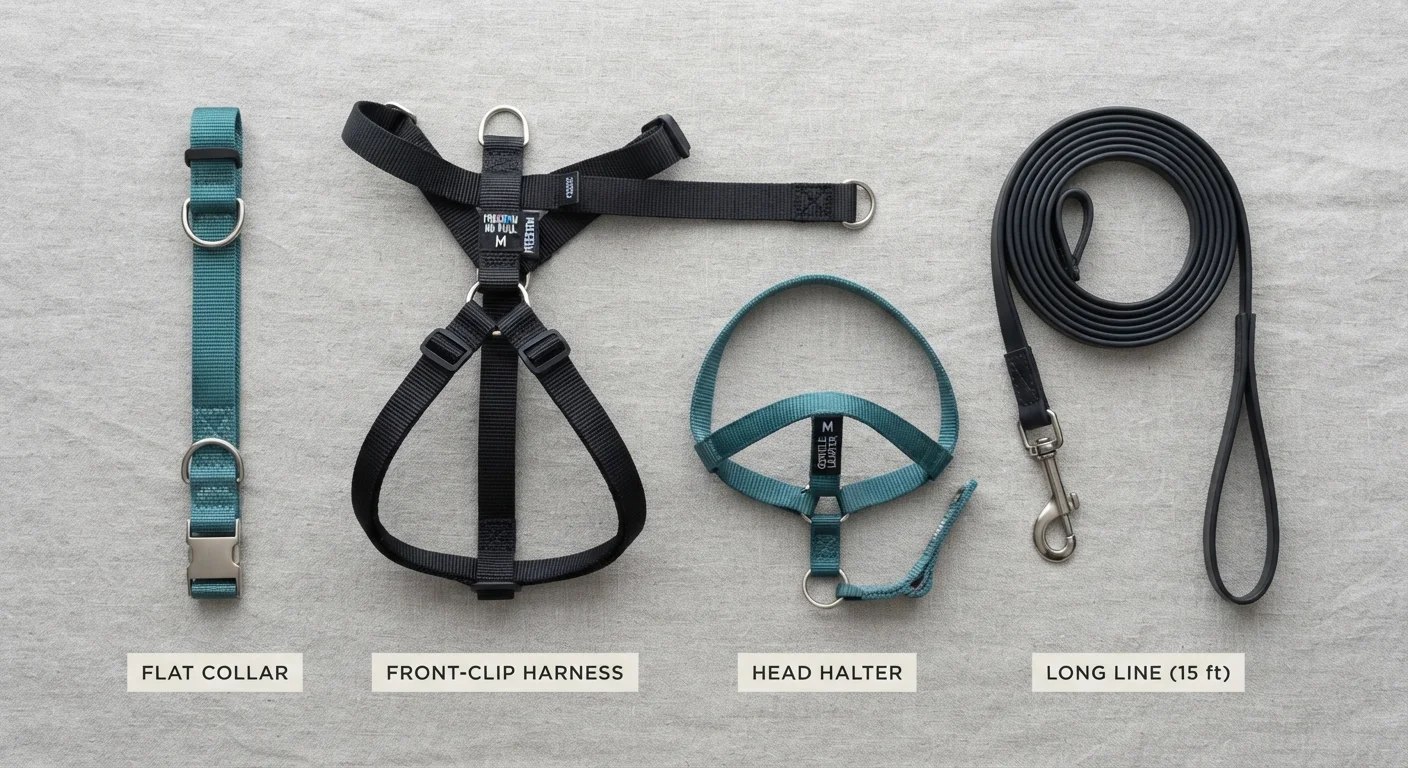
A flat collar - a simple buckle or snap collar worn around the neck - is the most common piece of dog equipment in use. It's the appropriate attachment point for ID tags and works well for leash walking in dogs that already have reasonable leash manners.
Mechanically, pressure from leash tension is applied directly to the trachea and cervical spine when a dog pulls. For this reason, flat collars are generally not recommended as a primary tool for dogs that pull heavily, lunge, or have any history of tracheal or neck issues. They remain practical for everyday wear and for dogs already comfortable walking on a loose leash.
Always Check Collar Fit First
A properly fitted flat collar should allow two fingers to slide comfortably beneath it - snug enough that it won't slip over the dog's head, but not tight enough to restrict breathing or cause skin irritation. Check fit regularly, especially in growing puppies whose neck size changes quickly. If you can't pass the two-finger test in both directions, adjust or resize before use.
Harnesses: Redistributing Pressure Across the Body
Harnesses distribute leash pressure across the chest and shoulders rather than concentrating it on the neck. Two main styles serve different purposes:
- Back-clip harnesses attach the leash at the dog's back. They're comfortable and easy to put on, but they can inadvertently reinforce pulling because the dog can lean into them without redirection. They're well-suited for dogs that already walk politely or for breeds with brachycephalic (flat-faced) or tracheal concerns.
- Front-clip harnesses attach the leash at the chest. When the dog pulls forward, the leash naturally steers them sideways, interrupting the pulling motion without a physical correction. Research in applied animal behavior supports front-clip designs as an effective, low-aversive method for reducing pulling. They pair well with reinforcement-based loose-leash training.
Fit is critical with harnesses. A harness that shifts or digs into the axilla (armpit area) can restrict natural shoulder movement and cause discomfort over time. Always check manufacturer sizing guides and verify the fit allows full range of motion.
| Flat Collar | Back-Clip Harness | Front-Clip Harness | Head Halter | Long Line | |
|---|---|---|---|---|---|
| Primary use | ID tags, polite walkers | Comfortable everyday wear | Reducing pulling | Redirecting strong pullers | Distance training, recall |
| Where pressure is applied | Neck / trachea | Chest and shoulders | Chest (redirects laterally) | Muzzle and head | Harness attachment point |
| Effect on pulling | None - may worsen | Minimal | Redirects and interrupts | Steers head, stops pull | Not applicable |
| Introduction difficulty | Low | Low | Low to moderate | High - requires desensitization | Low |
| Safety considerations | Risk with heavy pullers | Fit must allow shoulder movement | Fit must avoid armpit | No corrections; neck injury risk | Attach to harness, not collar |
| Best suited for | Dogs with good leash manners | Sensitive breeds, casual use | Most dogs that pull | Large, strong dogs | Off-leash skill building |
Head Halters: Steering From the Head
A head halter resembles a horse halter - it fits over the dog's muzzle and behind the ears, with the leash attaching beneath the chin. The principle is straightforward: where the head goes, the body follows. Redirecting the dog's nose redirects their entire direction of travel.
Head halters are particularly useful for large, strong dogs whose pulling exceeds what a handler can physically manage with other tools. They allow gentle steering without strength-based corrections. However, they require a careful introduction period. Most dogs initially paw at the halter or resist wearing it; rushing this process causes stress and reduces acceptance. Gradual desensitization - pairing the halter with high-value food over multiple sessions - is essential.
One important safety note: leash corrections should never be used with a head halter. A sudden hard jerk on a head halter can cause cervical (neck) injury. These tools are designed for gentle guidance, not correction-based handling.
Long Lines: Building Skills at a Distance
A long line is simply an extended leash - typically 15 to 30 feet in length - that allows a dog to move freely while remaining safely tethered. It is not a management tool for daily walks; it's a training tool for building skills that will eventually transfer to off-leash situations.
Long lines are most commonly used for recall (the "come" command) and for practicing core obedience commands at real-world distances. They give dogs enough freedom to make choices - which is necessary for the dog to practice responding to cues - while preventing dangerous scenarios like running into traffic.
Long lines should generally attach to a back-clip harness rather than a collar, since they can generate significant leash tension if a dog runs to the end. Lightweight biothane or nylon materials work well; avoid retractable leashes, which operate on constant tension and teach dogs to pull.
For households working multiple dogs, managing multi-dog training sessions requires additional planning around tool use and session separation.
Choosing the Right Tool for Your Dog
Selecting a training tool starts with an honest assessment of your dog's current behavior and your training goals. A few practical considerations:
- Pulling on leash: Front-clip harness or head halter, paired with consistent reinforcement for loose-leash walking.
- Recall and distance work: Long line attached to a back-clip harness.
- Polite walkers, ID tags, basic control: Flat collar is appropriate.
- Breeds with neck or respiratory sensitivity: Any harness style over a collar.
It's also worth reviewing common misconceptions that lead owners to reach for the wrong tool or apply tools incorrectly. The article on training myths that make behavior worse addresses several of these directly.
Whatever tool you select, reading your dog's response matters. Tension, avoidance, or persistent distress during tool use signals a need for slower introduction or a different approach. The signals dogs show during training can help you recognize when a session is working and when to adjust.
This article is for general educational purposes. For dogs with significant behavioral concerns, physical conditions, or history of reactivity, consult a certified professional trainer or veterinary behaviorist before selecting a training tool.