What a Bridging Signal Actually Does
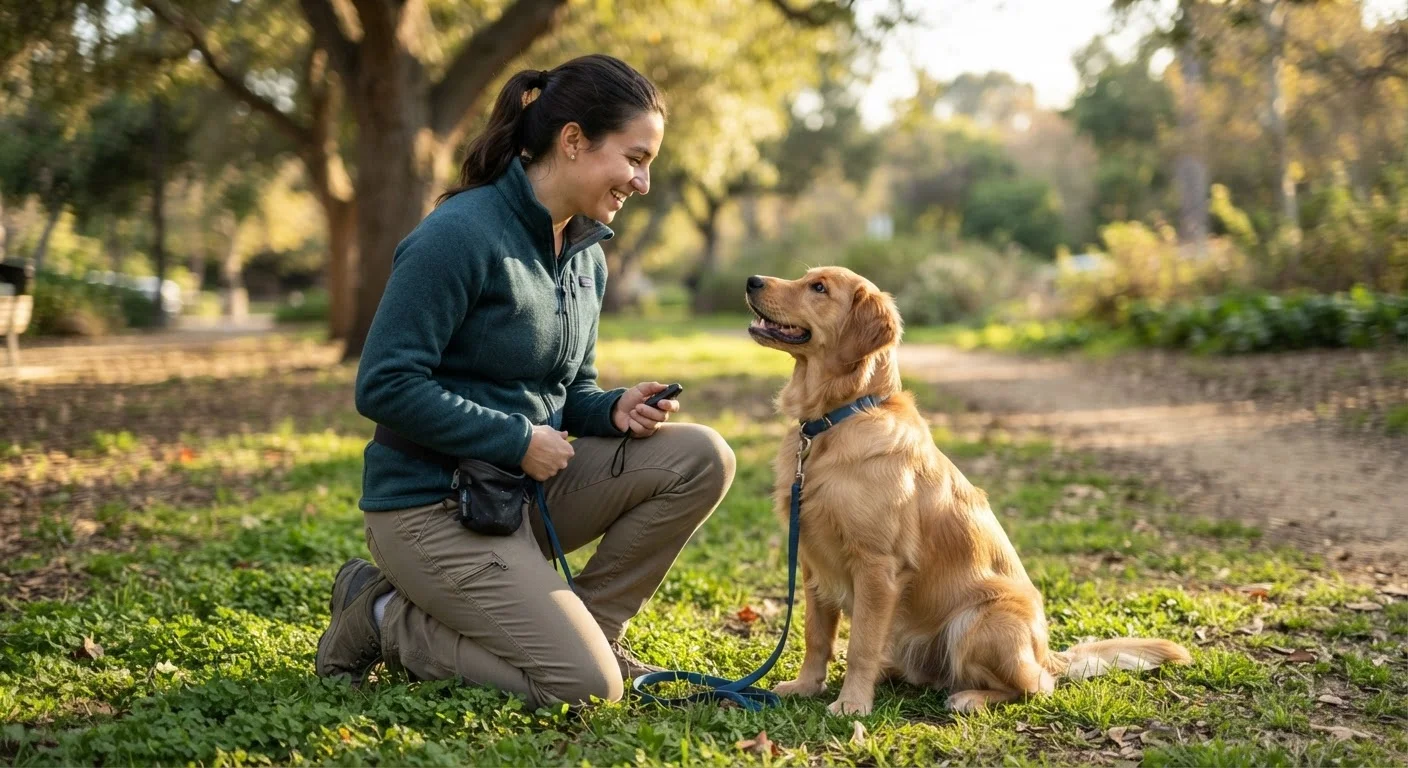
A bridging signal - also called a marker - is a precise, consistent cue that tells your dog: that exact thing you just did is what earns the reward. It bridges the gap between the behavior and the delivery of the treat, which often arrives a second or two later. Without a marker, your dog has to guess which part of their recent behavior produced the food.
Both verbal markers and clickers serve this same fundamental purpose. The difference lies in how each signal is produced, how clearly it registers with the dog, and how practical each is for everyday use. Understanding how a click communicates to your dog can help clarify why the choice of signal matters at all.
Both Signals Require the Same Foundation
Neither a clicker nor a verbal marker has any inherent meaning to a dog - each must be conditioned through repeated pairing with a reward. The signal becomes meaningful only after the dog has learned to associate that specific sound with something reliably good. Think of it less as a magic tool and more as a communication agreement you build with your dog over time.
How the Two Signals Compare
The core distinction between a clicker and a verbal marker comes down to consistency and emotional neutrality. A clicker always produces the same mechanical sound - it doesn't get louder when you're frustrated or quieter when you're tired. Your voice, by contrast, carries emotional tone, volume variation, and pronunciation differences from session to session. Dogs are highly attuned to these subtle shifts.
That said, verbal markers can be conditioned to the same degree of effectiveness as a click. The word itself carries no inherent meaning to a dog - it must be paired repeatedly with a reward until it becomes a reliable predictor of good things. A short, crisp word like "yes" or "mark" works best because it is easy to say consistently and sounds distinct from everyday conversation.
| Criterion | Verbal Marker | Clicker |
|---|---|---|
| Consistency of sound | Varies with tone and mood | Same mechanical sound every time |
| Emotional neutrality | Carries vocal emotion | Fully neutral, no emotional variation |
| Equipment required | None | Handheld clicker device |
| Ease in noisy environments | Can be harder to distinguish | Distinct sound cuts through noise |
| Suitability for noise-sensitive dogs | Usually well-tolerated | May startle some sensitive dogs |
| Hand demand | Hands-free | Requires one hand |
| Best phase of training | Maintenance and real-world use | Initial shaping and precision work |
For a broader look at how markers fit alongside other training tools, see this overview of training tools for dogs.
When Each Signal Has the Edge
The clicker's advantage is its acoustic distinctiveness. In a noisy environment, a mechanical click cuts through ambient sound in a way that a voice often cannot. This clarity is particularly useful during the early stages of shaping a behavior - a technique where you reward incremental steps toward a final goal. Precision at those early stages builds cleaner, more reliable behavior.
The verbal marker's advantage is availability. You cannot forget your voice at home. For owners working on loose-leash walking, door manners, or spontaneous socialization moments, a verbal marker means you're never caught without your training tool. It also frees up both hands, which matters when managing a leash and treats simultaneously.
Many professional trainers suggest learning on a clicker first to sharpen your timing, then building a verbal marker in parallel once your mechanics are solid. This gives you a precise tool for structured sessions and a practical one for daily life. As you build training fluency, you may also want to revisit how to fade food lures so your dog's behavior becomes reliable beyond the treat.
~0.5 sec
Optimal marker-to-behavior timing window
Animal learning research consistently shows that the most effective markers are delivered within half a second of the target behavior to maximize associative learning.
10-15 reps
Pairings needed to condition a new marker
Most applied animal behavior resources recommend conditioning a new bridging signal with 10 to 15 unprompted treat pairings before using it actively in training sessions.
Conditioning Your Chosen Signal - and Sticking With It
Whichever signal you choose, conditioning it follows the same process: pair the marker with a small, high-value treat approximately 10-15 times in a calm setting before expecting it to function in training. The dog isn't doing anything - you're simply clicking or saying your word and delivering a treat immediately after. This teaches the marker to reliably predict reward.
Consistency is non-negotiable. Switching marker words mid-training, or using your marker word casually in conversation, dilutes its value. Similarly, clicking accidentally or without following up with a treat weakens the signal. A good practice is to always have treats available when your marker is live, or to use a different word for praise and save your marker strictly for training.
Watch your dog's body language during sessions - engagement, ear position, and tail carriage tell you a lot about whether your timing is landing. The guide on reading your dog's body language during training can help you interpret what you're seeing between repetitions.