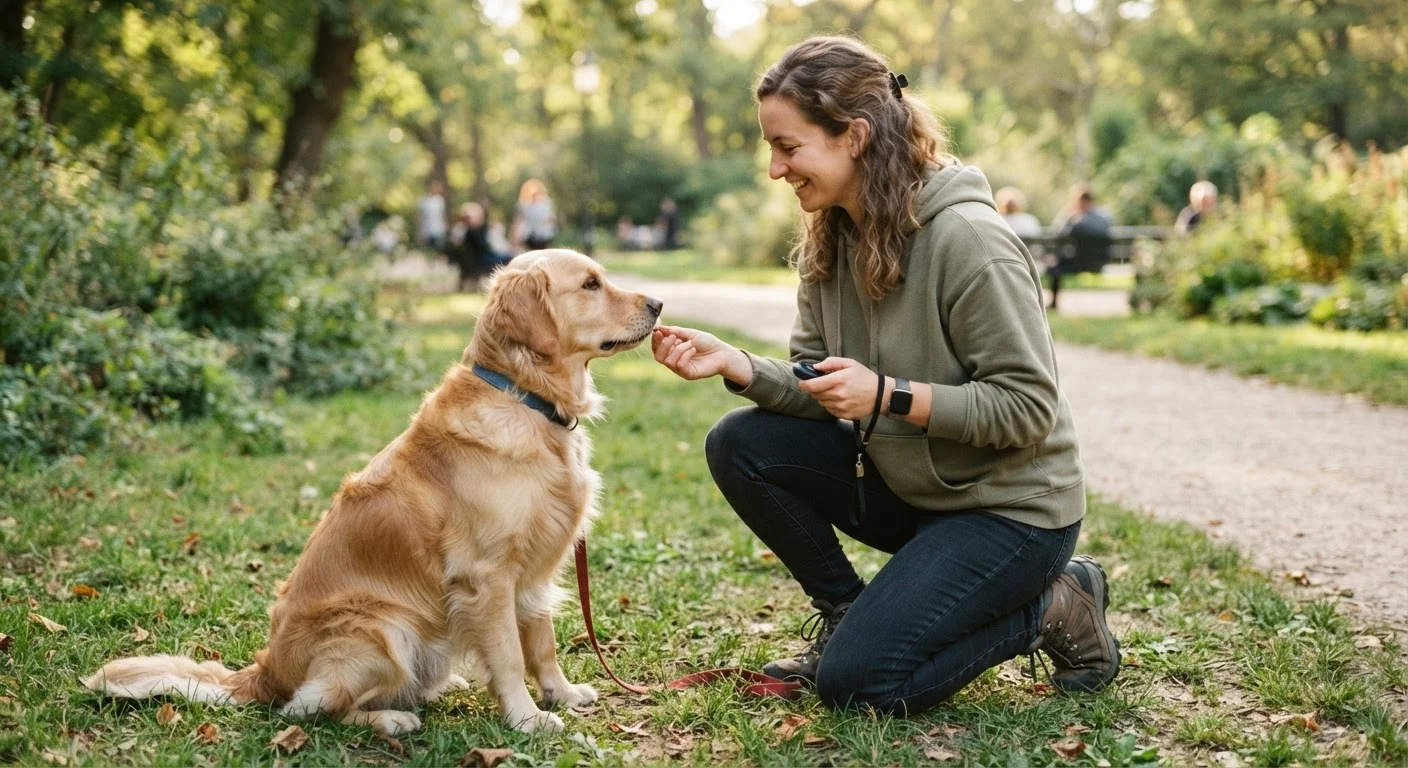
What the Click Actually Communicates
The click does one specific job: it tells the animal that action, right there, is what earned the reward. It is not a command, not a call for attention, and not a remote control. It is a marker - a precise signal that bridges the gap between the moment a behavior occurs and the moment the treat arrives.
This gap matters more than most owners realize. A dog's ability to associate a consequence with a specific action fades rapidly - within one to two seconds. Without a marker, by the time you reach into your treat pouch, your dog may have shifted weight, looked away, or stood up, and the reward lands on whatever happened last rather than what you intended to reinforce. The click collapses that window to zero.
To understand why this works, it helps to know a little about how dogs learn. The click becomes a conditioned reinforcer - a neutral sound that gains positive meaning through consistent pairing with food. Once charged, the brain registers the click itself as a mini-reward, which is why timing it precisely produces such clean learning. For a deeper look at the underlying principles, see how dogs actually learn.
Keep Your Treats Small and Ready
Treat size should be no bigger than a pea so your dog can eat it quickly and stay focused. Pre-portion treats into a pocket or treat pouch before starting a session so there's no fumbling between the click and the reward. Delay erodes the association the click is designed to build.
How to Get Started: Charging the Clicker
Before you can use a clicker to mark behaviors, the dog needs to learn what the sound means. This introductory step is called charging the clicker (or loading the marker), and it takes only a few minutes.
- Sit quietly with your dog and a small pile of soft, pea-sized treats.
- Click once - then immediately deliver a treat. Repeat this 10 to 15 times without asking for any behavior.
- Watch for a behavioral shift: ears pricking forward, the dog orienting toward you, or an expectant pause after the click. That response signals the association is forming.
- Test it by waiting until your dog is mildly distracted, then click. If the dog turns toward you expectantly, the clicker is charged.
Most dogs make this association within a single short session. After that, you're ready to use the clicker to mark real behaviors.
The Clicker Doesn't Need to Be Loud
Standard clickers can be too sharp for noise-sensitive dogs. If your dog startles at the sound, try muffling the clicker with your thumb or a layer of tape, or switch to a softer-sounding button clicker. A verbal marker like 'yes' is another excellent option for sound-sensitive animals.
Applying the Clicker to Teach New Behaviors
With a charged clicker, teaching a new behavior follows a reliable sequence: prompt or wait for the behavior → click the instant it happens → deliver the treat. This three-part loop, repeated across short sessions, builds the behavior into the dog's repertoire with minimal confusion.
For example, to teach a sit: hold a treat above the dog's nose and slowly move it backward toward the tail. As the dog's hindquarters lower, click the moment the sit completes - not after the dog has been sitting for two seconds, and not when you hand over the treat. The click marks the precise moment of completion. Repeat five to eight times, then take a short break.
As the behavior becomes reliable, you introduce a verbal cue by saying the word just before the dog begins the action. Eventually the cue predicts the behavior rather than following it. For a full breakdown of the core commands this approach applies to, see dog obedience training fundamentals.
Clicker training contrasts meaningfully with aversive-based methods. For context on how different training tools work and what the research says, the articles on training tools for dogs and electronic collar training provide helpful comparison.
~1-2 sec
Window to link behavior to consequence
Animal learning research consistently shows that the association between a behavior and its consequence weakens sharply after one to two seconds, underscoring why a marker signal is so valuable.
100%
Clicks that must be followed by a treat
Every click - including accidental ones - must be followed by a reward to preserve the reliability of the conditioned marker; inconsistency degrades the signal's meaning.
Reading Your Dog's Response During Sessions
Effective clicker training isn't only about mechanical precision - it also requires reading whether your dog is engaged, frustrated, or overwhelmed. A dog that is learning well typically shows loose body language, approaches willingly, and offers behaviors actively. A dog that is struggling may yawn repeatedly, look away, sniff the ground, or shut down entirely.
These signals are meaningful communication. Pushing through them tends to slow learning rather than speed it up. When you notice them, end the session on a successful repetition of something the dog already knows, then give it a rest. Reading your dog's body language during training can help you distinguish normal focus from early stress, which makes your sessions more productive and more humane.
Keep sessions to two to five minutes for puppies and five to ten minutes for adult dogs. Frequent short sessions outperform long, infrequent ones because the brain consolidates learning between repetitions rather than during them.
This article is for general educational purposes. For personalized guidance on training a dog with behavioral challenges, consult a certified professional trainer or veterinary behaviorist.