Why Core Commands Matter
Obedience commands are not about control for its own sake - they are practical tools that keep dogs safe, prevent conflicts, and strengthen the bond between dog and owner. Each foundational command addresses a specific real-world scenario where a dog's behavior can mean the difference between safety and harm.
Understanding what each command is designed to accomplish - and why it works - helps owners train with intention rather than rote repetition. For a deeper look at the learning principles that make these commands effective, see how dogs actually learn.
| Number of core commands | 5 foundational cues |
| Primary training method | Positive reinforcement (American Veterinary Society of Animal Behavior) |
| Recommended session length | 5-10 minutes |
| Most critical safety command | Recall ("Come") |
| Stay: training order | Duration → Distance → Distraction |
| "Leave it" primary function | Prevents contact with hazards |
The Five Foundational Commands
Sit
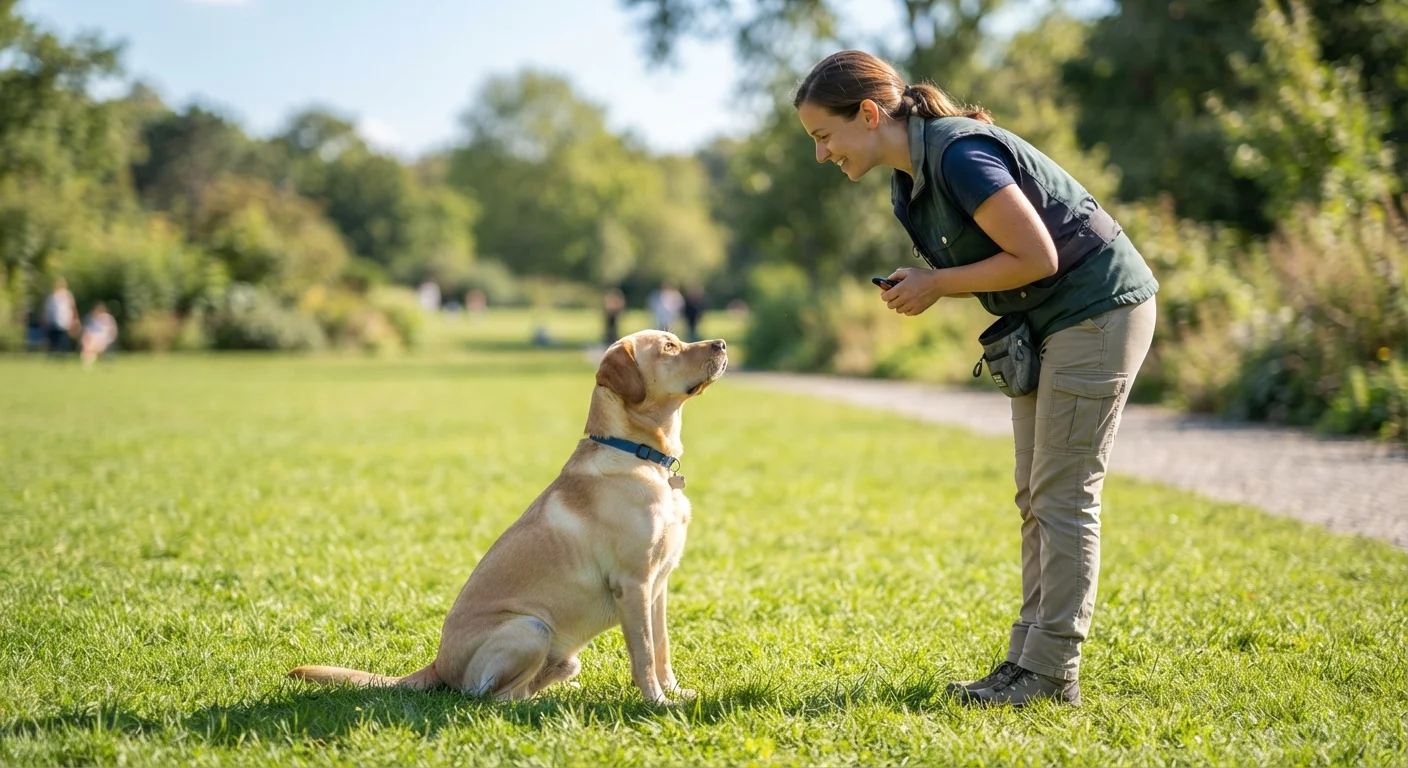
What it accomplishes: "Sit" is the gateway command - the first most dogs learn and the one that makes everything else easier. It interrupts forward motion, redirects excited energy, and creates a calm default posture. Practically, it's used at doorways, before meals, at crosswalks, and whenever a dog needs to settle before receiving attention or a leash clip.
Down
What it accomplishes: "Down" (lying flat on the belly) is a more physically committed position than sit, which makes it a stronger calming tool for high-arousal situations. A dog in a down is harder to spring into reactive behavior. It is especially useful during long waits - at a vet office, a café patio, or while guests are seated at a dinner table.
Stay
What it accomplishes: Stay teaches a dog to hold a position until released, regardless of distractions. Its primary safety role: preventing a dog from bolting through an open door, rushing into traffic, or approaching a stranger or animal before the owner has assessed the situation. Stay is built incrementally - duration, then distance, then distraction - in that order.
Come (Recall)
What it accomplishes: A reliable recall is widely considered the most important safety command a dog can have. It brings the dog back to the owner immediately, even when something interesting competes for attention. A well-trained recall can prevent a dog from running into the street, approaching wildlife, or getting into a fight. Because this command is so critical and nuanced to build correctly, it merits its own dedicated training focus - see teaching a reliable recall for a full breakdown.
Leave It
What it accomplishes: "Leave it" teaches a dog to disengage from something - food on the ground, a discarded object, a small animal, or another dog - on cue. This is a direct poison-prevention and injury-prevention command. A dog that responds to "leave it" reliably can be redirected away from toxic substances, sharp debris, or aggressive encounters before any contact is made.
Positive reinforcement
Adding something desirable (a treat, praise, or play) immediately after a behavior to increase the likelihood of that behavior recurring. It is the foundation of most humane, evidence-based training approaches.
Recall
The trained behavior of a dog returning to its owner on a specific cue, most commonly the word "Come." A reliable recall is considered one of the most important safety behaviors for any dog.
Generalization
The process by which a dog learns to perform a command reliably across different environments, people, and levels of distraction - not just in the setting where it was first learned.
Release cue
A specific word or signal (often "okay" or "free") that tells the dog its stay or held position is over and it may move freely. Without a release cue, "stay" has no defined endpoint.
Cue
A specific verbal word, hand signal, or other prompt that signals the dog to perform a particular behavior. Consistent cues are essential for clear communication during training.
Principles That Apply Across All Commands
Regardless of which command you're teaching, a few core principles consistently produce the best results:
- Positive reinforcement: Rewarding the behavior you want - with treats, praise, or play - is the most evidence-supported training method for companion dogs. It builds engagement rather than compliance under pressure.
- Short sessions: Dogs learn better in multiple brief sessions (5-10 minutes) than in long, exhausting drills. End each session on a success.
- Consistency: Every member of the household should use the same cue word and hand signal for each command. Mixed signals slow learning.
- Generalization: Dogs don't automatically transfer a learned command from the living room to the dog park. Practice each command in varied environments and with increasing distraction levels.
For a full explanation of behavioral science terms like reinforcement schedules and extinction, the training glossary is a useful companion reference. And if you're just starting out with a young dog, this puppy training roadmap provides a sequenced approach before habits form.
This article provides general educational information about dog training methods. It is not a substitute for guidance from a certified professional dog trainer or veterinary behaviorist, particularly for dogs showing fear, aggression, or anxiety-related behaviors.