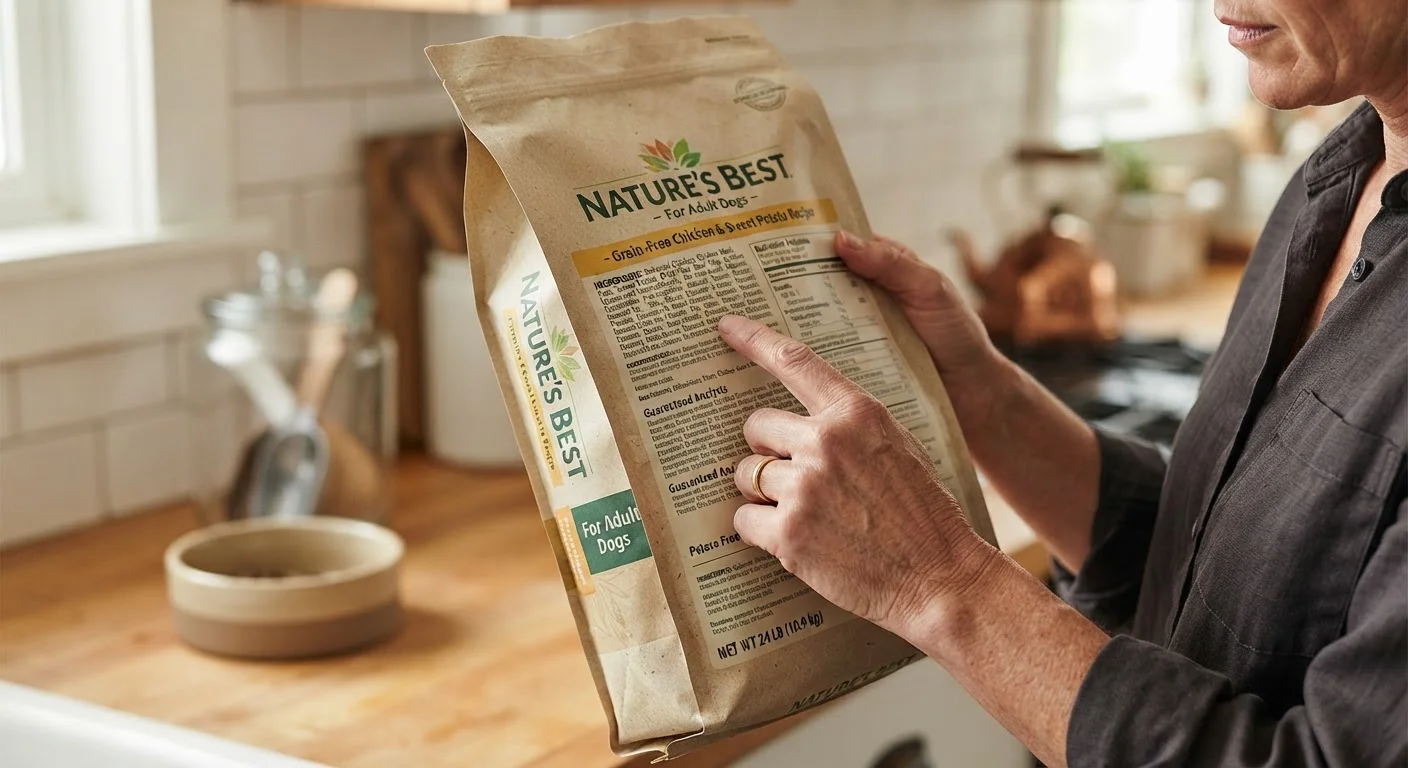
Why Labels Are Worth Decoding
Front-of-bag claims - words like 'natural,' 'holistic,' or 'premium' - are largely marketing language with little regulatory bite. The real nutritional story is printed in smaller text on the back or side of the package. Three sections carry most of the useful information: the ingredient list, the guaranteed analysis, and the AAFCO nutritional adequacy statement. Once you know what each section does and doesn't tell you, evaluating a new food takes only a minute or two.
For a broader comparison of how label reading works across food categories, see our guide to reading human nutrition labels - the logic is surprisingly similar.
AAFCO Sets the Standards, States Enforce Them
AAFCO is not a federal regulatory agency - it's an advisory organization whose model regulations are adopted (with some variation) by individual U.S. states. The FDA also has authority over pet food safety, particularly around contamination and labeling accuracy. Understanding this layered system explains why label compliance can look slightly different across products and regions.
The Ingredient List: What It Shows and What It Hides
Ingredients are listed in descending order by pre-cooking weight. This matters because whole meat - chicken, beef, salmon - contains roughly 70-75% water. After processing, that moisture is largely gone, which means the actual dry contribution of a whole-meat ingredient may be smaller than its position on the list implies. 'Chicken meal,' by contrast, is already dried and concentrated, so it delivers more protein per pound and ranks more accurately by its contribution to the finished product.
Watch for ingredient splitting: a manufacturer can list 'ground corn,' 'corn gluten meal,' and 'corn bran' as three separate entries. Taken together, their combined weight might exceed that of the first-listed protein - a practice that's technically compliant but can obscure the true composition of a diet.
Ingredient terms like 'by-products' are formally defined by AAFCO and don't automatically signal poor quality. Organ meats fall into this category and can be nutritionally dense. What matters more than individual ingredient names is the overall nutrient profile, which the guaranteed analysis begins to reveal.
Look Beyond the First Ingredient
Rather than focusing solely on what's listed first, scan the first five to seven ingredients as a group - they collectively represent the majority of the formula. Also note whether a named protein appears in multiple forms (e.g., 'chicken' and 'chicken meal'), which together indicate a stronger overall protein contribution.
The Guaranteed Analysis: Minimums, Maximums, and Moisture
The guaranteed analysis panel lists crude protein, crude fat, crude fiber, and moisture at minimum or maximum levels - not exact amounts. 'Crude' refers to the chemical method of measurement, not ingredient quality. A food guaranteed at 'minimum 26% crude protein' may actually contain more; the label only commits to the floor.
Comparing guaranteed analysis numbers between a wet food and a dry food is misleading without a conversion step. Wet foods can contain 75-80% moisture, which dilutes every nutrient percentage. To compare on equal footing, you'd need to convert both foods to a dry-matter basis - a calculation that removes moisture from the equation. Your veterinarian can help you interpret these numbers relative to your pet's specific needs.
For more on how carbohydrates, protein, and fat function in diet, our macronutrients explainer covers the fundamentals. And if you're weighing kibble against canned food, wet food vs. dry food walks through how format affects hydration, cost, and storage.
3%
Minimum ingredient required for a 'with [protein]' label claim
AAFCO's ingredient-naming rules set this threshold, meaning a bag labeled 'with salmon' may contain very little salmon relative to other protein sources.
25%
Minimum required when a single protein is the product's named recipe
Per AAFCO standards, if a food is called 'Chicken Recipe' or 'Beef Dinner,' that ingredient must make up at least 25% of the total formula.
75-80%
Typical moisture content in canned wet pet foods
This high moisture level significantly dilutes nutrient percentages on the guaranteed analysis panel, making direct comparisons to dry food percentages misleading without conversion.
The AAFCO Statement: The Most Important Line on the Label
The nutritional adequacy statement - sometimes called the AAFCO statement - tells you two critical things: whether the food is complete and balanced, and for which life stage it is intended. Look for language such as:
- ' is formulated to meet the nutritional levels established by the AAFCO Dog Food Nutrient Profiles for adult maintenance.'
- 'Animal feeding tests using AAFCO procedures substantiate that provides complete and balanced nutrition for all life stages.'
A food without this statement should not serve as a pet's primary diet. Life-stage designations matter: a food labeled for adult maintenance has not been confirmed to support the higher nutrient demands of a growing puppy or kitten. 'All life stages' is the most inclusive designation, but it may contain higher calorie and mineral levels than an older, less active animal needs.
Research into specific diet trends - like grain-free formulations - shows how marketing can move faster than science. Our grain-free diet overview offers a grounded look at what the evidence actually supports.
Marketing Claims Worth Questioning
Terms that sound meaningful but carry limited regulatory weight include 'natural,' 'holistic,' 'human-grade,' and 'premium.' AAFCO has a working definition for 'natural' - broadly, ingredients not produced by synthetic processes - but the term isn't a nutritional guarantee. 'Holistic' has no regulatory definition in pet food at all.
Naming rules do carry some weight: AAFCO's ingredient-naming standards require that if a single protein is named in the product title (e.g., 'Salmon Recipe'), it must comprise at least 25% of the food. If 'with salmon' appears, only 3% salmon is required. These thresholds help decode front-of-bag protein claims.
Understanding how marketing language works on food packaging more broadly can sharpen your label-reading skills. See how food marketing language can mislead shoppers for a parallel look at human food labeling tactics.
Finally, even a nutritionally sound food can contribute to weight problems if portions aren't calibrated to your individual pet. Our guide on overfeeding explains why the feeding guidelines on bags are starting estimates - not universal prescriptions.
This article is for general informational and educational purposes only. It is not a substitute for professional veterinary advice, diagnosis, or dietary guidance. Always consult a licensed veterinarian before making significant changes to your pet's diet.