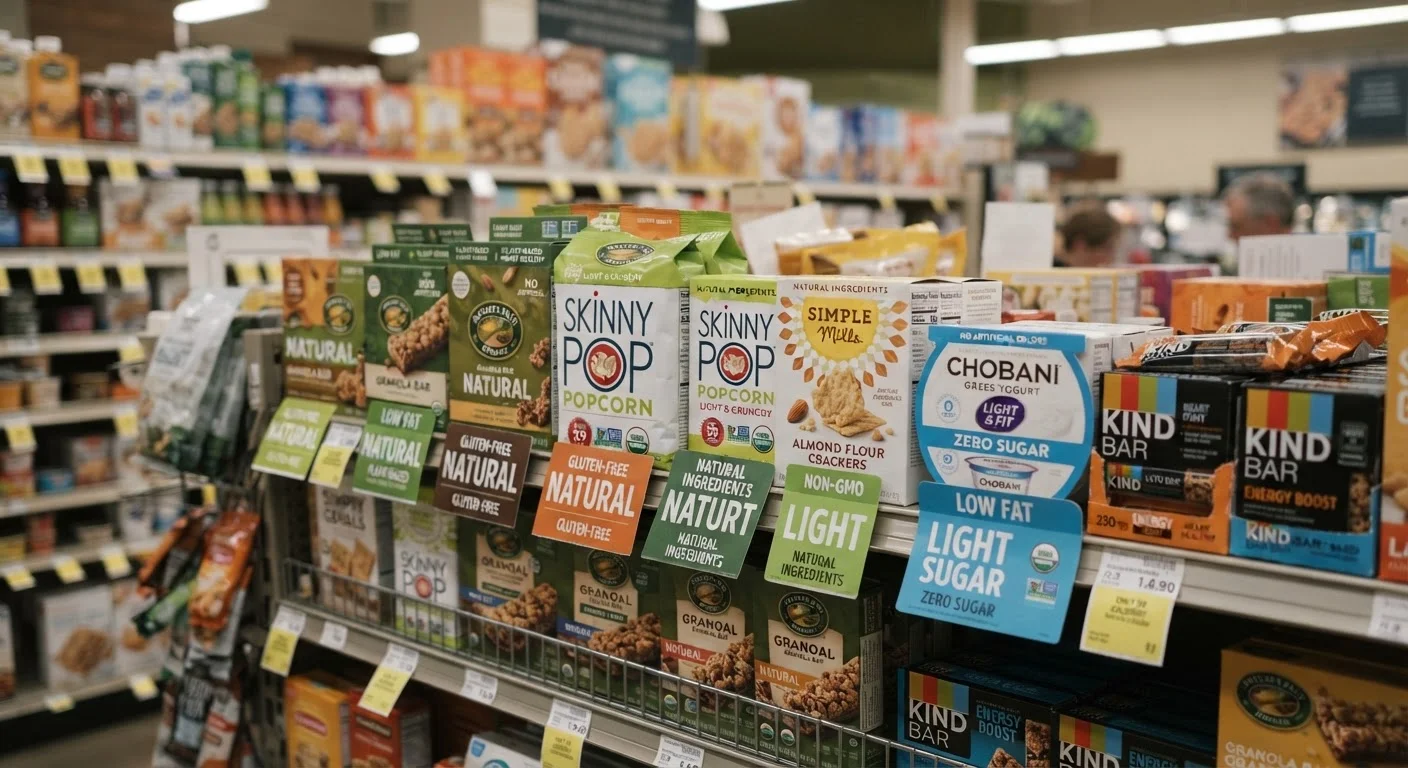
Why Packaging Language Is Designed to Impress, Not Inform
Walk down any grocery aisle and you'll encounter a barrage of front-of-package claims: wholesome, clean, artisan, guilt-free. These words are chosen by marketing teams, not nutritionists, and most carry no enforceable legal definition under U.S. Food and Drug Administration (FDA) guidelines. The result is a shopping environment where appealing language often does more work than actual nutritional content.
Unlike the Nutrition Facts panel - which the FDA regulates with specific formatting and disclosure rules - front-of-package claims operate in a far looser regulatory space. Shoppers who rely primarily on front-label language rather than the panel itself are more likely to misjudge a product's actual nutritional profile. For a practical guide to reading the panel itself, see how to interpret a Nutrition Facts label.
Treating 'natural' as a health or safety guarantee.
Why it happens: The word 'natural' sounds wholesome and unprocessed, leading shoppers to assume it means organic, additive-free, or nutritionally superior.
Assuming 'multigrain' means the product is made from whole grains.
Why it happens: Consumers often conflate 'multigrain' - which simply means more than one grain type was used - with 'whole grain,' which has a distinct nutritional meaning.
Interpreting 'light' or 'lite' as automatically low in calories or fat.
Why it happens: Shoppers assume 'light' always refers to calorie or fat content, but the FDA allows it to describe texture, color, or taste as well.
Taking 'no added sugar' to mean the product is low in sugar overall.
Why it happens: The phrase 'no added sugar' sounds like a blanket assurance about sweetness, but naturally occurring sugars in ingredients like fruit concentrate or dried fruit can still be substantial.
Confusing 'low-fat' with 'low-calorie' or 'healthy.'
Why it happens: Decades of diet culture created a widespread association between fat and poor health, leading many shoppers to equate reduced fat with overall healthfulness.
Trusting 'made with real fruit' to indicate meaningful fruit content.
Why it happens: The phrase implies generous, nutritious fruit content, when in practice 'made with' requires no minimum quantity under current labeling rules.
The Most Misleading Food Label Terms - and What They Actually Mean
Several specific terms appear frequently on packaging and are routinely misunderstood by shoppers. Knowing what each does and doesn't guarantee is one of the most practical consumer skills you can develop.
~60%
Americans relying on front-label claims
Research published in the Journal of the Academy of Nutrition and Dietetics has found that a majority of shoppers pay significant attention to front-of-package claims when selecting packaged foods.
Undefined
FDA regulatory status of 'natural'
As of the FDA's most recent formal guidance review, the term 'natural' on food labels has no binding legal definition for most product categories in the United States.
For context on how similar ambiguity plays out in other consumer categories, the same pattern exists in beauty products - terms like 'hypoallergenic' face comparable regulatory gaps, as explained in our guide to decoding beauty label claims.
The one major exception in food labeling worth knowing: the USDA Certified Organic seal. Unlike most front-label terms, 'organic' has a specific, federally enforceable meaning. What that certification actually guarantees - and what it doesn't - is worth understanding separately.
Health Halos Can Mask the Full Picture
A product adorned with terms like 'organic,' 'non-GMO,' or 'gluten-free' may still be high in sodium, saturated fat, or added sugars. These descriptors address specific attributes - sourcing, genetic modification, or gluten content - not overall nutritional quality. Always cross-reference front-label claims with the Nutrition Facts panel before concluding a product is a healthful choice.
Your Practical Approach at the Shelf
Healthy skepticism about front-of-package claims isn't cynicism - it's informed shopping. A few consistent habits can significantly reduce how often marketing language shapes your decisions.
First, treat the front label as advertising and the Nutrition Facts panel as data. Second, scan the ingredient list: ingredients are listed by weight, so what appears first dominates the product. A bread labeled 'multigrain' that lists enriched white flour as its first ingredient is predominantly a refined-grain product. Third, pay attention to serving sizes - many packaged items contain two or more servings per container, making calorie and sodium figures appear lower than a full portion delivers.
Understanding how food is processed and categorized can also sharpen your label literacy. What researchers mean by 'ultra-processed' food provides useful context for evaluating ingredient lists more critically. And if you've ever wondered whether a product's claims cross into outright misrepresentation, federal and state deceptive advertising law may be relevant.
This article is for general informational and educational purposes only. It is not medical or dietary advice. Consult a registered dietitian or qualified healthcare professional for guidance tailored to your individual health needs.