How Budget Automation Works
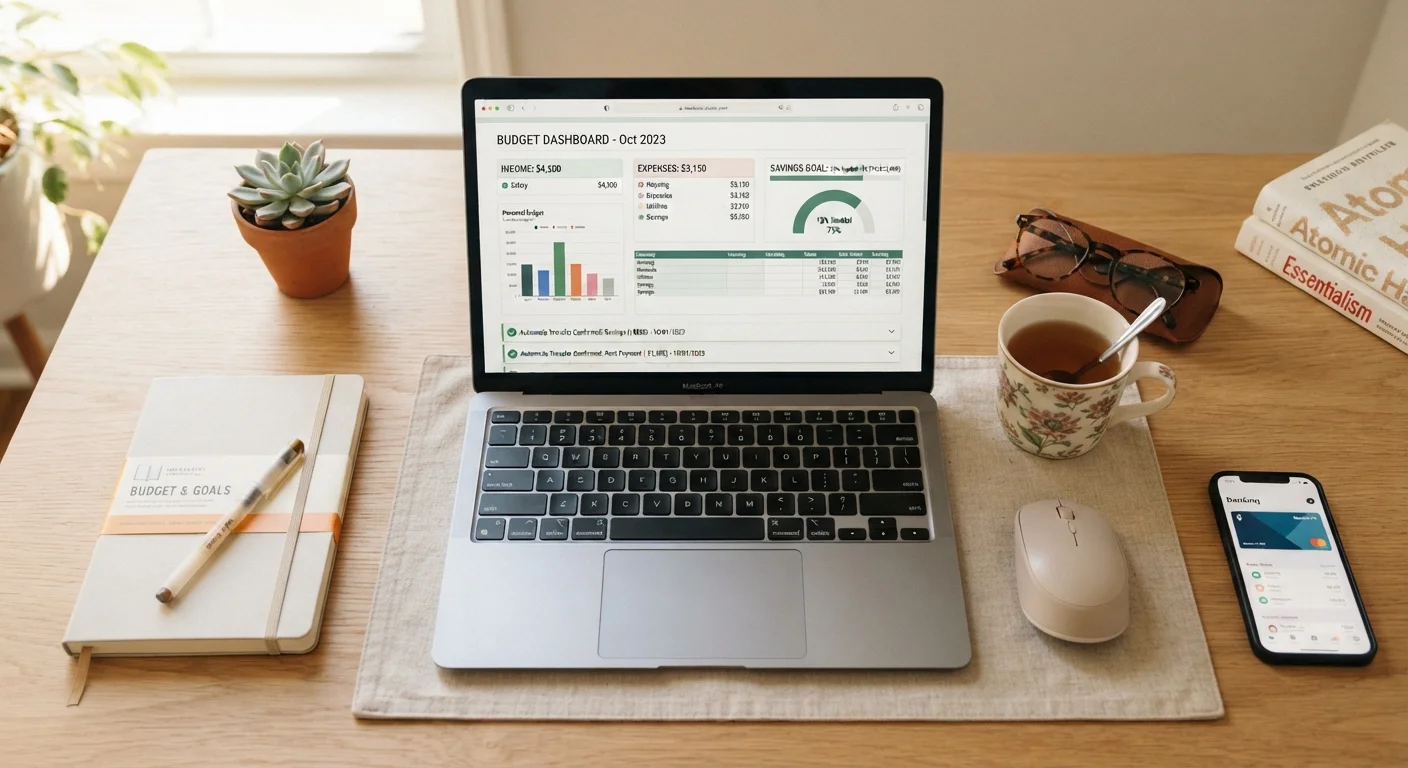
Budget automation refers to any financial task you schedule to run without manual action each cycle-automatic bill payments, recurring savings transfers, payroll direct deposits split across accounts, or auto-invested contributions to a retirement account. The goal is to remove friction from financial decisions that are largely routine.
Banks and credit unions allow customers to schedule recurring ACH transfers, and most billers offer autopay through their own portals. The underlying mechanics are straightforward: on a set date, a fixed amount moves from one place to another. What varies is how many of these flows you set up and how closely you monitor them afterward. To understand how ACH transfers work versus other payment methods, see our guide to wire transfers vs. ACH transfers.
Automation covers a spectrum. At the minimal end, you autopay one or two recurring bills. At the maximal end, every fixed expense, variable category allocation, and savings goal runs on a schedule-sometimes called a "pay yourself first" framework. Understanding where you sit on that spectrum matters when evaluating both the benefits and the gaps.
What Automation Genuinely Helps
Eliminates missed payments and late fees
Scheduled autopay ensures bills are paid on time every cycle, protecting both your finances and your credit score from avoidable penalties.
Makes saving consistent and effortless
Automatic transfers to savings or retirement accounts remove the monthly choice of whether to save, making it far more likely you follow through.
Reduces daily financial decision fatigue
Routine transactions handled automatically free up cognitive energy for financial decisions that genuinely require active judgment.
Supports a pay-yourself-first approach
Routing savings before discretionary spending arrives in checking makes it structurally harder to spend money you intended to save.
The clearest benefit of automated bill pay is payment reliability. A single missed payment can trigger a late fee and, if it remains unpaid past 30 days, a derogatory mark on your credit report. Autopay eliminates the cognitive overhead of remembering due dates across multiple accounts.
Automating savings is equally powerful because it exploits a well-documented behavioral tendency: money that is transferred before it reaches your checking account is money you are far less likely to spend. This is why payroll direct deposit splits-routing a fixed amount straight to savings-are widely recommended by financial educators. For a practical setup walkthrough, see automating your savings.
Automation also reduces decision fatigue. When routine financial actions no longer require active choices, mental energy is freed for decisions that genuinely need attention.
What Automation Can Quietly Hide
Creates spending blind spots over time
When money moves without your active review, you can lose a concrete sense of what you are spending, making it easier to drift over budget.
Subscription creep goes unnoticed
Small recurring charges for unused services accumulate quietly when every payment processes automatically and nothing prompts a review.
Price increases slip through undetected
When you are not manually approving each charge, rate changes from insurers, utilities, or subscription services may go unnoticed for months.
Overdraft risk with variable income
Fixed automated outflows on a set schedule can cause overdrafts if a paycheck arrives late or an irregular income month runs short.
Fosters a false sense of financial control
Having a system in place can feel like having a budget under control, even when actual spending patterns have drifted significantly from the original plan.
The same hands-off quality that makes automation efficient can make it hazardous. When payments run invisibly in the background, it becomes easy to lose track of what you are actually spending-and on what. Underestimating spending is already one of the most common budgeting errors; automation can amplify it by making real transaction totals feel abstract.
Subscription creep is a particularly common problem. Free trials convert to paid plans, annual renewals process unnoticed, and services that were once useful continue to charge long after they stopped being used. These charges are individually small enough to escape notice but collectively significant. Our article on hidden costs inside subscription offers explores how auto-renewals quietly offset savings.
Autopay and Billing Disputes
When a biller charges an incorrect amount and payment has already processed automatically, resolving the dispute can take additional time compared to catching the error before payment. Reviewing upcoming scheduled payments a few days before they process gives you a window to flag errors. This is especially relevant for accounts where the billed amount varies each cycle, such as credit cards or utilities.
Automation also masks price changes. Billers adjust their rates, insurance premiums renew at higher amounts, and utility charges fluctuate-none of which trigger an alert when you are simply watching money leave an account rather than reviewing each charge. If your income is irregular, fixed automated outflows can also cause overdrafts when a paycheck arrives late. Understanding your bank statement's spending patterns is one way to stay grounded in real numbers.
Staying Engaged Without Abandoning Automation
34%
Adults who pay at least one bill late per year
Research from the Consumer Financial Protection Bureau has found that payment timing errors remain a common source of avoidable fees and credit score damage for US consumers.
$219/mo
Average US household subscription spend estimate
Market research by C+R Research found that consumers tend to significantly underestimate their monthly subscription costs, highlighting the risk of set-and-forget payment habits.
The solution is not to abandon automation but to pair it with deliberate, regular engagement. A monthly review-15 to 30 minutes with your bank statement or budgeting tool-is the counterbalance that keeps automated systems honest. Check that every recurring charge is expected, that amounts match what you agreed to, and that your account balances are moving in the direction you planned.
If your budget includes irregular or annual expenses-car registration, holiday costs, insurance renewals-automated transfers into a dedicated sinking fund can smooth those lumps. Planning for annual and irregular expenses is a practical complement to any automated system.
Some people find that full automation feels disconnected and prefer hybrid approaches-automating savings and fixed bills while tracking variable spending manually. Envelope budgeting and spreadsheet-based tracking both offer more tactile engagement with spending if the hands-off quality of full automation is creating blind spots for you.
Automation is infrastructure, not a substitute for financial awareness. The monthly banking habits that support long-term stability are what turn automated transfers from a convenience into a genuine financial strategy.
This article is for general informational and educational purposes only and does not constitute personalised financial advice. Consult a qualified financial professional for guidance specific to your situation.