How Each Transfer Method Actually Works
Both wire transfers and ACH transfers move funds electronically between bank accounts, but their underlying mechanics are quite different.
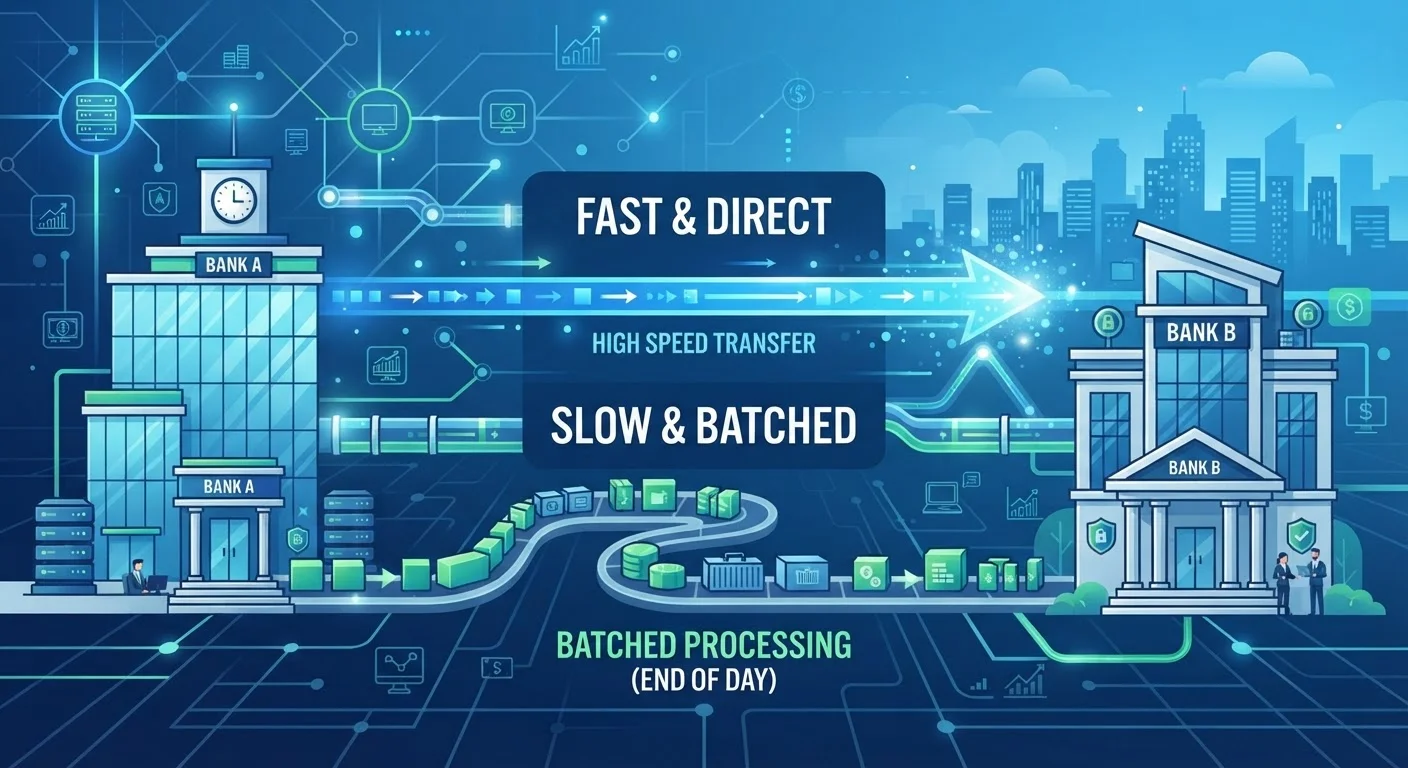
A wire transfer is a direct, bank-to-bank instruction that moves funds individually and in real time through networks such as Fedwire or SWIFT. Once your bank verifies the instruction, it sends a message to the receiving bank to credit the account. The process is discrete - each transfer is handled on its own - which is why settlement is so fast.
An ACH (Automated Clearing House) transfer works differently. ACH is a batch-processing network operated by Nacha (formerly NACHA) that groups thousands of payment instructions together and processes them in scheduled cycles throughout the day. Your paycheck's direct deposit, your utility autopay, and the transfer you make from one personal bank account to another are almost certainly running through ACH. Because transactions are batched and cleared in waves, there is an inherent delay built into the system.
Understanding this fundamental difference - individual and immediate versus batched and scheduled - explains nearly every practical distinction between the two methods.
| Criterion | Wire Transfer | ACH Transfer |
|---|---|---|
| Settlement Speed | Same business day (hours) | 1-3 business days (same-day option available) |
| Typical Cost (Outgoing) | $15-$50+ | Usually free |
| Reversibility | Generally irreversible once sent | Can be reversed within ~5 business days |
| Domestic vs. International | Both domestic and international | Domestic U.S. only |
| Processing Method | Individual, real-time instruction | Batched, scheduled cycles |
| Common Use Cases | Real estate, large business payments | Payroll, bill pay, personal transfers |
| Fraud Risk Profile | Higher (irreversible; BEC scams) | Lower (reversible; unauthorized debits) |
Speed, Cost, and Reversibility: The Key Practical Differences
Speed: Domestic wire transfers typically settle the same business day, often within a few hours if initiated before the bank's cutoff time. ACH transfers historically took two to three business days, though Nacha's Same Day ACH option has expanded significantly, allowing many ACH payments to settle within hours. Still, not all transactions are eligible for Same Day ACH, and processing windows apply.
Cost: Wire transfers carry fees - commonly $15 to $30 for domestic outgoing wires and $35 to $50 or more for international outgoing wires. Incoming wire fees of $10 to $15 are also common. ACH transfers, by contrast, are typically free for consumers. Some financial institutions charge a small fee for expedited ACH, but standard transfers between personal accounts usually cost nothing. This cost gap is significant if you are making frequent transfers.
Reversibility: This is perhaps the most consequential difference. Wire transfers are generally considered final and irreversible once the receiving bank has credited the funds. If you send a wire to the wrong account or fall victim to a scam, recovering the funds is difficult and not guaranteed. ACH transfers, by contrast, can often be reversed by the originating bank within a limited window - typically within five business days - if there is an error or unauthorized transaction. This makes ACH somewhat more forgiving, though still not a substitute for careful verification.
Same Day ACH: A Growing Middle Ground
Nacha has progressively expanded Same Day ACH, raising per-transaction dollar limits and adding processing windows. As of recent rule changes, Same Day ACH handles transactions up to $1 million per payment, covering many use cases that previously required a wire. Check with your bank to see which of your transfers qualify, as eligibility depends on the type of transaction and the receiving institution's participation.
For readers who automate recurring payments, understanding how ACH fits into a broader budgeting strategy matters. See how automated transfers affect your budget awareness for a fuller picture.
When to Use Each - and What to Watch For
Choose a wire transfer when: the transaction is time-sensitive (a real estate closing, a business contract deposit), the amount is large, or the recipient is at a foreign bank. The finality of a wire can actually be an advantage in these cases - it assures the recipient that the funds are guaranteed and will not be clawed back.
Choose an ACH transfer when: you are setting up direct deposit for your paycheck, paying a recurring bill, transferring money between your own accounts, or making a standard personal payment where a one-to-three-day window is acceptable. ACH is deeply embedded in U.S. banking infrastructure, and your financial institution almost certainly supports it at no cost.
Fraud awareness matters with both: Wire fraud is a significant and growing problem. Scammers sometimes impersonate real estate agents, attorneys, or vendors to redirect wire payment instructions - a scheme known as Business Email Compromise (BEC). Always verify wire instructions by phone using a number you independently sourced, not one provided in an email. ACH fraud also occurs, often through unauthorized debits, so monitoring your accounts regularly is important regardless of which method you use.
Your choice of banking institution can also influence which options are available to you and at what cost. Online banks and traditional banks often differ in their wire fee structures and ACH capabilities, so it is worth reviewing your institution's fee schedule.
This article is for general informational and educational purposes only and does not constitute personalized financial, banking, or legal advice. Transfer availability, fees, and processing times vary by financial institution. Consult your bank or a qualified financial professional for guidance specific to your situation.