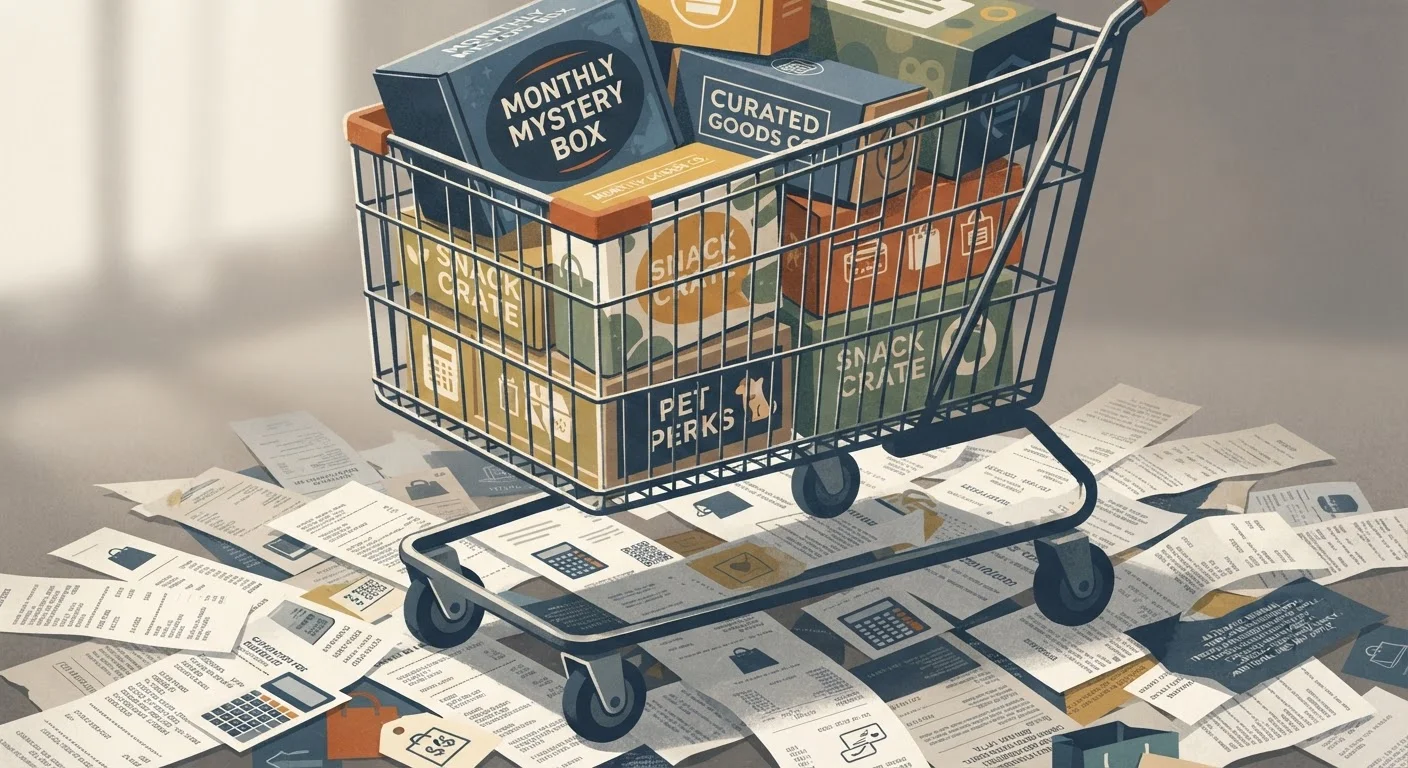
Why Subscribe-and-Save Feels Like a Safe Bet
Subscribe-and-save programs have become a standard fixture across retail categories - household goods, pet supplies, personal care, software, meal kits, and beyond. The appeal is straightforward: commit to regular deliveries or automatic renewals, and a retailer rewards you with a percentage discount, free shipping, or bundled perks. For products you genuinely use at a predictable rate, the logic holds.
But the gap between what these programs promise and what they deliver is wide enough that it's worth examining exactly where costs hide. The mistakes below aren't rare edge cases - they're structural features of how subscribe-and-save programs are typically designed. Understanding them is the first step toward deciding whether a given program genuinely saves you money or simply changes when you notice spending it.
For a broader look at how commitment-based savings offers work - and where they don't - see the financial trade-offs of subscription services.
Accepting the introductory discount as the permanent price.
Why it happens: Retailers advertise the initial discount prominently while burying the post-promotion standard rate in terms and conditions. Most shoppers remember the number that drew them in, not the clause that expires it.
Subscribing to a cadence that doesn't match actual consumption.
Why it happens: Default delivery frequencies are often set at intervals that benefit the seller, not the buyer. Monthly deliveries of a product you use quarterly means accumulating inventory you've already paid for.
Overlooking the full annual cost when evaluating the discount.
Why it happens: A 10% or 15% discount looks meaningful on a single-unit price but is easy to mentally detach from the total annual spend. Shoppers often compare a subscription price to a single alternative purchase rather than to what they'll spend over twelve months.
Treating cancellation as something you can do anytime without friction.
Why it happens: Subscribe-and-save programs frequently use deliberate design choices - hard-to-find cancellation options, multi-step confirmation flows, or customer service requirements - to make leaving slow and effortful. Shoppers assume the process mirrors sign-up in simplicity.
Ignoring price creep on auto-renewed subscriptions.
Why it happens: Auto-renewal notifications - often buried in email or sent with minimal lead time - are easy to miss. Many programs raise rates gradually, making each individual increase feel minor even as the cumulative change is significant.
How to Audit Your Subscriptions Before Costs Compound
The practical antidote to subscription drift is a simple, recurring audit. Once every one to three months, pull a list of every active subscription - bank statements and credit card transaction histories are the most reliable source, since email inboxes don't always surface renewals clearly. For each subscription, note the current price, the original sign-up price, the cancellation process, and whether you've used the product or service since the last billing cycle.
~$219
Average monthly U.S. consumer spend on subscriptions
A 2022 Consumer Intelligence Research Partners study estimated that U.S. consumers underestimate their subscription spending by a factor of roughly two to three times.
42%
Subscribers unaware of price increases on active plans
A 2023 survey by C+R Research found that nearly four in ten subscribers did not realize their subscription price had increased since they enrolled.
If the cancellation process for a subscription requires a phone call during limited hours, a mailed letter, or more than three clicks to complete online, that friction is not accidental - it's a retention mechanism. The Federal Trade Commission has issued guidance requiring that cancellation be at least as easy as sign-up for many online services, and several states have their own auto-renewal disclosure laws. Consumer protections that apply to subscription services outlines what the rules require and how to use them.
Finally, subscription programs are worth viewing in the context of your overall automated spending. Automating your budget is powerful for reducing missed payments - but it can also disconnect you from noticing when automatic charges quietly shift upward. Treating subscribe-and-save enrollments as a line item in your budget review, rather than a set-and-forget decision, keeps the savings real.
Auto-Renewal Terms Can Change Mid-Subscription
Some subscribe-and-save programs reserve the right to adjust pricing, delivery quantities, or included perks on active subscriptions with limited notice - sometimes as little as a single email. Review the terms of any program you join for language around unilateral changes, and keep an eye on your renewal confirmations rather than treating them as routine. If a program changes terms materially, you generally have the right to cancel before the next billing cycle.