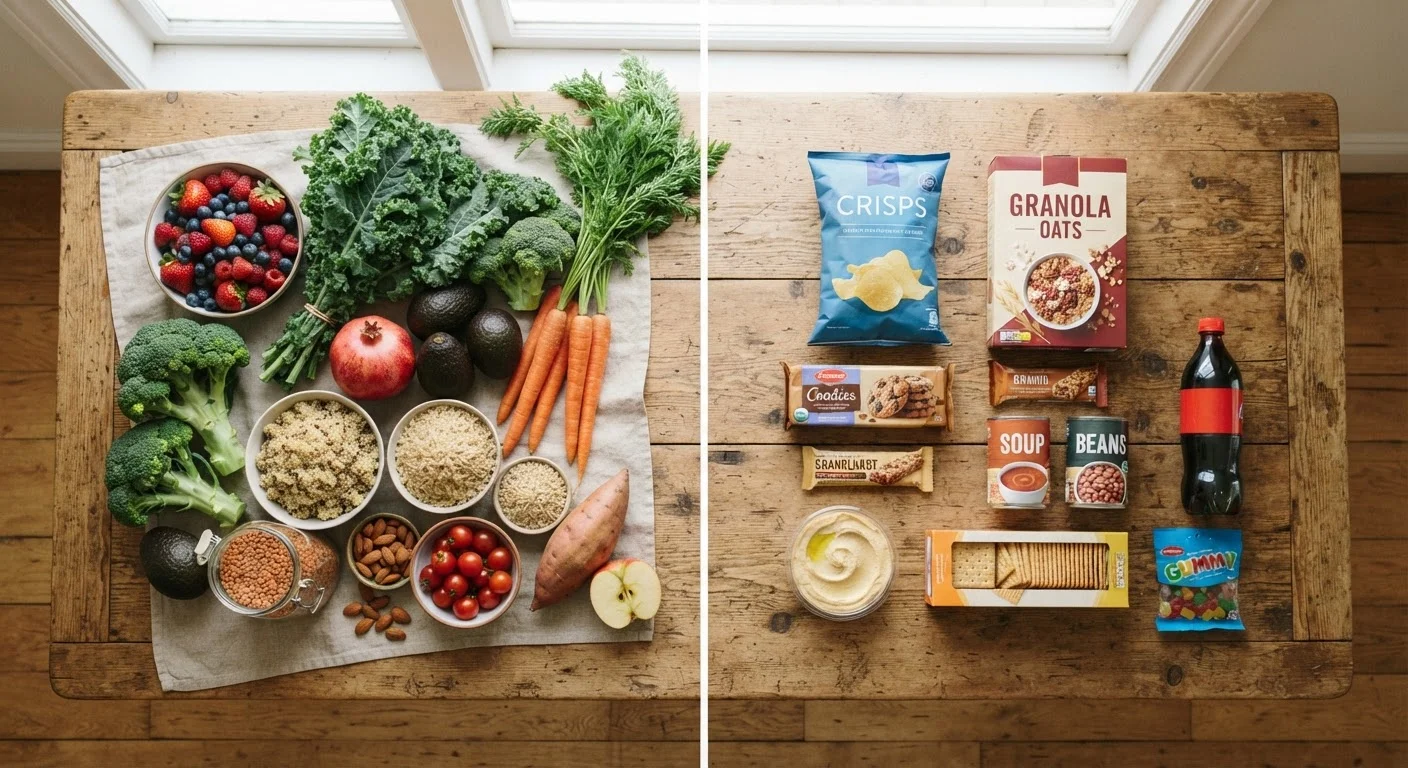
Defining the Terms: More Than a Simple Split
The phrase "whole foods vs. processed foods" implies a clean divide, but nutrition science tells a more layered story. A whole food is generally understood as one that has undergone minimal alteration from its natural state - think an apple, a handful of walnuts, a piece of salmon, or dried lentils. What you see is essentially what grew or was raised.
Processed food, by contrast, is a much broader category. Researchers at the University of São Paulo developed the NOVA classification system, which organizes foods by degree of processing rather than nutrient content alone. Under this framework, there is an important distinction between minimally processed foods (like frozen spinach or pasteurized milk), processed culinary ingredients (like olive oil or flour), processed foods (like canned tomatoes or cheese), and ultra-processed foods - products formulated with industrial ingredients, additives, and flavorings that have no equivalent in home cooking. For a deeper look at this framework, see what ultra-processed food means and why researchers study it.
Lumping a can of chickpeas together with a flavored chip is a category error. Understanding where a food falls on this spectrum is the first step toward making more informed choices.
Where Whole Foods Hold a Clear Nutritional Advantage
The evidence in favor of whole foods rests primarily on what they contain - and what they don't. Whole plant foods deliver fiber in its intact form, which supports gut health, slows glucose absorption, and contributes to satiety. Fruits, vegetables, legumes, and whole grains also carry vitamins, minerals, and phytonutrients that appear in complex combinations that researchers are still working to fully understand.
57%
Share of calories from ultra-processed foods in average U.S. diet
Research published in BMJ Open estimated that ultra-processed foods account for roughly 57% of energy intake among American adults.
10x
Fiber gap between ultra-processed and whole-food diets
Dietary fiber intake among Americans averages around 15 grams per day - roughly 10 grams below the generally recommended daily target, a gap largely attributed to low whole-food consumption.
30%+
Increase in cardiovascular risk associated with ultra-processed diets
Several large observational studies, including analyses of European and U.S. cohorts, have found associations between high ultra-processed food intake and elevated cardiovascular disease risk.
Whole foods also tend to be lower in added sugars and sodium - two dietary components that many Americans consume above recommended levels. The naturally occurring sugars in fruit, for instance, arrive with fiber and water that change how the body processes them. For a closer look at why that distinction matters, see why the source and amount of sugar both count.
It's worth noting that cooking method can affect the nutrient content of even the most wholesome ingredients. What happens to nutrition when you cook food depends heavily on temperature, time, and technique.
What Research Actually Says About Processed Food and Health
Population studies have consistently found associations between high consumption of ultra-processed foods and increased risks of certain chronic conditions, including cardiovascular disease, type 2 diabetes, and obesity. These associations do not prove direct causation - diet is notoriously difficult to study in isolation - but the consistency of findings across multiple countries and research designs is notable.
Observational Research Has Limits
Most large-scale findings on processed food and health come from observational studies, which track dietary patterns and outcomes over time but cannot definitively prove cause and effect. People who eat more ultra-processed foods often differ in other ways - income, sleep, activity levels - that may independently affect health. Researchers attempt to control for these variables, but residual confounding remains a limitation. This doesn't invalidate the findings, but it does argue for interpreting them with appropriate nuance.
What these studies rarely show is a meaningful negative association with all processed foods. Pasteurized dairy, canned fish, and fortified breakfast cereals are processed, yet many dietary patterns that include them are associated with good health outcomes. The harm signal is strongest and most consistent for the ultra-processed end of the spectrum: foods engineered for palatability, with long lists of additives and minimal whole-food content.
Dietary patterns matter more than any single food. For guidance on reading the nutrition headlines that often obscure this nuance, a framework for evaluating food news can help you interpret study coverage more critically.
Head-to-Head: A Practical Comparison
Comparing whole foods and processed foods across key dimensions reveals where the practical trade-offs actually live.
| Criterion | Whole Foods | Processed Foods |
|---|---|---|
| Fiber content | High - naturally intact | Often removed or reduced |
| Added sugars | None | Varies widely; often significant |
| Sodium | Naturally low | Often elevated, especially ultra-processed |
| Micronutrients | Naturally abundant | Sometimes fortified, often reduced |
| Shelf life | Short to moderate | Extended, often months to years |
| Cost | Can be higher, especially fresh | Generally lower per serving |
| Preparation time | Typically requires cooking | Often ready-to-eat or quick |
| Additive content | None | Ranges from minimal to extensive |
Access and cost are real factors. Fresh produce, lean meats, and whole grains can be expensive or difficult to obtain in some communities - a structural issue that individual dietary advice cannot solve. Frozen vegetables, canned legumes, and plain oats occupy a middle ground: minimally processed, affordable, and nutritionally solid. For readers exploring predominantly plant-based approaches, plant-based eating and what the research shows offers useful context on nutrient considerations.
Making Sense of It for Your Own Plate
There is no universal diet that suits every person's physiology, budget, culture, or schedule. What nutrition research does support is a general direction: eating more foods that are closer to their whole, unaltered state - and being more selective about how frequently ultra-processed products form the bulk of a meal - is associated with better long-term health outcomes across most populations studied.
Practical strategies don't require perfection. Reading ingredient lists is more informative than relying on front-of-package health claims. A shorter ingredient list, one dominated by recognizable items, generally signals less industrial processing. Understanding the difference between healthy and saturated fats is another useful lens when evaluating packaged products.
Protein sources also deserve attention within this framework - whole-food protein sources like eggs, legumes, and fish bring additional nutrients compared with many processed meat products. Protein sources compared across animal, plant, and other categories provides a useful reference.
This article is for general informational and educational purposes only and does not constitute medical or dietary advice. Consult a registered dietitian or qualified healthcare professional before making significant changes to your diet, especially if you have an existing health condition.