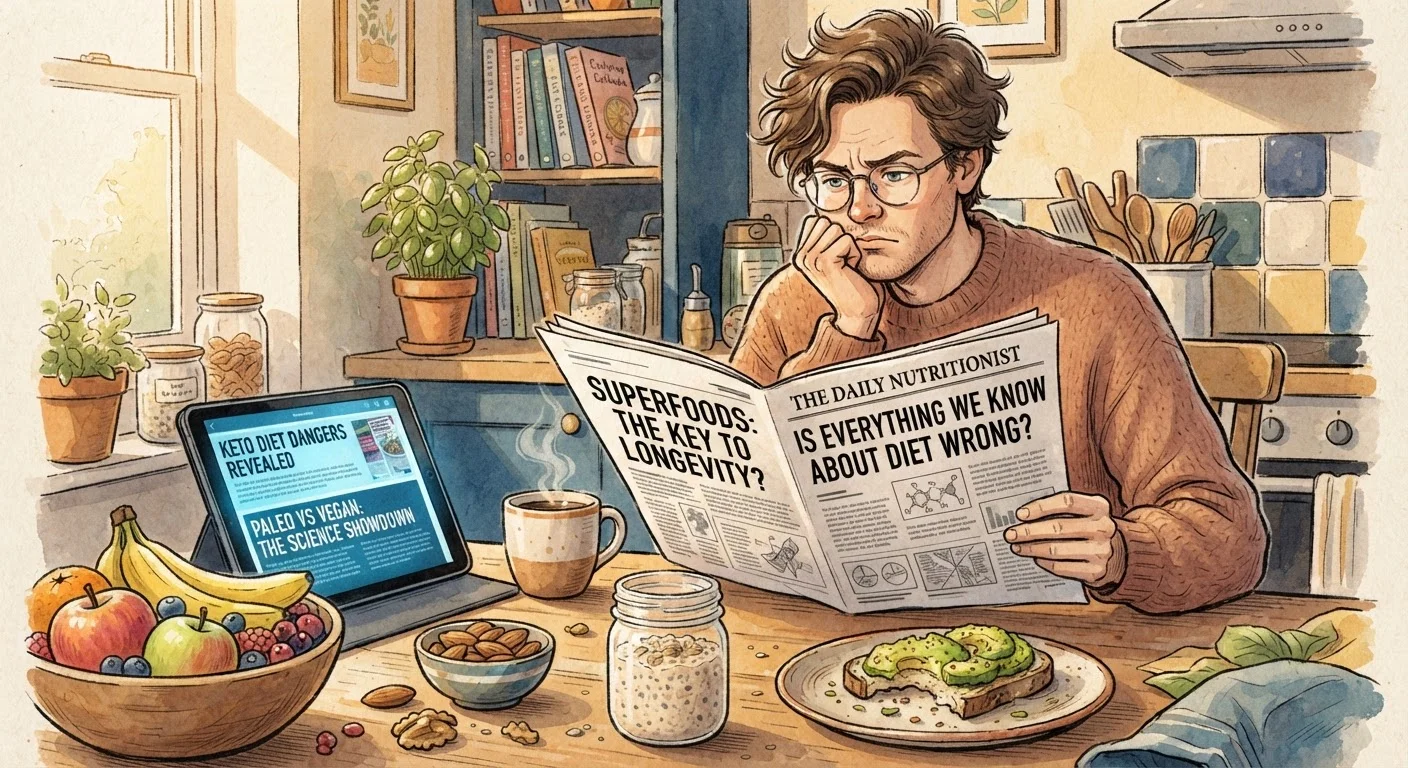
Why Nutrition News Feels So Contradictory
One week, eggs are a heart attack risk. The next, they're fine in moderation. Coffee prevents disease; coffee causes it. If you've ever felt whiplash from nutrition headlines, you're not imagining the chaos - but there are structural reasons for it that make the confusion more understandable and more manageable. For a deeper look at why the science itself seems to shift, see our companion piece Why Nutrition Advice Seems to Keep Changing.
Nutrition science is genuinely difficult to conduct well. Humans eat hundreds of different foods in endlessly varied combinations, across lifetimes shaped by genetics, environment, and behavior. Isolating the effect of a single food or nutrient - the way a drug trial isolates a pill - is rarely possible. Most findings represent probability and association within a population, not guaranteed outcomes for any individual. That's not a flaw in the science; it's the honest nature of what diet research can measure.
The problem is that media coverage rarely communicates this nuance. The framework below gives you practical tools to evaluate any nutrition headline more clearly - and to decide when a story deserves a change in your habits versus when it simply deserves a skeptical read.
This Is General Information, Not Medical Advice
The framework in this article helps you read and interpret nutrition news more critically. It is not a substitute for personalized guidance from a registered dietitian or licensed healthcare provider. If you have a diagnosed condition, food allergy, or specific health concern, always consult a qualified professional before making dietary changes.
What to Do When a Headline Catches Your Attention
The steps below walk you through a consistent evaluation process. You won't need all seven for every story, but building even a few of these habits will make you a substantially more critical consumer of food news. Before you begin, take stock of what you'll need:
What you will need
PubMed (pubmed.ncbi.nlm.nih.gov)
Free public database of peer-reviewed biomedical and nutrition research - use it to find original studies behind news stories.
Your institution or public library
Many libraries offer free access to full-text journal articles behind paywalls through digital lending programs.
Registered Dietitian (RD or RDN)
A licensed nutrition professional who can help you interpret research in the context of your own health and dietary needs.
Pause before you share or react
The first step is the simplest and hardest: resist the urge to immediately change your diet, or forward a dramatic headline to family, based on a single news article. Nutrition research accumulates gradually over years and decades. One new study - even a well-designed one - rarely reverses the weight of existing evidence. Give yourself permission to wait and read more before deciding whether a story is worth acting on.
Identify what kind of study it is
Not all research is equally powerful. A randomized controlled trial (RCT) - where participants are randomly assigned to a treatment or control group - provides stronger evidence of cause and effect than an observational study, where researchers simply watch what people already eat and track outcomes. Observational studies are common in nutrition research and are genuinely useful for spotting patterns, but they cannot prove that a food caused a health outcome. Look for these terms in the article or the study abstract itself.
- Randomized controlled trial (RCT): Stronger causal evidence, but harder to run long-term for diet studies.
- Cohort study / prospective study: Follows a group over time; shows associations, not causation.
- Meta-analysis / systematic review: Synthesizes many studies; generally considered high-quality evidence when done well.
- Case study or anecdotal report: Lowest level of generalizability - illustrative, not conclusive.
Check the sample size and population
A study of 40 college students tells you far less than a well-conducted study of 40,000 adults tracked over a decade. Look for the number of participants and who they were - age range, health status, country of origin, and how their dietary habits were measured. Findings from one population may not translate to another. For example, research conducted in populations with very different baseline diets may not apply directly to typical American eating patterns.
Look at who funded the research
Funding source does not automatically invalidate a study, but it is a legitimate consideration. Research funded by an industry group with a financial stake in the outcome has a higher risk of bias - not because researchers are dishonest, but because of how research questions get framed, which results get published, and how findings get communicated. Peer-reviewed journals typically require disclosure of funding; look for it in the article's acknowledgments or conflict-of-interest section.
Compare the headline to the actual finding
Headlines are written by editors optimizing for attention, not by the scientists who ran the study. Common distortions include: upgrading an association to a cause ("X causes Y" when the study only found a correlation), exaggerating effect size, omitting the fact that the result was only seen in a specific subgroup, or ignoring that the finding conflicted with earlier research. After reading the headline, locate the study's actual conclusion in the abstract. Ask yourself: does the headline accurately describe what the researchers actually found?
Weigh it against the broader body of evidence
Individual studies are data points, not verdicts. The most reliable nutritional guidance comes from systematic reviews and meta-analyses that pool many studies, and from consensus positions issued by major health and scientific organizations. If a single new study contradicts decades of consistent evidence, the most likely explanation is not that everything changed overnight - it's that the new study has limitations, or adds nuance to an existing picture. Place new findings in that wider context before adjusting your habits.
Bring lingering questions to a professional
If a nutrition story genuinely concerns you - particularly if it relates to a food you eat regularly, a supplement you take, or a health condition you manage - bring it to a registered dietitian or your primary care provider. They can interpret emerging research in the context of your individual health history, medications, and goals. General information, including everything in this article, cannot substitute for that personalized guidance.
Beware of Absolute Language in Headlines
Words like 'causes,' 'cures,' 'destroys,' or 'proven to' are almost always oversimplifications of nuanced research. Nutrition science rarely produces findings that are absolute or universal. When a headline makes a sweeping claim, treat it as a signal to dig deeper before changing your eating habits.
Go Straight to the Source
Most news articles covering nutrition research link to or name the original study. Search for the abstract on PubMed (pubmed.ncbi.nlm.nih.gov) - a free, publicly accessible database of peer-reviewed research. Even reading just the abstract and conclusions gives you far more context than a headline ever can.
Once you're comfortable applying this framework, you'll find it easier to build a grocery list grounded in consistent nutrition principles rather than reacting to whichever food is trending in the headlines this week. You might also find it useful to understand how food marketing language can mislead shoppers, since the same critical thinking applies to packaging claims as it does to research coverage.
For further context on specific nutrition topics this framework can help you evaluate, explore our coverage of whole foods vs. processed foods, dietary fats, and what ultra-processed food really means.
This article is for general informational and educational purposes only and does not constitute medical or dietary advice. Consult a qualified healthcare provider or registered dietitian for guidance specific to your health needs.