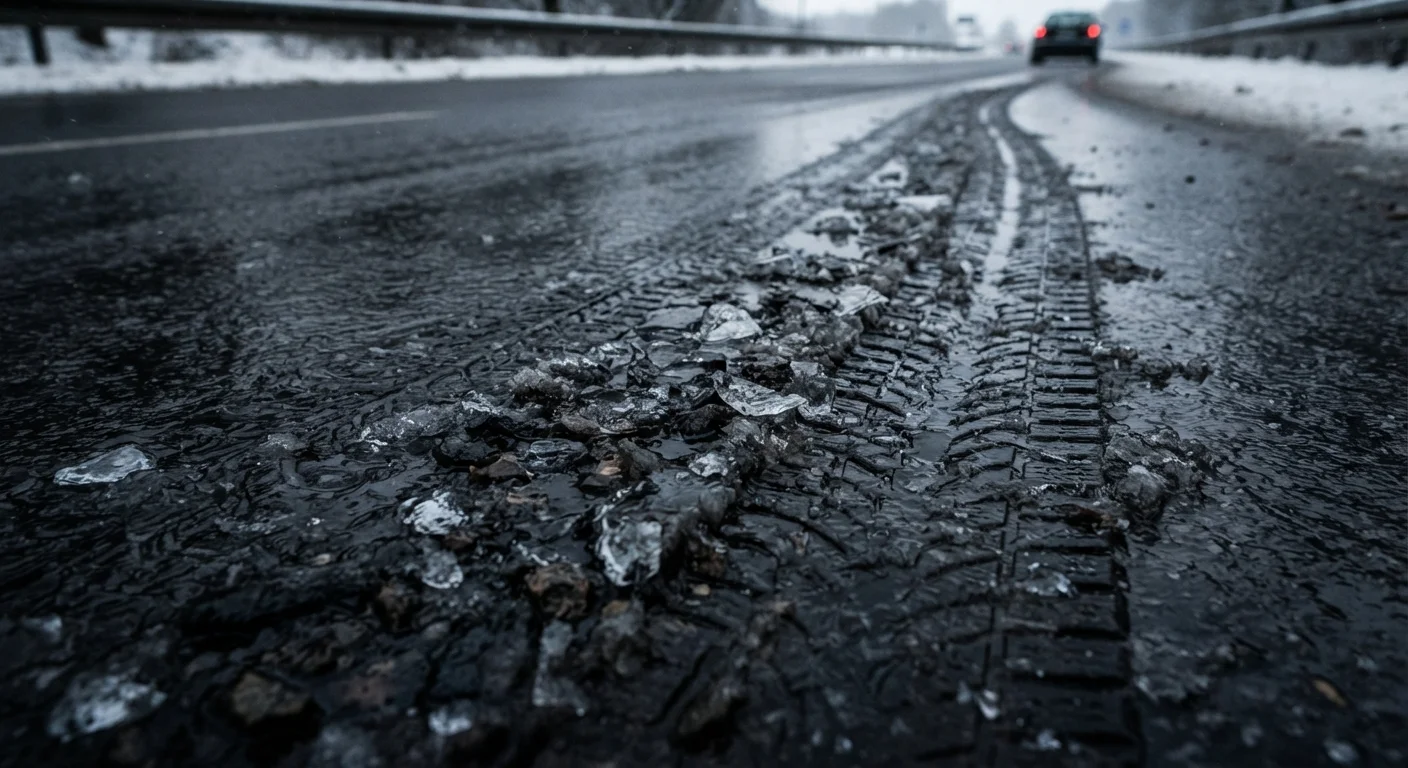
The Physics Behind an Ice Skid
When a tire rolls on dry pavement, microscopic friction between the rubber and road surface allows the driver to steer, brake, and accelerate predictably. Ice eliminates most of that friction. The tire still spins, but instead of gripping the surface and translating that rotation into directional movement, it glides over the ice with little resistance.
The result is that the vehicle's momentum continues in whatever direction it was already traveling. Newton's first law-an object in motion stays in motion-describes exactly what happens: the car keeps going straight even as the driver turns the wheel, or keeps sliding forward even as the driver presses the brake.
Two conditions make ice especially treacherous. First, it frequently forms unevenly, so a driver might have grip in one spot and none in the next. Second, black ice-a thin, nearly invisible glaze-gives no visual warning before traction disappears. See our guide to how different weather conditions affect vehicle control for a broader look at how ice compares to other hazardous surfaces.
~17%
U.S. crashes occurring on snowy, icy, or slushy roads
According to the Federal Highway Administration, weather-related road conditions-including ice and snow-account for a significant share of annual crash totals.
0.1
Approximate friction coefficient on glare ice
Compared to roughly 0.7 on dry asphalt, glare ice reduces available tire grip by approximately 85%, dramatically extending stopping distances and reducing steering response.
3-10×
Stopping distance increase on ice vs. dry pavement
Driving safety researchers and transport agencies note that stopping distances on ice can be several times longer than on dry roads, depending on speed and tire type.
Understeer vs. Oversteer: The Two Types of Ice Skid
Most ice skids fall into one of two categories, and recognizing which type you're experiencing is essential to choosing the right response.
Understeer
Understeer occurs when the front tires lose traction. The car continues moving forward-or in a wide arc-rather than following the turn you're steering into. Front-wheel-drive vehicles are particularly prone to understeer because the front wheels carry the load of both steering and powering the car. When they lose grip, you lose both functions simultaneously.
Oversteer
Oversteer occurs when the rear tires lose traction. The back end of the vehicle slides outward, causing the car to rotate. If uncorrected, oversteer leads to a spin. Rear-wheel-drive vehicles are more susceptible, especially when accelerating through a curve. For a detailed breakdown of how these two scenarios-and full spin-outs-differ in feel and response, see the difference between skidding and spinning out.
“The most dangerous moment in a skid is when drivers do what feels natural. Braking harder and steering more sharply are exactly the wrong moves when tires have no grip.”
— A Senior Driving Instructor, Winter Driving Safety Program, Upper Midwest
Why Your Instincts Work Against You
The natural human reaction to sudden loss of control is to brake hard and counter-steer sharply. On ice, both responses typically make the situation worse.
Jamming the brakes locks the wheels on vehicles without ABS, converting rolling tires into sliding blocks-objects with even less grip than a rotating tire. Even with ABS, aggressive braking reduces the fine control needed to recover.
Similarly, yanking the steering wheel in a panic overloads already-slipping tires with a demand they can't meet. A tire that has lost traction cannot suddenly grip harder because you turned the wheel further. Overcorrection also risks sending the vehicle into a secondary skid in the opposite direction once-or if-some traction returns.
Practice the Response Before You Need It
Many drivers first experience a real ice skid in a high-stress, high-speed situation with no mental rehearsal. If you live in a region with regular winter weather, consider finding a large, empty snow-covered parking lot at low speed to feel how your vehicle responds to braking and steering inputs on slippery surfaces. This builds muscle memory for the smooth, measured corrections that actually work-before you need them on a real road.
The physics-based correction is counterintuitive: ease off all pedals, make smooth and measured steering inputs, and give the tires time and space to find grip again.
Technology That Helps-and Its Limits
Most vehicles built in the past fifteen years include Electronic Stability Control (ESC), which monitors wheel speed, steering angle, and lateral acceleration. When ESC detects a developing skid, it selectively applies braking force to individual wheels and reduces engine torque to help realign the vehicle.
ESC is genuinely effective at preventing many low-speed skids on lightly slippery surfaces. But it operates within physical limits. On heavily glazed ice at highway speeds, ESC may reduce the severity of a skid without eliminating it. It is a safety aid, not an override of physics.
Tire choice plays an equally important role. All-season tires harden in cold temperatures, reducing the rubber's ability to conform to surface irregularities and generate grip. Dedicated winter tires use softer compounds and specialized tread patterns designed to remain flexible at low temperatures. Our comparison of all-season vs. winter tires explains what these differences mean in practical driving conditions. It's also worth noting that four-wheel drive does not improve braking or cornering on ice-a point that surprises many drivers.