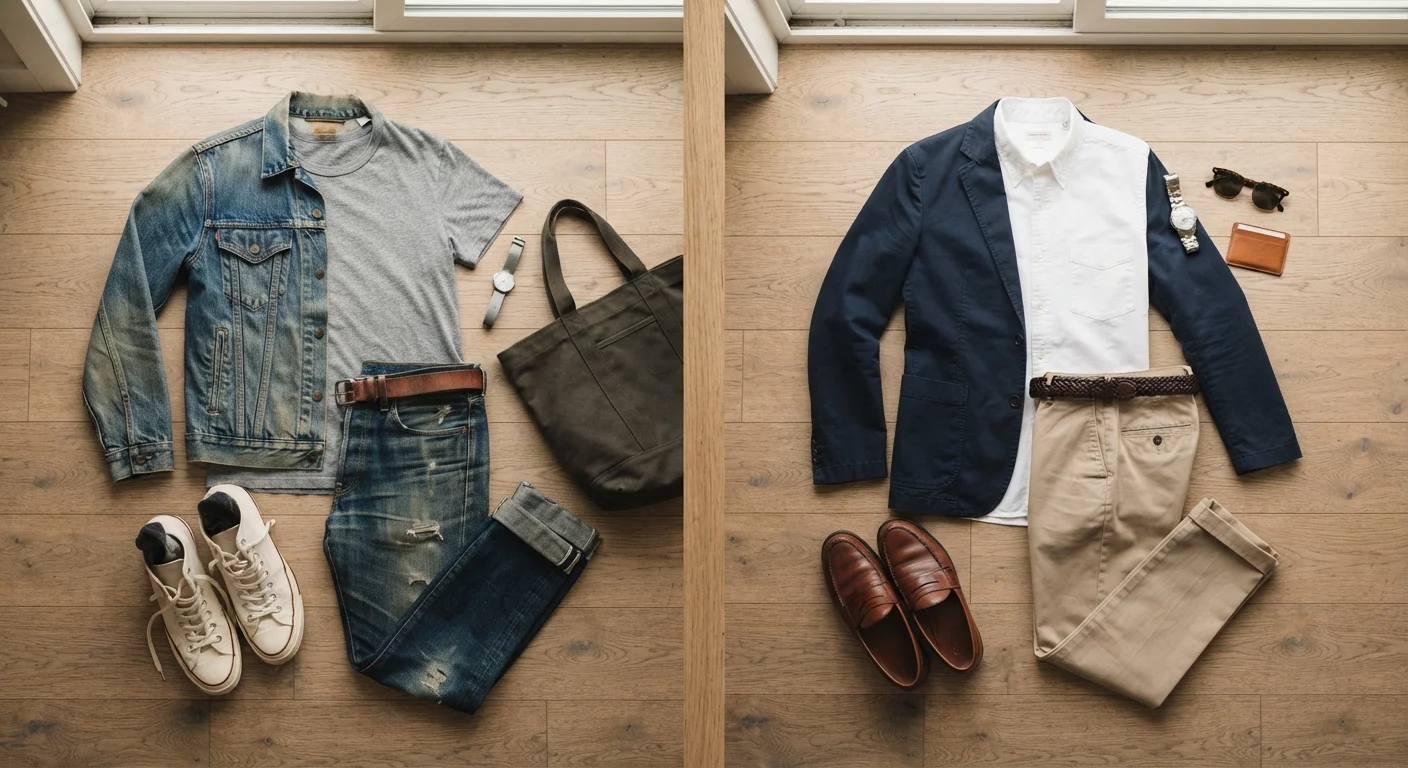
The Core Difference, Plainly Stated
Dress codes exist on a spectrum, and casual and smart-casual sit closer together than most people realise - which is exactly why the distinction trips everyone up. Understanding them isn't about memorising rules; it's about learning what signals you're sending with your clothes.
Casual means dressing purely for comfort and ease. Think worn-in jeans, graphic tees, hoodies, and sneakers. There's no expectation of coordination beyond basic decency, and the goal is simply to feel relaxed and unrestricted.
Smart-casual, by contrast, asks you to apply intentionality to that comfort. It's still relaxed - just elevated. The same jeans might work, but they're darker, better-fitted, and paired with a structured top and clean leather shoes. Smart-casual is the art of looking like you put in effort without appearing overdressed. For a deeper dive into how this fits within the full dress code landscape, the Dress Codes Decoded guide is a great place to start.
| Criterion | Casual | Smart-Casual |
|---|---|---|
| Primary goal | Comfort and ease | Polished but relaxed |
| Typical bottoms | Distressed or relaxed jeans, sweats | Dark jeans, chinos, tailored trousers |
| Typical tops | Graphic tees, hoodies, oversized knits | Button-downs, structured knits, blazers |
| Footwear | Sneakers, slides, worn-in boots | Loafers, leather sneakers, ankle boots |
| Occasion fit | Errands, home, casual meetups | Dinners, work socials, events |
| Accessories | Optional or minimal | At least one polished element |
The Details That Actually Separate Them
Once you know the philosophy, the practical differences become much easier to spot. Here's where the two codes diverge in real wardrobe terms:
- Fit: Casual tolerates oversized, slouchy, or relaxed silhouettes. Smart-casual generally favours clothes that fit closer to the body - not tight, but intentional.
- Fabric: Jersey, fleece, and distressed denim read casual. Crisp cotton, linen, ponte, or even refined knitwear reads smart-casual.
- Footwear: This is the single fastest signal. Chunky sneakers and flip-flops say casual; clean leather sneakers, loafers, ankle boots, or block-heeled sandals say smart-casual.
- Finishing touches: Smart-casual tends to include at least one polished element - a blazer, a structured bag, tailored trousers, or considered accessories. Casual skips these without consequence.
It's worth noting that smart-casual isn't uniform across contexts. A smart-casual wedding in the South may look different from a smart-casual gallery opening in Brooklyn. When in doubt, lean on the practical decision framework for ambiguous dress codes to calibrate your choice.
Smart-Casual Varies by Context
Smart-casual is one of the most context-dependent dress codes in existence. What reads as appropriately elevated at a casual outdoor wedding may be underdressed at a city restaurant's "smart-casual" request. When you receive an invitation with this label, it's always reasonable to ask the host or check the venue's own dress code guidelines. The full explanation of smart-casual breaks down these context variations in more detail.
Building Your Own Version of Each
Style becomes most powerful when it reflects who you are - not just what a dress code demands. Both casual and smart-casual are flexible enough to carry your personality. The key is building a wardrobe that moves fluidly between them without requiring a full outfit change every time the occasion shifts.
Start with a few transitional pieces that genuinely work across both registers: a well-cut dark jean, a simple merino crewneck, a clean white button-down, and one pair of shoes that's comfortable but polished. These become your building blocks.
From there, experiment with how small swaps change the register entirely. The same dark jeans tucked into ankle boots with a blazer reads smart-casual; paired with white sneakers and a hoodie, it's purely casual. The clothes are almost identical - the intentionality is what shifts. For a broader look at how different style philosophies shape these choices, comparing classic, trendy, and eclectic approaches to dressing offers useful perspective. Smart-casual especially rewards a personal signature - it's flexible enough to hold your identity while still meeting the occasion's expectations. For more practical everyday outfit ideas, explore the Everyday Fashion hub.
65%
Americans unsure what smart-casual means
Surveys on dress code comprehension consistently find that smart-casual is among the most misunderstood clothing labels, with large portions of respondents uncertain how to interpret it.
1 swap
Outfit changes needed to shift registers
Style educators often note that swapping a single element - shoes, a layer, or a bag - is typically enough to move an outfit from casual to smart-casual territory.