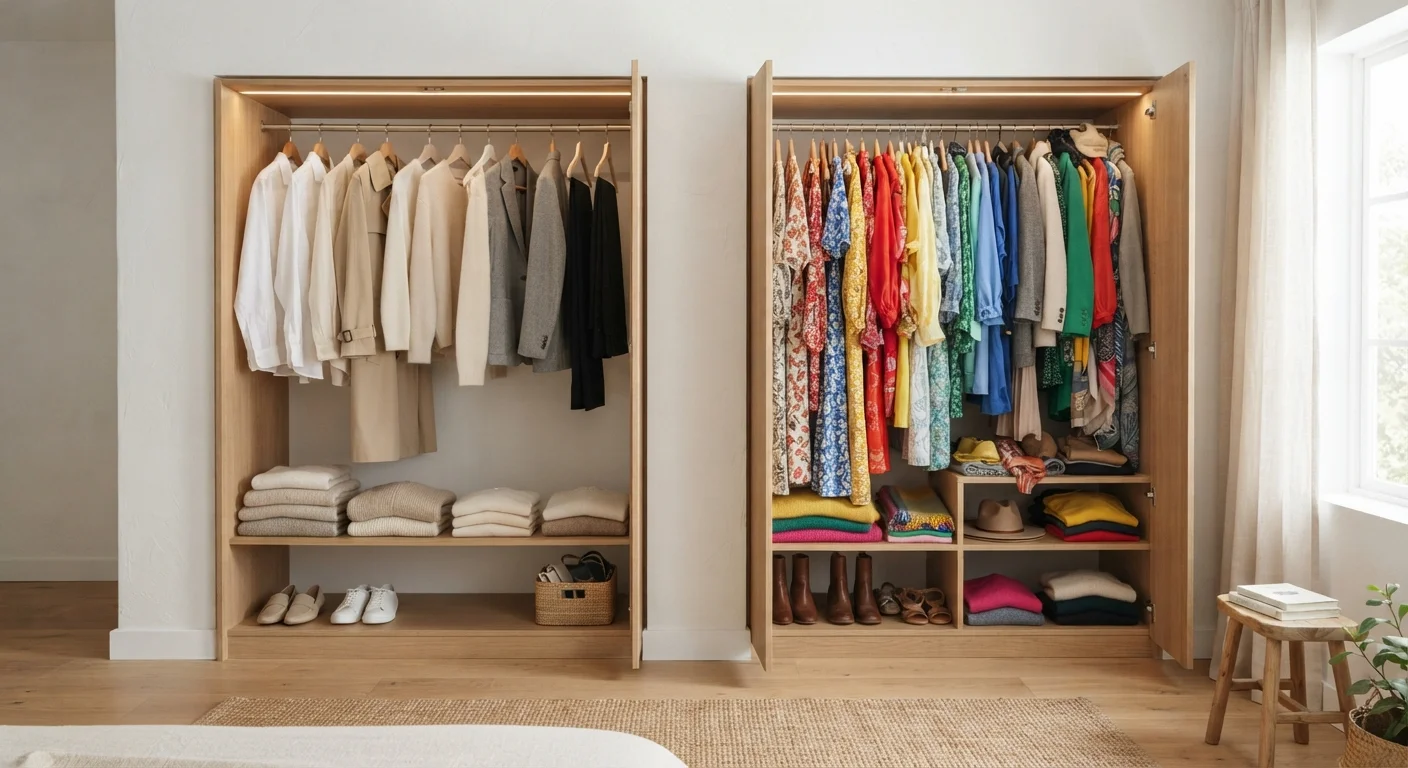
What Each Approach Actually Means
Before choosing a side, it helps to know what you're actually choosing between. A capsule wardrobe is a deliberately curated collection - typically somewhere between 25 and 50 garments - where every piece is selected to work with the others. The goal is maximum outfit combinations from minimum items. Think neutral anchors, clean silhouettes, and intentional additions rather than impulse buys.
A full wardrobe doesn't have a firm item count - it's simply a closet built around access and variety. It might include trend-driven pieces, items for specific occasions, sentimental favorites, and seasonal rotations. There's no constraint by design. For a deeper look at what capsule wardrobes really involve in practice, see what the concept really involves.
The distinction isn't just about quantity - it's about philosophy. Capsule dressing asks you to define your style tightly and shop with discipline. A full wardrobe invites exploration, accumulation, and reinvention over time. Neither is inherently wasteful or indulgent; it depends entirely on how you use what you own.
| Criterion | Capsule Wardrobe | Full Wardrobe |
|---|---|---|
| Typical item count | 25-50 pieces | No defined limit |
| Decision fatigue | Low - everything pairs easily | Can be high without organization |
| Creative expression | Moderate - intentional and cohesive | High - wide range of options |
| Storage requirements | Minimal | Substantial |
| Budget implications | Higher per-item spend, lower volume | Variable; can grow over time |
| Adaptability to life changes | Requires deliberate re-editing | Naturally accommodates variety |
| Best for routine type | Consistent, predictable days | Varied, occasion-heavy schedules |
How Your Daily Life Should Drive the Decision
The most useful question isn't "which approach is better?" - it's "which approach fits the life I actually live?" Your wardrobe should reflect your real routine, not a fantasy version of it. Aligning your style with your actual routine is one of the most underrated steps in building a closet that genuinely works.
If your days are fairly consistent - commuting to a professional setting, managing weekend errands, the occasional dinner out - a capsule wardrobe can cover all of it with room to spare. Fewer pieces means less time choosing, less laundry decision fatigue, and a more streamlined closet that's easy to maintain.
If your calendar is unpredictable - creative industry events, formal occasions, athletic activities, travel to different climates - a fuller wardrobe gives you options without improvising. Versatility here comes from having the right item for the right moment, not from mixing and matching endlessly from a narrow pool.
80%
Of clothes worn only 20% of the time
A commonly cited wardrobe audit finding suggests most people regularly wear only a small fraction of what they own, regardless of closet size.
~33
Items in a classic capsule wardrobe
The original capsule wardrobe concept, popularized in the 1970s and later refined, typically recommends around 33 core items per season.
It's also worth thinking about storage. A capsule approach works beautifully in a small apartment or shared space. A full wardrobe needs room to breathe - overcrowding a closet with pieces you love doesn't serve anyone well. For practical guidance on making one wardrobe stretch across different occasions, making one wardrobe do double duty offers real, workable ideas.
The Trade-Offs Worth Knowing
Both approaches come with genuine advantages - and real limitations that don't always show up in the glossy Pinterest versions.
With a capsule wardrobe, the upside is clarity. Getting dressed is quicker, your style reads as intentional, and shopping becomes a more deliberate act. The challenge? If your taste shifts, a life event changes your dress code, or you simply want more creative range, a tight edit can start to feel restrictive. The honest pros and cons of owning a very small wardrobe walks through this honestly.
A full wardrobe, on the other hand, gives you expressive freedom. You can dress for your mood, experiment with trends, and adapt to wildly different occasions without stress. The trade-off is management - more items require more attention, more storage, and more willpower to avoid wearing the same ten things anyway while the rest hangs untouched.
Your Wardrobe Reflects More Than You Think
Clothing choices are rarely just practical - they're often tied to identity, mood, and self-perception. If you're finding that neither a minimal nor a maximal closet feels quite right, it may be worth reflecting on what you want your style to communicate. What your wardrobe reveals about your self-image explores this connection in depth and may help clarify your approach.
There's also a financial dimension. A capsule wardrobe often encourages spending more per piece on quality items you'll wear constantly. A full wardrobe may involve lower per-item costs but a higher overall spend if shopping isn't thoughtful. If you're actively budgeting your clothing expenses, basic budgeting strategies can help you think through what you can realistically allocate to either approach.
Finding Your Middle Ground
Here's the truth most style conversations skip: the cleanest answer for most people isn't fully one or the other. A hybrid approach - building a capsule-style core of reliable, versatile pieces and adding a curated layer of expressive items - gives you structure without rigidity.
Start by identifying what you wear on at least 80% of your days. Those items form your functional core. Then ask yourself what you genuinely reach for to express personality, mark a special occasion, or simply because you love them. Those are your intentional extras - not clutter, but considered additions that expand the emotional range of your closet.
Your wardrobe is also not a static thing. Seasons shift, life circumstances change, and personal style evolves. Transitioning your wardrobe between seasons without a full shopping haul is a skill that serves both capsule and full wardrobe owners equally well.
Ultimately, the wardrobe that suits your lifestyle is the one you actually use - where you open the closet and feel capable, comfortable, and like yourself. That's the metric worth optimizing for, whatever the item count.