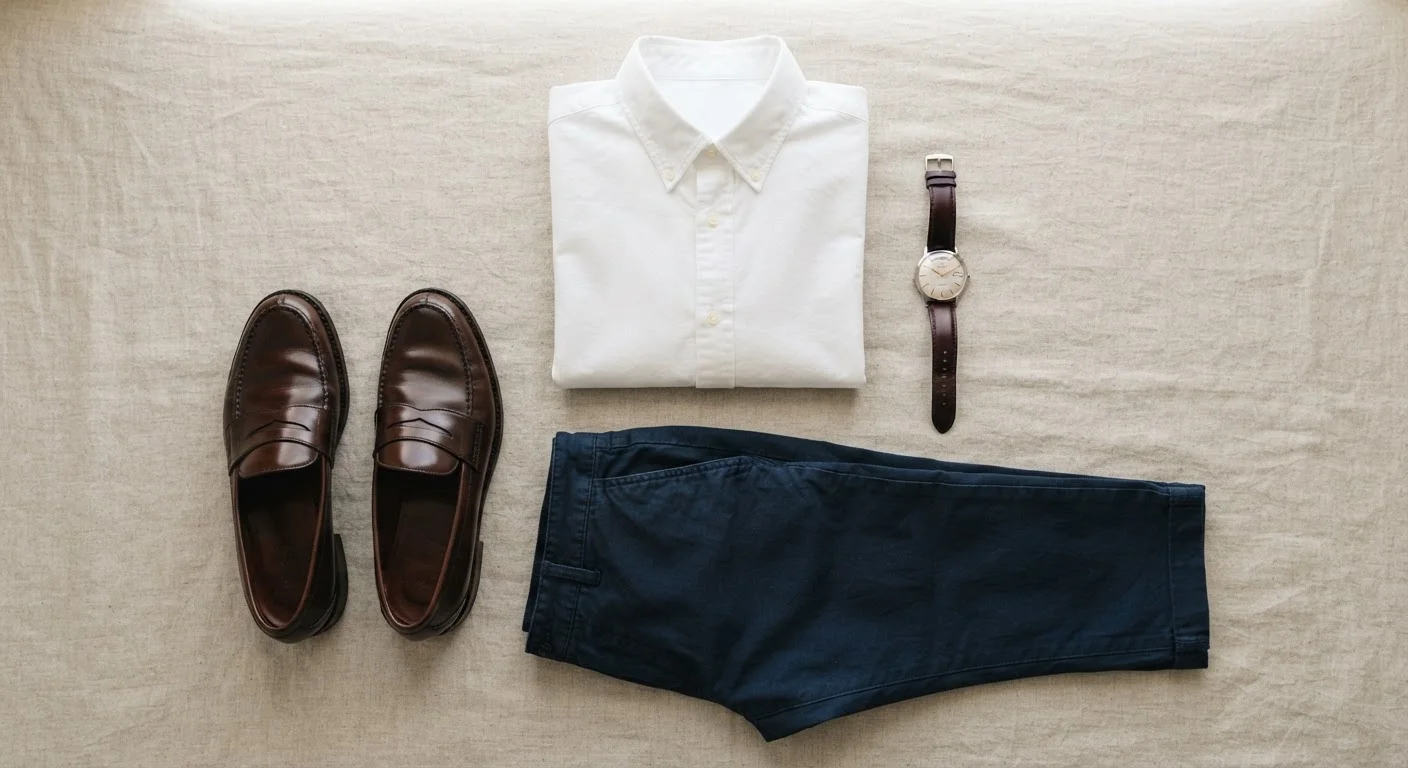
Why Smart Casual Causes So Much Confusion
Dress codes exist to give people a shared starting point - a shorthand for the energy and formality of an occasion. Most of them do their job reasonably well. "Black tie" is clear. "Beach casual" is clear. But "smart casual" manages to be both everywhere and somehow never fully defined.
Part of the problem is the phrase itself. "Smart" is a British English term meaning neat or sharp-looking, but it doesn't carry that meaning universally in American English. To many people, "casual" is the louder of the two words, which is exactly how underdressing happens. Others read "smart" as the dominant signal and show up in a blazer and dress shirt to a laid-back rooftop party, feeling overdressed the moment they walk in.
The ambiguity is also structural. Unlike "business formal" or "cocktail attire," smart casual has no agreed-upon rulebook. It shifts depending on the industry, the city, and even the host's personal taste. Understanding the difference between casual and smart casual is a solid first step in cutting through that fog.
Smart Casual Isn't Universal
What counts as smart casual can shift noticeably depending on region and industry. A tech company in San Francisco may read clean jeans and a blazer as smart casual, while a law firm in Atlanta might expect pressed trousers and a collared shirt at minimum. When the stakes are higher, it's always worth leaning slightly more polished rather than testing the lower boundary.
The Core Principle: Polished Without Being Stiff
Strip away the ambiguity and smart casual really comes down to one idea: your outfit should look intentional. You've thought about what you're wearing. Things fit properly, they're clean, and they work together as a cohesive look. That's actually most of the battle.
This means well-fitting trousers or dark jeans, a button-down or neat knit top, and shoes that aren't athletic. For women, a tailored blazer over a simple blouse, a midi dress with ankle boots, or smart trousers with a polished top all land squarely in the zone. For men, chinos with a collared shirt - tucked or neatly untucked - covers a huge range of smart casual situations.
Fit is non-negotiable. A moderately priced outfit that fits well will always look sharper than an expensive one that doesn't. If you're unsure whether something reads as smart casual, ask yourself: "Does this look like I made a deliberate choice?" If the answer is yes, you're probably on solid ground.
The "One Step Up" Rule
When you're genuinely unsure where your outfit lands, apply the one-step-up rule: take whatever you'd wear for a comfortable day out and elevate it by one notch. Swap sneakers for loafers, add a blazer over a simple top, or choose a structured bag instead of a backpack. Small upgrades add up quickly and almost always push an outfit into smart casual territory without effort.
Smart Casual Across Different Contexts
Context shapes the interpretation significantly. A smart casual dress code at a creative agency's team dinner in a major city will look different from a smart casual wedding rehearsal dinner in a smaller town - and both will differ from a smart casual work-from-office day.
As a general rule, look at the venue, the host, and the nature of the event. A restaurant with linen tablecloths and a prix-fixe menu suggests the higher end of smart casual. A casual outdoor engagement party suggests the lower end. When you can, ask the host or check if others who have attended similar events have posted photos. Context clues are your best friend.
For situations where the dress code is genuinely ambiguous, navigating uncertain dress expectations offers a practical decision framework that takes the guesswork out of getting dressed.
Building a Smart Casual Wardrobe Without Starting Over
The good news is that most people already own the majority of what they need. Smart casual draws heavily from the kinds of pieces that naturally live in an American wardrobe - it just asks you to reach for the neater versions.
41%
Americans uncertain about dress code interpretations
A survey by the Emily Post Institute found roughly 4 in 10 Americans report feeling unsure how to interpret dress codes like smart casual for social events.
1 in 3
People who've shown up over- or underdressed
Consumer research on social dress anxiety consistently finds that a significant portion of adults have experienced the discomfort of misjudging a dress code at least once.
Dark jeans without distressing, clean chinos, a few collared shirts or elevated knit tops, one or two blazers, and a solid pair of leather-look or suede shoes will handle an enormous range of smart casual situations. Layering matters too: a well-chosen jacket elevates just about any look almost instantly.
If you're trying to make a single wardrobe work across more than one context, making one wardrobe do double duty covers exactly how to get more mileage from the pieces you already have. Smart casual is often the sweet spot that makes that kind of versatility possible.