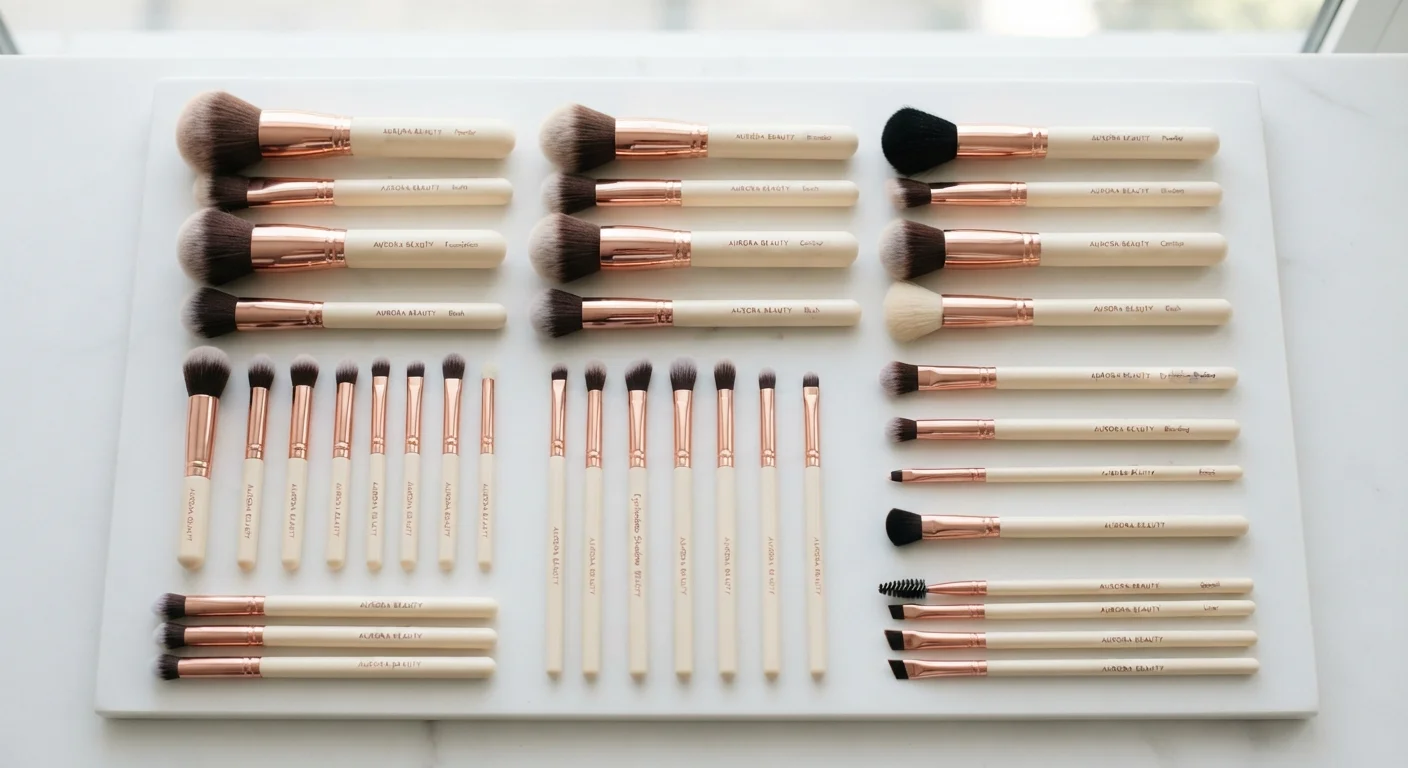
Why Brush Shape and Size Actually Matter
Walk into any beauty aisle and you'll encounter a wall of brushes - fluffy ones, tiny ones, flat ones, angled ones - with names that offer little guidance. The good news: brush design isn't arbitrary. Shape, density, and bristle type are all intentional, each engineered to move product in a specific way. Once you understand the logic, the whole kit clicks into place.
Before diving into individual brushes, check out our guide on skin prep before makeup - because the canvas you're working on matters just as much as the tools you use.
| Brush bristle types | Natural (animal hair) or synthetic (nylon/taklon) |
| Best bristle for powder products | Natural or fluffy synthetic |
| Best bristle for liquid/cream | Dense synthetic bristles |
| Minimum functional kit size | 4-6 brushes cover most everyday looks |
| Recommended cleaning frequency | Weekly for face brushes; after each use for eye brushes (General dermatology and cosmetic guidance) |
Face Brushes: Coverage, Contour, and Everything Between
Face brushes cover the most surface area and handle the heaviest lifting in any routine.
- Foundation brush: Flat or slightly domed, this brush buffs liquid or cream foundation into skin with a smooth finish. Stippling brushes - those with two layers of bristles - create an airbrushed, buildable effect with less product.
- Kabuki brush: A short-handled, densely packed brush designed to buff powder products (setting powder, bronzer, mineral foundation) across broad areas quickly. Its compact shape provides pressure and control in a circular or sweeping motion.
- Powder brush: Large and fluffy, this brush applies loose or pressed setting powder in a light, diffused layer. It's meant for a soft touch - not heavy coverage.
- Contour brush: Angled or tapered, this brush deposits bronzer or contour powder precisely along cheekbones, jawlines, and the sides of the nose.
- Fan brush: A delicate, wide-spread brush for dusting highlighter across cheekbones or removing fallout from under the eyes. Its sparse bristles deposit product lightly, making it ideal for a subtle glow.
- Blush brush: Similar to a powder brush but smaller and sometimes angled, designed for placing color onto the apples of the cheeks or sweeping it upward toward the temples.
Kabuki brush
A short-handled, densely packed brush traditionally used to apply powder products like mineral foundation or bronzer. Its compact shape delivers controlled, buildable coverage with a buffing motion.
Stippling brush
A dual-fiber brush with two layers of bristles - typically shorter synthetic fibers and longer natural-style fibers - that creates a diffused, airbrushed finish when applying liquid or cream products.
Spoolie
A spiral-bristled grooming tool used to comb, shape, and blend brows and to separate lashes after mascara application. Often found on the reverse end of brow pencils.
Shader brush
A flat, densely packed eyeshadow brush designed to press pigment onto the eyelid with intensity, maximizing color payoff without diffusing the product.
Blending brush
A fluffy, dome-shaped eye brush used to soften and blend eyeshadow edges, diffuse color into the crease, and create seamless transitions between shades.
Fan brush
A wide, spread-out brush with sparse bristles used to apply highlighter lightly or sweep away fallout. Its open shape deposits product in a subtle, controlled layer.
Eye and Detail Brushes: Precision Where It Counts
Eye brushes are where specificity really pays off. Using the wrong shape here often means muddy blending or misplaced liner.
- Flat shader brush: Packed bristles, flat edge - this is for pressing eyeshadow onto the lid with intensity. It deposits color without blending it away.
- Fluffy blending brush: The dome-shaped workhorse of the eye. Use it in windshield-wiper motions to blend harsh lines, diffuse shadow into the crease, and create seamless transitions between shades.
- Pencil brush: Narrow and tapered, this brush places pigment precisely - inner corners, lower lash line, detailed smudging. Think of it as a controlled dot applicator.
- Angled liner brush: Thin and slanted, perfect for drawing sharp liner with gel, cream, or pressed shadow. It can also define and fill brows with powder.
- Spoolie: Technically a tool, not a brush - the spiral bristles comb and shape brows, blend brow product, and separate lashes after mascara.
Keeping these brushes clean isn't just about hygiene - it preserves their shape and performance. See our guide to cleaning makeup brushes for the right technique and frequency.
Building a Kit That Works for You
You don't need every brush category to build a functional kit. A flat foundation brush, a large powder brush, a blending brush, and a spoolie cover the fundamentals for most everyday looks. Add specialty brushes - contour, fan, pencil - as your technique and interest grow.
For a broader picture of how brushes fit into a full routine, our complete overview of daily beauty routine basics walks through every step from skincare to finish. Understanding each tool's purpose is the first step toward using them confidently - and that confidence is the real foundation of any good look.
Natural vs. Synthetic Bristles: A Quick Note
Natural bristles (made from animal hair) are traditionally favored for powder products because they pick up and distribute loose pigment well. Synthetic bristles are better suited to liquid and cream formulas - they don't absorb as much product and are easier to clean. Many modern synthetic brushes perform well across both categories, making them a versatile and widely available option.