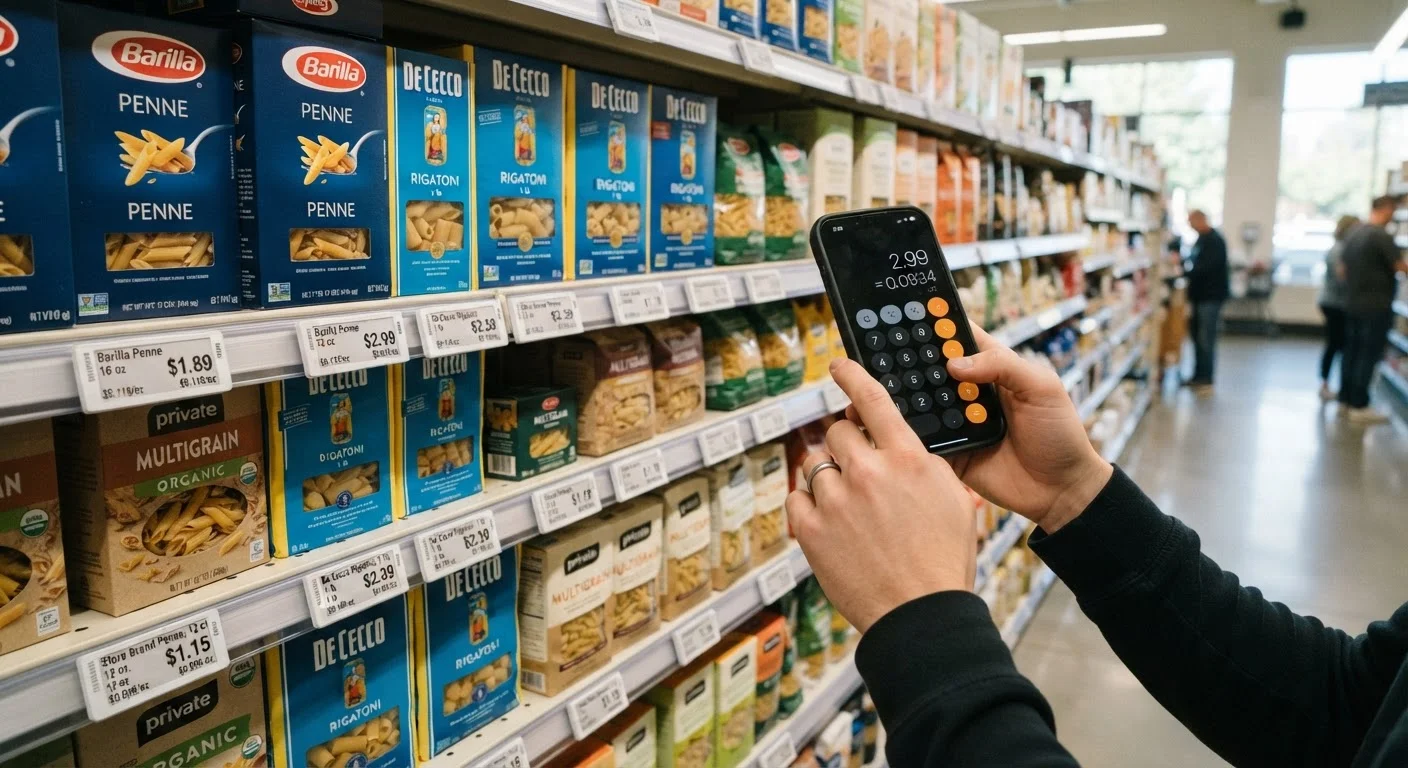
Why the Sticker Price Misleads You
Retailers present prices in dozens of formats: a 12-pack for $8.99, a 16 oz bottle for $3.49, a "club size" 48 oz for $11.99. Each number is accurate. None of them, by itself, tells you which option costs less per ounce, per sheet, or per serving. That's not an accident.
As pricing strategy research shows, retailers structure prices to favor certain comparisons over others. A larger package signals savings through sheer size - but the per-unit math doesn't always bear that out. Without converting to a shared denominator, you're comparing inches to centimeters and calling it a fair race.
Package price answers one narrow question: Can I afford this item today? Per-unit pricing answers a different, more useful one: Am I getting more for my money than the alternative? Both questions matter, but they're not interchangeable.
How Per-Unit Pricing Works - and Why Retailers Make It Hard
Per-unit price is simply the package price divided by the quantity inside, expressed in a consistent unit: price per ounce, per count, per square foot, per fluid ounce. The math is straightforward. The challenge is that retailers don't always use the same unit across competing products - or the shelf tag buries the figure in small print.
| Per-Unit Pricing | Package Price | |
|---|---|---|
| Best use | Comparing value across sizes or brands | Budget planning and checkout decisions |
| Calculation required | Yes - divide price by quantity | No - shown directly on the tag |
| Reveals shrinkflation | Yes - exposes cost increases hidden by same sticker price | No - unchanged price masks reduced quantity |
| Accounts for storage limits | No - ignores whether you can use the quantity | Indirectly - total cost reflects package size |
| Retailer manipulation risk | Low - normalized measure resists framing | High - package size and design influence perception |
| Ease of use in-store | Moderate - requires checking unit labels or calculating | High - immediately visible |
For a practical breakdown of how to read shelf labels, unit pricing shelf tag math covers the common formats and edge cases in detail. The short version: divide total price by total quantity, and always verify the unit matches between the two items you're comparing.
Shrinkflation - when manufacturers reduce package size without reducing price - makes this skill especially important. A box that has always cost $4.29 may now hold 10% fewer crackers. The package price didn't change; the per-unit price did.
"Bulk" Doesn't Always Mean Cheaper Per Unit
Warehouse and club-size packages carry a strong implied promise of savings, but that promise isn't always kept. Manufacturers and retailers set bulk pricing strategically, and the per-unit figure can occasionally be higher than the standard size - particularly when the standard size is on sale. Always run the numbers rather than assuming size equals value. This is especially relevant for perishables, where waste can eliminate any per-unit savings.
When Package Price Still Matters
Per-unit pricing wins on value comparisons, but package price serves real purposes. It determines whether an item fits your budget at checkout. It's the number that drives whether a product fits within a specific shopping trip's spending target - a concern covered in more depth in the context of budgeting basics.
Package price also matters when storage or use rate is a factor. A bulk purchase of 200 trash bags may carry a better per-unit cost, but if you have nowhere to store them or won't use them before they degrade, the "savings" evaporate. The relevant comparison is really cost-to-use - a concept price-per-use math addresses directly.
~30
U.S. states with unit pricing laws
According to Consumer Reports research, roughly 30 U.S. states have laws requiring unit price disclosure, though enforcement and display format vary considerably by retailer and product category.
9%
Average package size reduction in shrinkflation cases
Research from the Bureau of Labor Statistics and academic economists has documented average package size reductions of roughly 9% in common consumer goods categories during recent inflationary periods, without corresponding price decreases.
Neither metric is independently sufficient. A disciplined shopper uses package price to set a budget ceiling and per-unit price to maximize value within it.
Putting It Into Practice
The calculation is simple enough to do on a phone. Divide the shelf price by the quantity, and write it down or keep a running note if you're comparing multiple options. Many grocery apps and price tracking tools can surface historical price data that adds further context - useful for confirming whether a "sale" price genuinely represents a reduction in per-unit cost.
Quick In-Store Unit Price Check
Before dropping an item in your cart, open your phone's calculator and divide the shelf price by the count or weight. Compare that number - not the sticker - against other sizes and brands. If the retailer's shelf tag already shows a unit price, verify it uses the same unit as competing products; mismatched units (e.g., per ounce vs. per pound) are a common source of confusion.
Watch for unit inconsistencies between products. Paper towels measured in "sheets" can vary dramatically in sheet size. Coffee measured in "cups" can reflect different brew strengths. When units aren't equivalent, adjust: a 100-count pack of full-size sheets isn't the same as a 100-count pack of half-size sheets, even if both show the same per-sheet price.
Retailers' use of cognitive shortcuts to shape perception - framing, anchoring, and urgency signals - can nudge shoppers away from doing this math. Understanding price psychology tactics helps you recognize when the presentation of a price is designed to discourage comparison rather than enable it. Per-unit math is the antidote: a consistent, retailer-neutral standard you control.