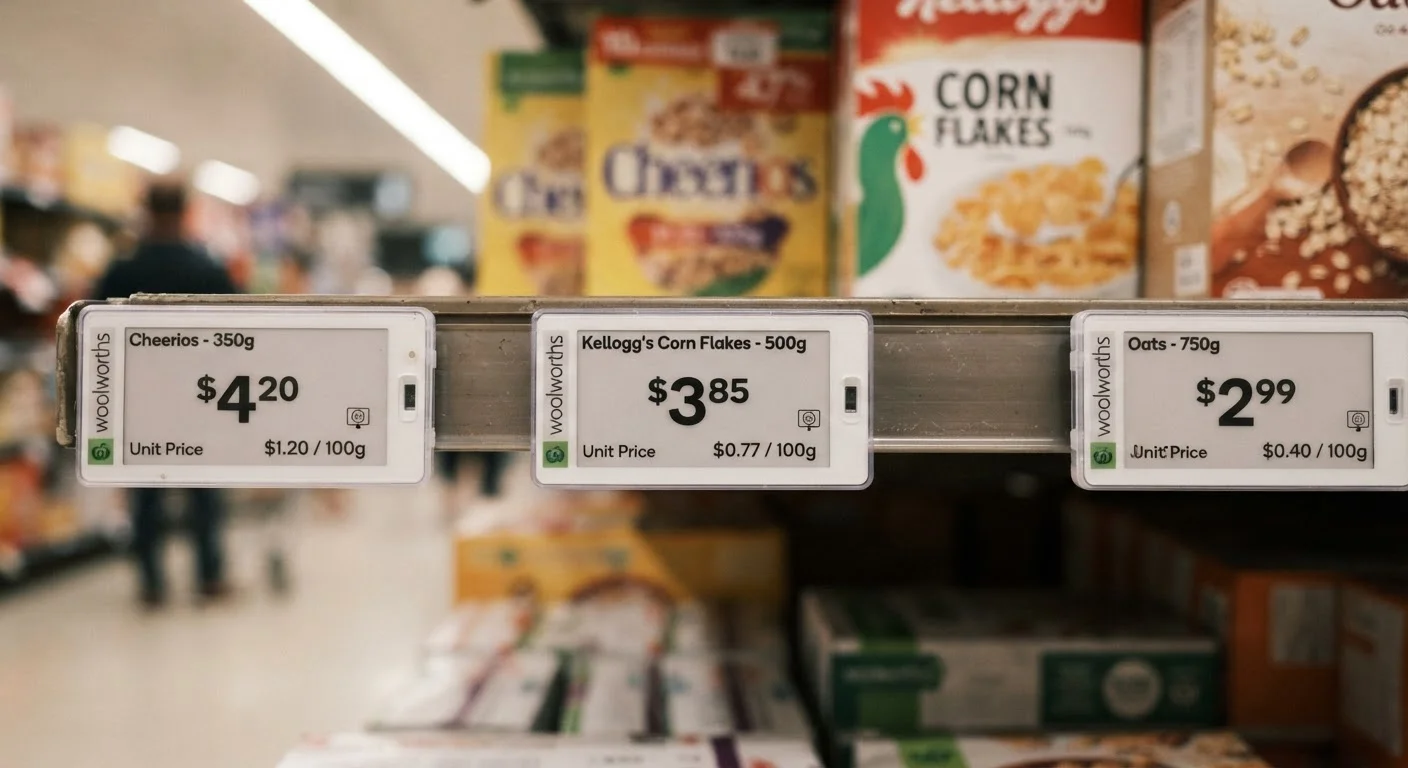
What the Shelf Tag Is Actually Telling You
Walk down any grocery aisle and you'll see two numbers on most shelf tags: the package price in large print, and a smaller figure that represents the unit price. That smaller number is the one worth focusing on. It converts the package cost into a standard measure - cents per ounce, dollars per 100 count, cents per square foot of paper towel - so that wildly different package sizes become directly comparable.
For example, a 16 oz jar of peanut butter priced at $3.84 has a unit price of 24 cents per ounce. A 40 oz jar at $8.40 works out to 21 cents per ounce. Without the unit price calculation, the larger jar just looks more expensive. With it, the cost difference becomes immediately visible.
Understanding this math connects directly to a broader principle: the sticker price is rarely the whole story. As explored in our total cost of ownership guide, the number on the front of a package is only one variable in what you actually spend.
~30%
Potential savings from consistent unit-price comparison
Consumer research has found shoppers who actively use unit pricing can reduce grocery spend by roughly 17-30% compared to price-tag-only decision-making, according to studies cited by the U.S. Federal Trade Commission.
32
U.S. states with mandatory unit pricing laws for food retailers
As of available federal and state consumer protection records, approximately 32 states have some form of unit pricing requirement for grocery or food stores, though coverage and enforcement vary.
Common Traps That Make Unit Pricing Confusing
Unit pricing is straightforward in principle, but retailers don't always make it easy in practice. Three patterns trip up even attentive shoppers:
- Inconsistent units within a category. One brand of olive oil might be priced per fluid ounce; another per 100 ml. Converting between those requires extra arithmetic that most shoppers skip, which is exactly the kind of confusion that retailers rely on to nudge you toward a higher-margin option.
- Sale prices that don't lower the unit price proportionally. A "buy two, get one 50% off" promotion can look attractive but may still yield a worse unit price than a competing brand's everyday price. Run the numbers on the actual cost of the units you'd take home.
- Shrinkflation obscuring the comparison. When a manufacturer reduces package size without changing the price, the unit price quietly rises. A tag that looked competitive last month may no longer be after a quiet reformulation.
For a deeper look at how package size and total price interact, see our article on per-unit pricing versus package price.
Quick Check Before You Grab a Package
Before placing an item in your cart, glance at the unit price - not the package price. If two similar items use different units (oz vs. grams, for instance), use your phone's calculator to convert them to the same measure. This 10-second habit pays off across an entire shopping trip.
Applying Unit Price Math Beyond the Grocery Aisle
Unit pricing logic extends well past canned goods. For household supplies like paper towels, the relevant unit is usually cost per sheet - not per roll or per pack. For laundry detergent, it's cost per load. For batteries sold in mixed packs, it's cost per battery. Whenever a product is sold in variable quantities, dividing the total price by the number of usable units gives you a workable comparison figure.
This approach overlaps with cost-per-use thinking. A product with a lower unit price but a shorter effective lifespan may not deliver the savings it appears to offer. Our price-per-use framework walks through how to account for durability and frequency of use alongside the raw unit price.
Unit Price Doesn't Account for Expiration
A bulk purchase with a great unit price is only a genuine saving if your household will use the product before it expires or degrades. Perishables, vitamins with potency dates, and products sensitive to storage conditions all warrant extra thought before you commit to the largest available size.
Keeping a simple habit - checking the unit price shelf tag before placing an item in the cart, rather than after - is one of the lowest-effort, highest-return practices in everyday shopping. It requires no app, no loyalty card, and no special knowledge beyond knowing which unit measure the tag is using.
For a fuller picture of the forces that shape what you ultimately pay, including dynamic pricing and geographic variation, the complete guide to price variables is a useful reference. Shoppers working toward tighter budget discipline will also find unit pricing naturally supports the goals covered in budgeting basics.