The Core Financial Comparison
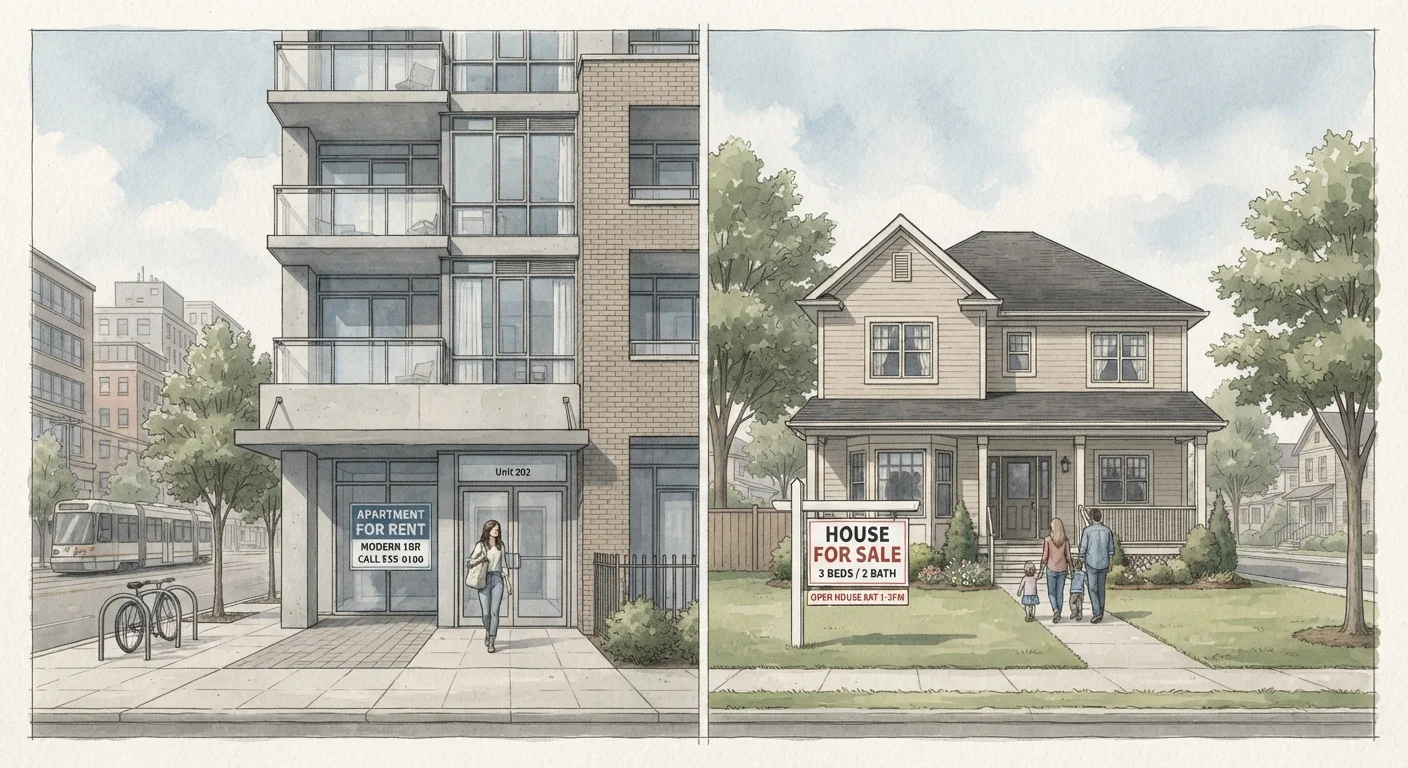
The rent-vs.-buy debate is most often framed as a monthly payment contest - but that framing misses significant costs on both sides. For renters, the visible cost is the monthly rent check. What's less obvious are application fees, security deposits, pet fees, and parking charges. Our guide to the hidden costs of renting covers many expenses that listings routinely omit.
For buyers, the mortgage payment is only one piece. Property taxes, homeowner's insurance, private mortgage insurance (PMI - required when a down payment is below 20%), HOA fees where applicable, and routine maintenance typically add 1-3% of a home's value annually in upkeep alone. A thorough analysis also needs to account for closing costs, which commonly run 2-5% of the purchase price.
One useful framework is the price-to-rent ratio: divide a home's purchase price by annual rent for a comparable property. Ratios above 20 generally suggest renting is more cost-competitive; ratios below 15 tend to favor buying. Markets vary widely, and this ratio is a starting point, not a verdict. For a deeper look at how savings and debt interact with this decision, see the savings and debt dimensions of renting vs. buying.
65.6%
U.S. homeownership rate
According to the U.S. Census Bureau, roughly two-thirds of American households own their home, though this figure varies significantly by age group and income level.
5-7 years
Typical break-even timeline for buying
Housing economists generally estimate buyers need to hold a property for at least five to seven years to offset transaction costs and early-year interest payments through equity and appreciation.
1-3%
Annual home maintenance cost estimate
Industry guidance commonly suggests budgeting 1-3% of a home's purchase price per year for maintenance and repairs, though older homes and certain climates can push costs higher.
Pros and Cons of Renting
Renting suits a wider range of situations than it's often given credit for, particularly in high-cost housing markets or for households anticipating life changes in the near term.
Lower upfront financial commitment
Renters typically need a security deposit and first month's rent to move in - far less than the 3-20% down payment plus closing costs required to buy. This preserves capital for other financial goals.
Flexibility to relocate without financial penalty
Lease terms are typically 12 months, making it far easier to move for work, family, or lifestyle reasons compared to selling a home, which carries transaction costs of 6-10% of the sale price.
Predictable, limited maintenance responsibility
In most rental agreements, the landlord is responsible for major repairs and structural maintenance. Renters avoid the unpredictable costs of replacing a roof, water heater, or HVAC system.
Access to amenities without ownership costs
Many rental communities include fitness centers, pools, or concierge services that would cost substantially more for a homeowner to replicate independently.
That said, renting has real financial limitations that compound over time.
Rent payments build no equity
Every rent payment goes to the landlord with no financial return to the renter. Over a decade or more, this represents a substantial transfer of wealth with no ownership stake accumulated.
Susceptibility to rent increases and eviction
Landlords can raise rent at lease renewal or choose not to renew a lease, creating instability that homeowners with fixed-rate mortgages don't face. In tight rental markets, these increases can be significant.
Limited control over the living space
Renters generally cannot make structural changes, repaint without approval, or keep certain pets. This limits personalization and can reduce the sense of ownership over one's living environment.
For renters navigating affordability questions, understanding what landlords will negotiate on can meaningfully reduce monthly costs. And for renters comparing rental types, our overview of apartment vs. house rental trade-offs can inform the search.
The Ownership Equation: Equity, Stability, and Risk
Homeownership is frequently described as the cornerstone of household wealth-building in the U.S. - and historically, real property has appreciated over long periods. But appreciation is not guaranteed, varies significantly by location, and does nothing for owners who sell too soon after purchase.
The equity argument is real but nuanced. In the early years of a fixed-rate mortgage, the majority of each payment goes toward interest rather than principal. An owner typically needs to hold a property for five to seven years at minimum before selling costs and interest payments are offset by equity gains and appreciation. Those who move sooner may find they'd have been better off renting.
Stability is a genuine advantage: a fixed-rate mortgage payment doesn't rise the way rent can in a competitive market. Owners also have full control over their space - renovations, pets, paint colors - without landlord approval. For a framework covering the full range of financial, lifestyle, and market factors involved, see the factors that actually matter in the rent-vs.-buy decision.
What a Mortgage Actually Covers
A mortgage payment is typically broken into principal, interest, property taxes, and homeowner's insurance - often abbreviated as PITI. In the early years of a 30-year mortgage, the majority of each payment goes toward interest rather than reducing the loan balance. Understanding this amortization structure is important context when comparing total ownership costs against renting over short time horizons.
Owning also introduces risks renters don't carry: a leaking roof, failed HVAC system, or structural issue becomes the owner's financial responsibility entirely. These expenses are unpredictable and can be substantial. Budgeting for a home reserve fund - often recommended at 1-2% of home value annually - is a standard part of responsible ownership planning. For broader budgeting strategies, budgeting basics offers practical guidance.
Lifestyle Factors That Often Outweigh the Math
Even when the financial math favors buying, personal circumstances can make renting the more sensible choice. Job stability, relationship status, family plans, and geographic preferences all affect how long someone realistically stays in one place - and time horizon is the single biggest variable in whether buying pays off.
Renters tend to find it easier to relocate for career opportunities, and in cities where housing prices are elevated relative to incomes, renting near transit and employment hubs can cost far less than buying a comparable property. Our look at urban, suburban, and rural living trade-offs explores how location shapes both cost and lifestyle in meaningful ways.
Owners, by contrast, often report greater psychological stability and community connection. Research consistently finds that long-term homeowners tend to be more engaged in local civic life - though this likely reflects the self-selection of people who intend to stay. For a closer look at how tenure status shapes neighborhood experience, see how renting vs. owning shapes your relationship to your neighborhood.
The decision also intersects with credit. Buying requires qualifying for a mortgage, which depends heavily on credit scores, debt-to-income ratios, and documented income - barriers that effectively make renting the only near-term option for some households. For those on the renting side of that equation, thinking through the rent-or-buy decision holistically is a useful starting point.
This article is for general informational and educational purposes only and does not constitute personalized financial, legal, or investment advice. Readers should consult a qualified financial adviser or real estate professional before making housing decisions.