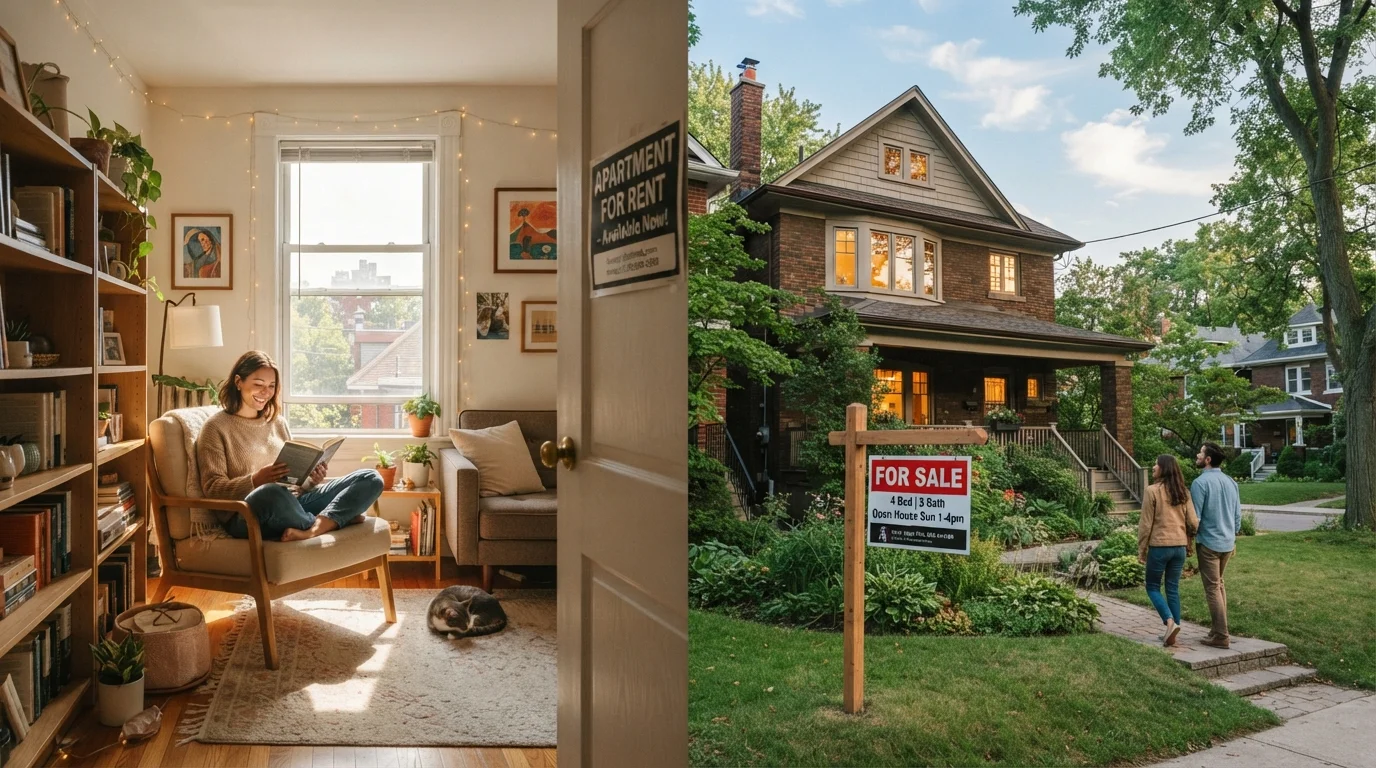
The Question Behind the Question
The rent-or-buy debate is often framed as a purely financial calculation - but it's equally a question about life stage, priorities, and how much uncertainty you're comfortable with. Before running numbers, it helps to clarify what you actually need from your housing situation.
Renters and owners have fundamentally different relationships to their homes and communities. As explored in how tenure status shapes neighborhood engagement, even people living on the same block often experience their neighborhood differently depending on whether they own or rent. That social and psychological dimension is part of the decision, not separate from it.
The financial structure of each path also differs in ways that aren't always obvious at first glance. A framework for evaluating your financial situation and timeline can help clarify which factors carry the most weight for your circumstances.
Key Financial Differences
Renting requires relatively little upfront: typically a security deposit and first month's rent. Buying demands significantly more capital - a down payment (commonly 3-20% of the purchase price), closing costs (typically 2-5%), and cash reserves for immediate repairs or move-in expenses.
| Criterion | Renting | Buying |
|---|---|---|
| Upfront costs | Security deposit + first month | Down payment + closing costs (5-25%+) |
| Monthly cost predictability | Fixed rent (subject to renewal increases) | Fixed mortgage; variable taxes, maintenance |
| Equity building | None | Yes, over time through principal paydown |
| Flexibility to relocate | High (lease end or break fee) | Low (listing, sale, closing timeline) |
| Maintenance responsibility | Landlord's responsibility | Fully owner's responsibility |
| Control over the space | Limited by lease terms | Full control within local codes |
| Market risk exposure | Minimal | Significant (value can rise or fall) |
Monthly costs also differ in structure. A fixed-rate mortgage payment is predictable, but total ownership costs include property taxes, homeowners insurance, HOA fees where applicable, and ongoing maintenance - often estimated at 1-2% of a home's value annually. Rent, by contrast, is the ceiling of your monthly housing cost, not the floor.
There are also savings and debt dimensions that deserve attention. The savings and debt implications often left out of the rent-vs.-buy debate - including how mortgage debt affects borrowing capacity and how renters can invest capital differently - are worth examining before deciding.
Lifestyle and Flexibility Considerations
Flexibility is renting's clearest advantage. Renters can relocate for jobs, relationships, or personal preference with far less friction than homeowners, who must navigate listing, negotiation, and closing timelines. This matters significantly for people early in careers, in transitional life stages, or living in cities with volatile job markets.
Ownership, on the other hand, provides stability and control. Owners can renovate, repaint, adopt pets freely, and make decisions about their space without landlord approval. That autonomy has real quality-of-life value - though it comes with the full burden of maintenance and repair.
Renter Protections Vary Widely by Location
Tenant rights - including rent stabilization, eviction protections, and habitability standards - differ significantly by state and municipality. Renters in some markets have strong legal protections; in others, landlords have considerable latitude. Understanding your local tenant rights is an important part of evaluating the rental path. Local housing agencies and tenant advocacy organizations can provide jurisdiction-specific guidance.
For a broader look at what renting and owning mean for financial and personal trade-offs, the financial and lifestyle trade-offs of renting vs. owning covers both dimensions in depth.
When Market Conditions Shift the Math
Local housing markets can dramatically alter which option makes more financial sense. In markets where home prices have surged well beyond what local incomes support, the monthly cost of buying often exceeds renting comparable space - sometimes by a wide margin. In more affordable markets, buying can be competitive with or cheaper than renting over a similar time horizon.
One useful metric is the price-to-rent ratio: the ratio of a home's purchase price to its annual rent. A high ratio generally favors renting; a lower ratio may favor buying. This varies significantly by city and even by neighborhood within a city.
5-7 years
Typical break-even horizon for buying vs. renting
Most housing economists suggest buyers generally need to stay in a home at least five to seven years for purchase costs to be recouped, though this varies by market.
2-5%
Typical closing cost range for home purchases
The Consumer Financial Protection Bureau notes that closing costs typically fall between 2% and 5% of the loan amount, representing a significant upfront hurdle for buyers.
1-2%
Annual home maintenance cost estimate
A commonly cited rule of thumb suggests homeowners budget roughly 1-2% of their home's value each year for maintenance and repairs, though actual costs vary.
Time horizon is the other major variable. Transaction costs mean buying rarely makes financial sense if you'll move within a few years. Most analyses suggest a minimum of five to seven years of planned occupancy before buying becomes clearly advantageous, though this depends on local market appreciation rates and mortgage terms.
For those also evaluating the structure of lease versus ownership arrangements in other contexts, the same underlying logic applies - understanding the real financial structure of leasing vs. buying offers a parallel framework worth considering.
This article is for general informational purposes only and does not constitute financial, legal, or real estate advice. Readers should consult a qualified financial adviser or real estate professional before making housing decisions.