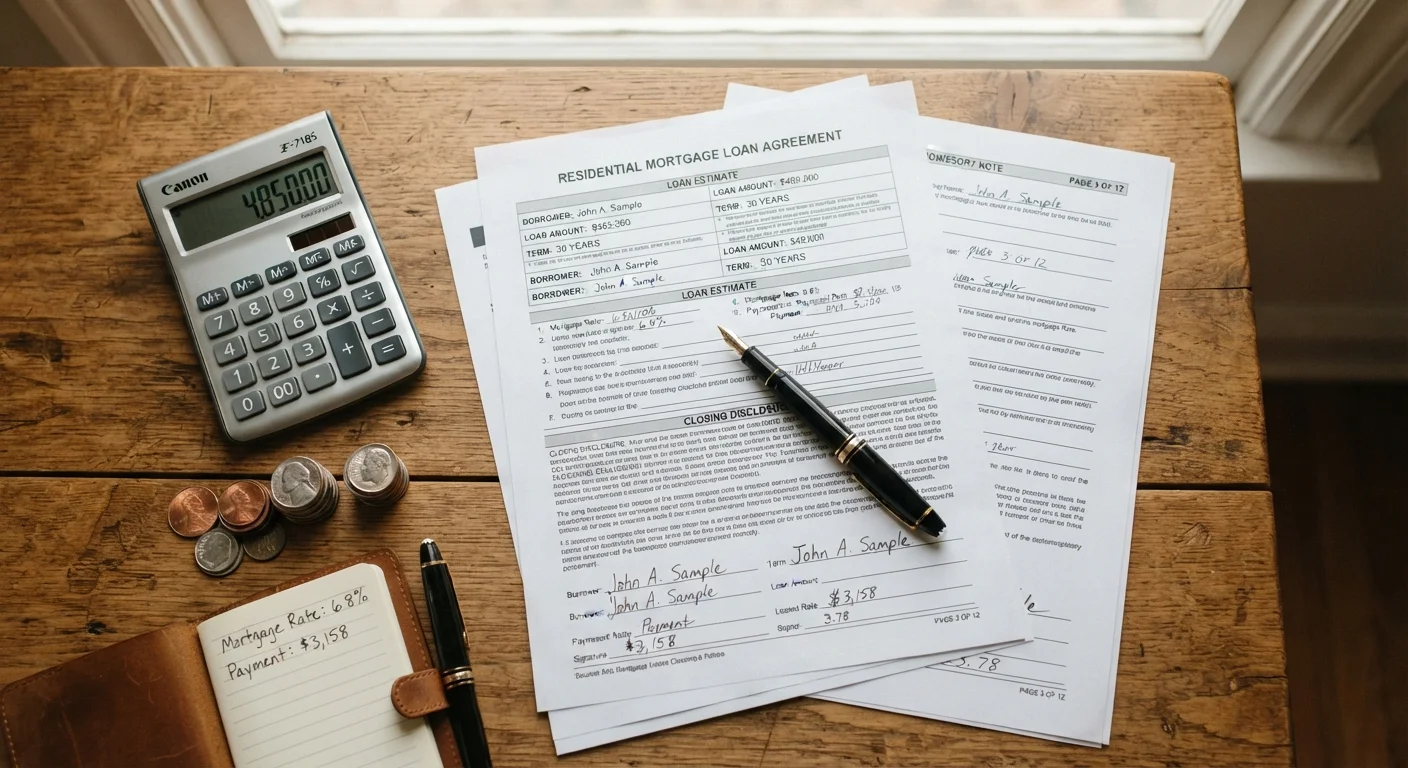
What Mortgage Points Actually Are
When a lender quotes you a mortgage rate, that rate often comes with options. You can accept the quoted rate as-is, or you can pay extra at closing - called buying points - to receive a lower rate for the entire loan term.
Each discount point costs 1% of the total loan amount. On a $350,000 loan, one point equals $3,500 paid at closing. In return, the lender reduces your interest rate - typically by around 0.25 percentage points per point purchased, though lenders vary.
It helps to think of points as a form of prepaid interest. You're not paying a fee for a service; you're shifting interest payments from the monthly schedule into a single upfront sum. For a deeper look at how this fits into broader mortgage terminology, see our mortgage terminology guide.
Points vs. Origination Fees: Know the Difference
Discount points and origination fees both appear on your Loan Estimate, but they serve different purposes. Origination fees compensate the lender for processing your application and do not reduce your rate. Discount points are purely about rate reduction. When comparing lenders, make sure you're isolating each charge so you can evaluate them accurately.
Calculating the Break-Even Period
The single most important calculation before buying points is the break-even period: how long you need to stay in the home for the upfront cost to be offset by monthly savings.
The formula is straightforward:
- Determine the total cost of the points (e.g., 2 points on a $300,000 loan = $6,000).
- Calculate your new monthly payment with the reduced rate, and compare it to the original payment.
- Divide the cost of points by the monthly savings. The result is your break-even month.
For example: $6,000 in points that saves $120 per month breaks even in 50 months - just over four years. If you sell or refinance before month 50, you pay more than you save.
When comparing offers with different point structures, our guide on comparing mortgage offers walks through the apples-to-apples method lenders won't always spell out for you.
1%
Cost of one mortgage point as share of loan
This is the standard industry definition: one point equals 1% of the loan amount, paid at closing.
~0.25%
Typical rate reduction per point purchased
The actual reduction varies by lender and market; always confirm the specific rate schedule in your Loan Estimate.
4-6 years
Common break-even range for discount points
Actual break-even depends on loan size, rate difference, and monthly savings - calculate yours before committing.
When Paying Points Makes Sense - and When It Doesn't
Points are most valuable in predictable, long-horizon situations. They tend to work in your favor when:
- You plan to stay in the home well beyond the break-even period.
- You're taking a fixed-rate mortgage and the lower rate applies for the full term. On an adjustable-rate loan, the rate changes regardless of points paid - see our fixed vs. adjustable-rate guide for context.
- You have sufficient cash reserves after closing. Depleting savings to buy points can leave you financially exposed.
Points tend to not make sense when:
- You're likely to move within a few years due to job, family, or lifestyle factors.
- You're considering refinancing in the near future - a rate drop would reset the math entirely. Our refinancing guide explores when that move makes sense.
- The cash could eliminate higher-cost debt or strengthen your emergency fund.
Run Your Own Break-Even Calculation
Before agreeing to any points, ask your lender for two side-by-side scenarios: the rate with points and the rate without. Then divide the points cost by the monthly savings amount. If that number of months exceeds how long you realistically plan to stay in the home, skip the points. Many lenders and mortgage websites offer free calculators to do this math quickly.
Points in the Broader Context of Closing Costs
Discount points are just one line item among many at closing. Origination fees, title insurance, appraisals, and prepaid escrow amounts all add to the upfront cost of a mortgage. Understanding what each charge represents helps you evaluate whether you're being offered a genuinely competitive deal.
If a lender is quoting a notably low rate but charging two or three points, the effective cost may be higher than a loan with a slightly higher rate and zero points - depending on how long you keep the mortgage. Always request a Loan Estimate and review the full picture.
For buyers using government-backed financing, points work the same way but layer on top of mortgage insurance considerations. The FHA loan trade-offs article covers how those costs interact. You may also want to consider how a rate lock fits into your timing strategy, especially in a fluctuating rate environment.
This article is for general informational and educational purposes only and does not constitute financial, tax, or legal advice. Consult a qualified mortgage professional or financial adviser before making decisions about your specific loan.