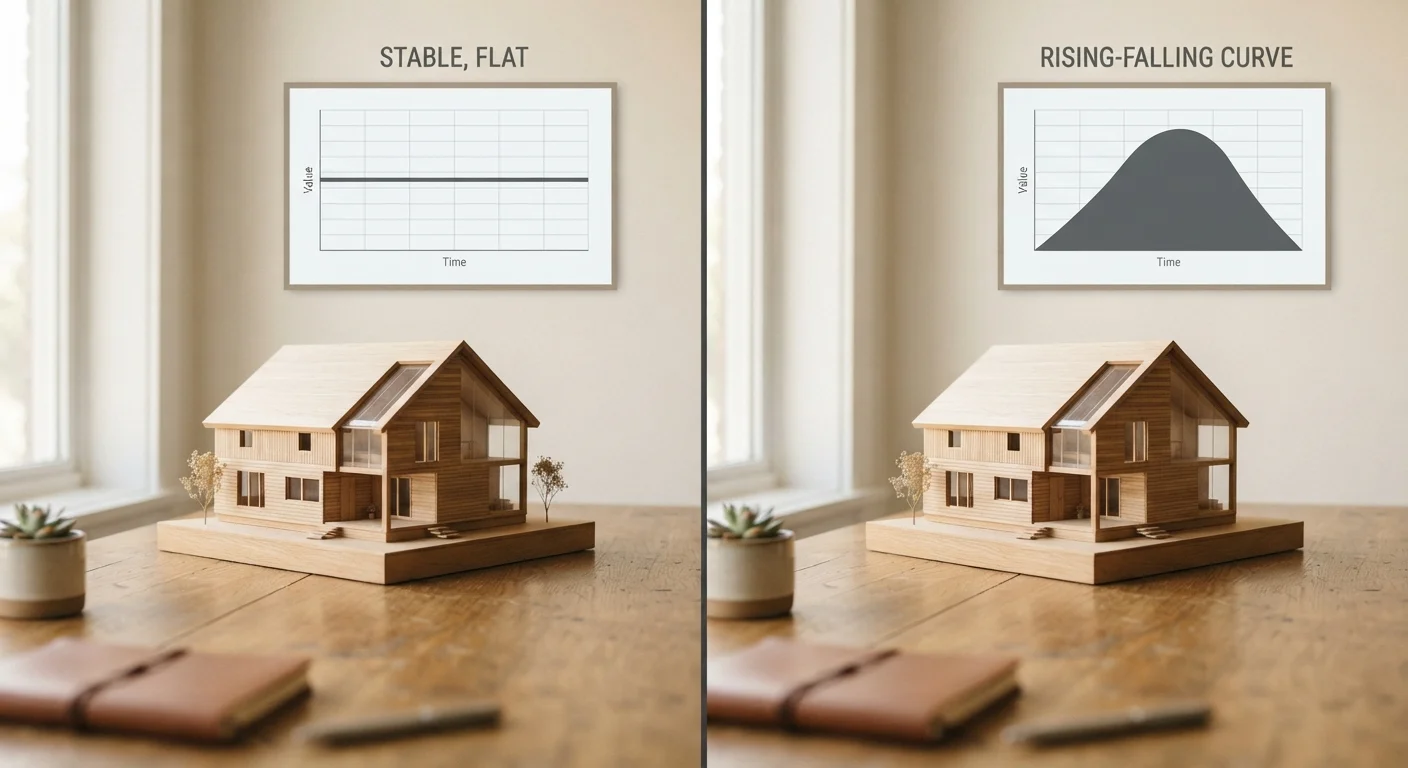
How Each Rate Structure Works
At their core, both mortgage types charge interest on the money you borrow - the difference is whether that rate stays constant or moves with the market.
A fixed-rate mortgage locks your interest rate on the day you close. Whether you take a 15-year or 30-year term, the rate printed in your loan agreement is the rate you pay for every month of the loan's life. Your principal and interest payment never changes. For a plain-language breakdown of terms like principal, amortization, and escrow, see our mortgage terminology guide.
An adjustable-rate mortgage (ARM) works in two stages. First comes an introductory fixed period - commonly 5, 7, or 10 years - during which the rate holds steady, often below the prevailing fixed-rate market. After that period, the rate adjusts at set intervals (typically once per year) based on a published benchmark index plus a lender margin. The result is a payment that can rise or fall depending on where rates stand at each adjustment date. For a detailed look at how those adjustments are calculated, our article on how an ARM changes over time covers caps, indexes, and margins in depth.
| Criterion | Fixed-Rate Mortgage | Adjustable-Rate Mortgage (ARM) |
|---|---|---|
| Interest rate over time | Stays the same for the full term | Fixed initially, then adjusts periodically |
| Starting rate | Typically higher than ARM intro rate | Usually lower during introductory period |
| Monthly payment stability | Completely predictable | Can rise or fall after fixed period ends |
| Rate adjustment risk | None | Yes - subject to caps and index changes |
| Common loan terms | 15- or 30-year fixed | 5/1, 7/1, or 10/1 ARM structures |
| Best horizon | Long-term ownership (10+ years) | Short-to-medium ownership (under 7 years) |
| Protection from rate increases | Full protection | Partial - limited by adjustment and lifetime caps |
The Trade-Off: Certainty vs. Initial Cost
Fixed-rate mortgages typically carry a slightly higher starting rate than ARMs because lenders price in the risk of holding that rate steady for decades. In exchange, borrowers get complete payment predictability - useful for long-term budgeting and financial planning. If you want to understand how interest and principal shift over the life of a fixed loan, our guide on mortgage amortization explains why early payments are mostly interest.
ARMs offer a trade in the other direction: a lower initial rate in exchange for future uncertainty. The savings during the fixed period can be meaningful - potentially hundreds of dollars per month on larger loan amounts - but borrowers must be prepared for the possibility that payments will rise once adjustments begin.
30 years
Most common fixed mortgage term in the US
The 30-year fixed-rate mortgage has historically been the most widely used home loan product among American borrowers, according to Freddie Mac data.
5/1
Most common ARM introductory structure
The 5/1 ARM - fixed for five years, then adjusting annually - is among the most frequently originated adjustable-rate products in the US market.
2%/5%
Typical ARM annual/lifetime rate caps
Many standard ARM products carry caps limiting annual rate increases to around 2 percentage points and lifetime increases to around 5 percentage points above the initial rate.
One factor borrowers sometimes overlook is the role of rate locks. If you're choosing between loan types while your purchase is in process, understanding how a mortgage rate lock works can help you protect whichever rate you choose while the transaction closes.
It's also worth distinguishing the interest rate from the annual percentage rate (APR) - two figures that often appear together in mortgage quotes but measure different things. Our explainer on interest rate vs. APR clarifies the gap and why it matters when comparing loan offers.
ARM Caps Limit - But Don't Eliminate - Risk
Adjustable-rate mortgages include built-in caps that restrict how much the rate can change at each adjustment and over the life of the loan. A common structure limits each annual adjustment to 2 percentage points and sets a ceiling of 5 to 6 points above the initial rate. While caps prevent unlimited increases, even a capped adjustment can meaningfully raise your monthly payment. Always calculate what your payment would look like at the cap ceiling before committing to an ARM.
Choosing Based on Your Situation
The right structure depends less on which type is abstractly "better" and more on your specific circumstances. Three questions anchor the decision:
- How long will you stay? If you're confident you'll sell or refinance before the ARM's fixed period ends, the initial rate advantage may never expose you to adjustment risk. If you're planting roots for the long haul, locking in a fixed rate offers durable peace of mind.
- How stable is your income? A fixed payment is easier to plan around. An ARM introduces variability that requires either financial cushion or confidence that your income will grow alongside any potential rate increases.
- What is the rate environment? When fixed rates are relatively low by historical standards, locking one in is often attractive. When fixed rates are elevated, an ARM's lower introductory rate may make more short-term sense - though future movements are never predictable.
For a deeper comparison of which mortgage structure fits different buyer profiles, see our article on choosing the right mortgage structure. And if you're weighing whether to reduce your rate through upfront costs, our guide on mortgage points explains when paying upfront makes financial sense.
This article is for general informational purposes only and does not constitute personalized financial or mortgage advice. Consult a licensed mortgage professional or financial adviser regarding your specific situation.